
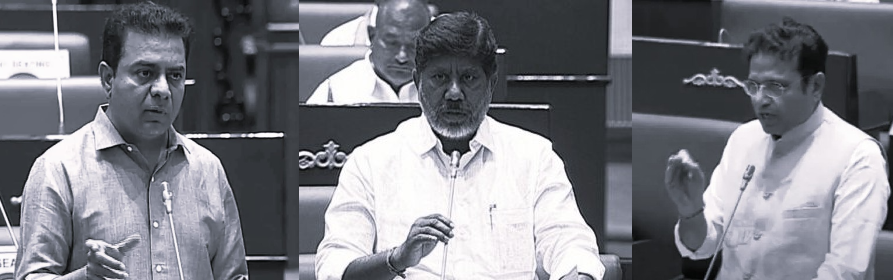
Telangana Assembly Turns Turbulent Amid KTR-Speaker Clash and Musi Row
The Telangana Legislative Assembly witnessed high political drama , as heated exchanges between BRS Working President K.T. Rama Rao (KTR) , Speaker Gaddam Prasad Kumar , and ruling Congress leaders escalated into a full-blown confrontation over both MLA disqualification rulings and the Musi river rejuvenation project .
The initial flashpoint emerged during the discussion on the motion thanking the Governor’s address, where KTR sharply criticized the Speaker’s decision to reject disqualification petitions filed by the Bharat Rashtra Samithi (BRS) against defecting MLAs. He expressed dissatisfaction over the ruling, particularly questioning a case involving an MLA who contested the 2024 Lok Sabha elections on a Congress ticket.
Speaker Prasad Kumar responded firmly, cautioning KTR against making allegations without fully understanding the judgment. He advised that any grievances should be addressed through judicial channels and urged adherence to Assembly rules. KTR, while maintaining respect for the Speaker’s office, defended his right as an elected representative to question decisions.
The debate intensified as Revenue Minister Ponguleti Srinivasa Reddy accused the BRS of hypocrisy, questioning why the party remained silent when defections occurred during its own tenure from 2014 to 2023. He also pointed to the BRS’s recent electoral setbacks.
Tensions further escalated during Question Hour when the focus shifted to the ambitious Musi river rejuvenation project , triggering another round of confrontation. Alleging corruption , lack of transparency, and a poorly planned execution strategy , the BRS staged a dramatic walkout from the Assembly.
State IT and Industries Minister D. Sridhar Babu defended the project, stating that the government has submitted a Detailed Project Report (DPR) prepared by Singapore-based firm Meinhardt , and is awaiting approval from the Asian Development Bank (ADB) . He noted that preliminary feedback from the ADB has been positive, with final approval expected in its upcoming board meeting.
The minister added that the government is open to executing the project through alternative funding routes, including Public Private Partnership (PPP) models, if required. He emphasized that the goal is to transform the Musi from its current polluted state into a perennial river , improving living conditions for thousands residing along its banks.
However, KTR countered these claims, alleging inconsistencies in the project’s planning, including ambiguity over phases and DPR details. He claimed that officials themselves had indicated the absence of a clear DPR and accused the government of attempting a “ Rs 1.50 lakh crore loot ” under the guise of the project.
Deputy Chief Minister Mallu Bhatti Vikramarka questioned whether the BRS opposed river cleaning altogether, to which KTR clarified that his party supports rejuvenation but demands transparency and accountability .
Rejecting the allegations, Sridhar Babu termed them “baseless mud-slinging” , clarifying that the estimated cost for the first phase stands between Rs 6,500 crore and Rs 7,000 crore , far below the figures claimed by the opposition.
The twin controversies come close on the heels of the Speaker’s March 11 decision to dismiss disqualification petitions against two MLAs who defected from BRS to Congress, effectively closing proceedings related to 10 legislators .
With both the defection issue and the Musi project igniting sharp political divisions, the Assembly session underscored the deepening rift between the ruling Congress and the opposition BRS, setting the stage for continued political confrontation in the state.