
Tejashwi’s pledge, Lalu’s legacy: Bihar at a crossroad
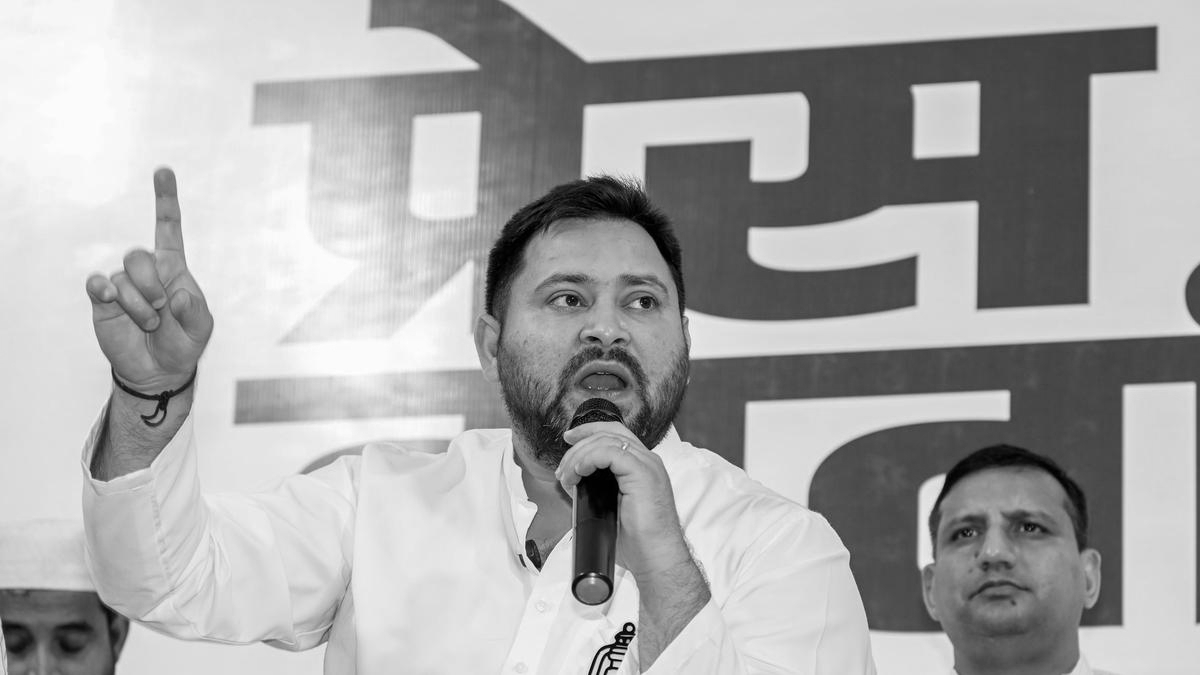
RJD leader and INDIA bloc’s chief ministerial candidate Tejashwi Yadav has once again promised a corruption-free Bihar. Speaking in Patna, Tejashwi accused the BJP-led Centre of shielding corrupt leaders and criminals and vowed a government that would deliver jobs, education, affordable healthcare, and a responsive administration. “The BJP sets up factories in Gujarat and seeks victory in Bihar. This is not going to happen,” he declared, countering PM Narendra Modi’s ‘jungle raj’ narrative by insisting that “real jungle raj exists where scams go unchecked and criminals roam free.”
While the pledge sounds appealing on the campaign trail, the reality of Bihar’s entrenched political culture raises a serious question: can any government here truly escape corruption?
Yet, Bihar’s governance challenges run far deeper than party politics. Ministers and MLAs often exploit their positions to secure contracts, transfers, and development funds for personal gain or to benefit their political networks. For instance, in June 2021, over 2,000 state employees were transferred in Bihar, raising allegations of corruption. BJP MLA Satyendra Kumar Singh claimed that ruling party MLAs had earned approximately ₹100 crore through these transfers, suggesting that officials were being moved to positions where they could extort money from the public. Additionally, in August 2025, Vinod Kumar Rai, a superintendent engineer in Bihar's Rural Development Department, was arrested for allegedly amassing over ₹100 crore through corrupt practices during his government tenure. Authorities seized ₹52 lakh in cash and other assets from his residence, highlighting the extent of corruption within the department.
Local body representatives, from panchayat heads to ward councillors, routinely divert welfare schemes, whether it’s housing, road construction, or ration supplies, to benefit themselves or their allies. For example, in August 2025, a government employee in Arwal district was caught accepting a ₹10,000 bribe for releasing housing assistance funds under the Pradhan Mantri Awas Yojana. Even when policies are well-intentioned, implementation is riddled with unofficial levies and favouritism. In the case of the Nal-Jal Yojana, a scheme aimed at providing drinking water to rural households, only 10 to 20 percent of the intended work was completed due to corruption in block offices.
Bureaucrats, too, play a key role in the system. While some officers strive for integrity, many adapt to unwritten rules where bribes, delays, and backchannel approvals dictate whether projects move forward. In such an environment, honesty is praised publicly but often punished quietly.
Adding to the irony of Tejashwi Yadav’s promise is his own family legacy. The RJD, led by his family, has long been associated with high-profile corruption cases. His father, former Bihar Chief Minister Lalu Prasad Yadav, was convicted in the Fodder Scam , involving the embezzlement of nearly ₹1,000 crore from the animal husbandry department. He is also implicated in the IRCTC hotel contract case , in which the CBI alleged that Lalu awarded hotel maintenance contracts in exchange for prime Patna land, calling him the “fountainhead” of the conspiracy. Another case, the Land-for-Jobs scam , involves allegations that low-level railway jobs were exchanged for land favors benefiting Lalu’s family and associates, currently under investigation by the Enforcement Directorate. Tejashwi’s mother, Rabri Devi, who also served as Chief Minister, has faced accusations in several corruption cases, further highlighting the RJD’s entanglement with graft over decades.
Tejashwi’s insistence on a corruption-free government, therefore, faces natural skepticism. Can the son truly reform a system that his father once manipulated? Critics argue that such promises, while rhetorically strong, risk remaining aspirational slogans rather than actionable reforms.
The reality is clear: Bihar’s governance is built on layers of entrenched political patronage and bureaucratic complicity. Achieving a genuinely corruption-free government would require dismantling these networks, enforcing accountability, and changing a culture that has normalized favouritism and shortcuts for decades.
Tejashwi’s vision is ambitious and perhaps sincere, but Bihar’s voters must ask themselves: is this a genuine new beginning, or another chapter in a legacy of unfulfilled promises? Only time will tell if a corruption-free Bihar is possible, or if it will remain an election-season mirage.