
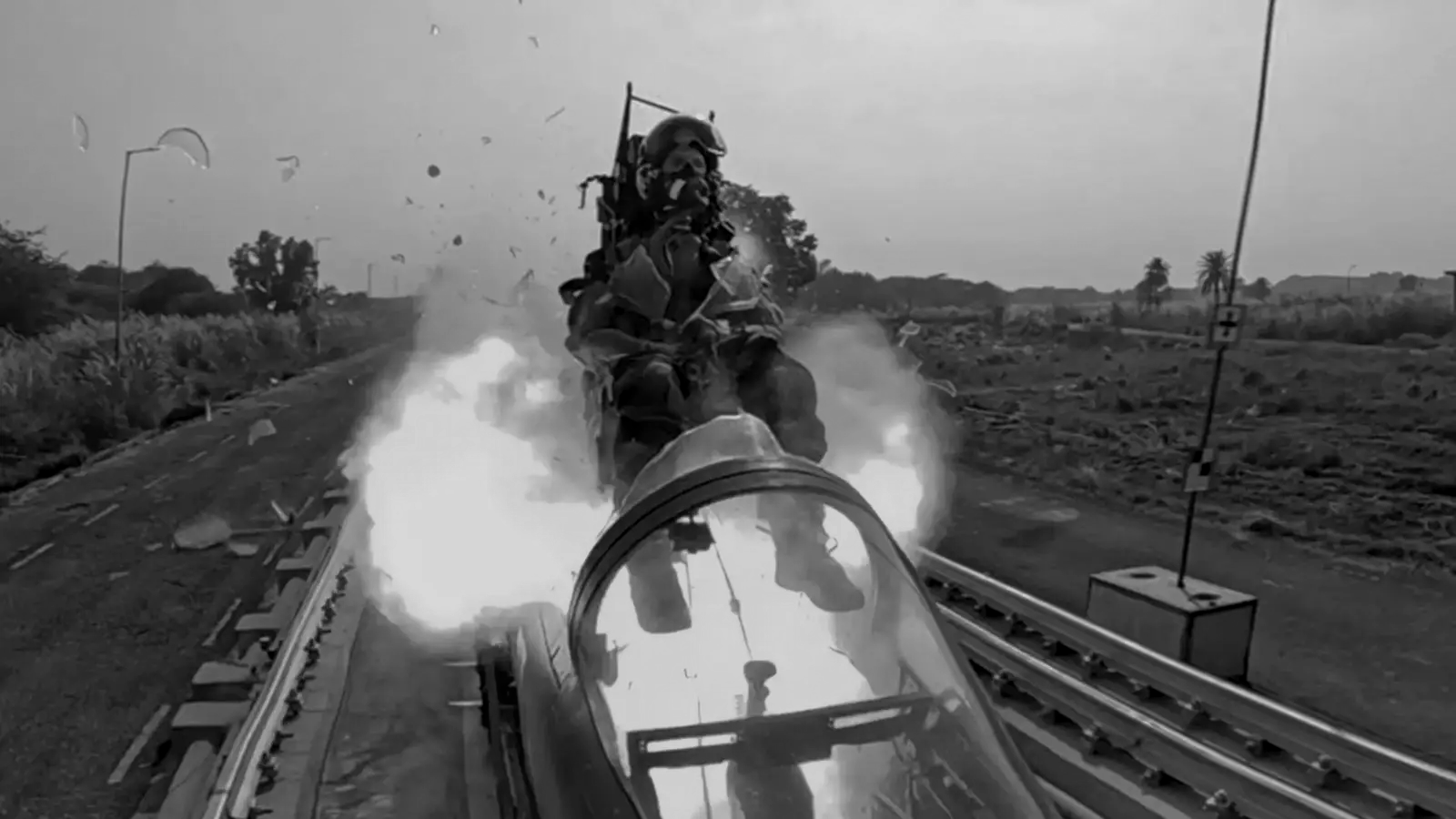
Tejas Mk2 ejection system validated in 800 km/h rocket-sled test
In a major milestone for India’s indigenous fighter program, the Defence Research and Development Organisation (DRDO) successfully conducted a high-speed rocket-sled test of a fighter aircraft escape system designed for the Tejas Light Combat Aircraft (LCA). The trial was observed by officials from the Indian Air Force (IAF), Hindustan Aeronautics Limited (HAL), and the Aeronautical Development Agency (ADA).
The test was carried out at the Rail Track Rocket Sled (RTRS) facility of the Terminal Ballistics Research Laboratory (TBRL) in Chandigarh. Using a dual-sled setup, the forebody of a Tejas prototype encompassing the cockpit and nose section was accelerated to a speed of 800 km/h, simulating the extreme aerodynamic stresses experienced during flight. This allowed precise validation of the escape system under realistic operational conditions.
The system tested included the canopy-severance mechanism, ejection seat sequencing, and aircrew recovery via parachute deployment. An instrumented test dummy recorded critical forces and accelerations experienced during ejection. The sequence ensured that the canopy was safely removed before seat ejection, providing a controlled and reliable escape path for the pilot.
This indigenous system was developed by DRDO, with major contributions from the Armament Research and Development Establishment (ARDE), Pune, and the High Energy Materials Research Laboratory (HEMRL), in collaboration with ADA and HAL. The successful validation demonstrates that the escape system is fully compatible with both the existing Tejas Mk1 and the upgraded Tejas Mk2, which features higher performance and advanced capabilities.
Union Defence Minister Rajnath Singh hailed the achievement as a major step toward defence self-reliance, noting that it reduces dependence on foreign suppliers for critical pilot safety systems. DRDO Chairman Dr. Samir V. Kamat congratulated the teams for their precise execution of this high-speed test, calling it a “key success for India’s aerospace capabilities.”
Experts say this test not only strengthens pilot safety but also ensures that India’s next-generation Tejas Mk2 fighters will operate with fully validated, home-grown escape systems, marking a major milestone in the country’s indigenous combat aircraft program.