
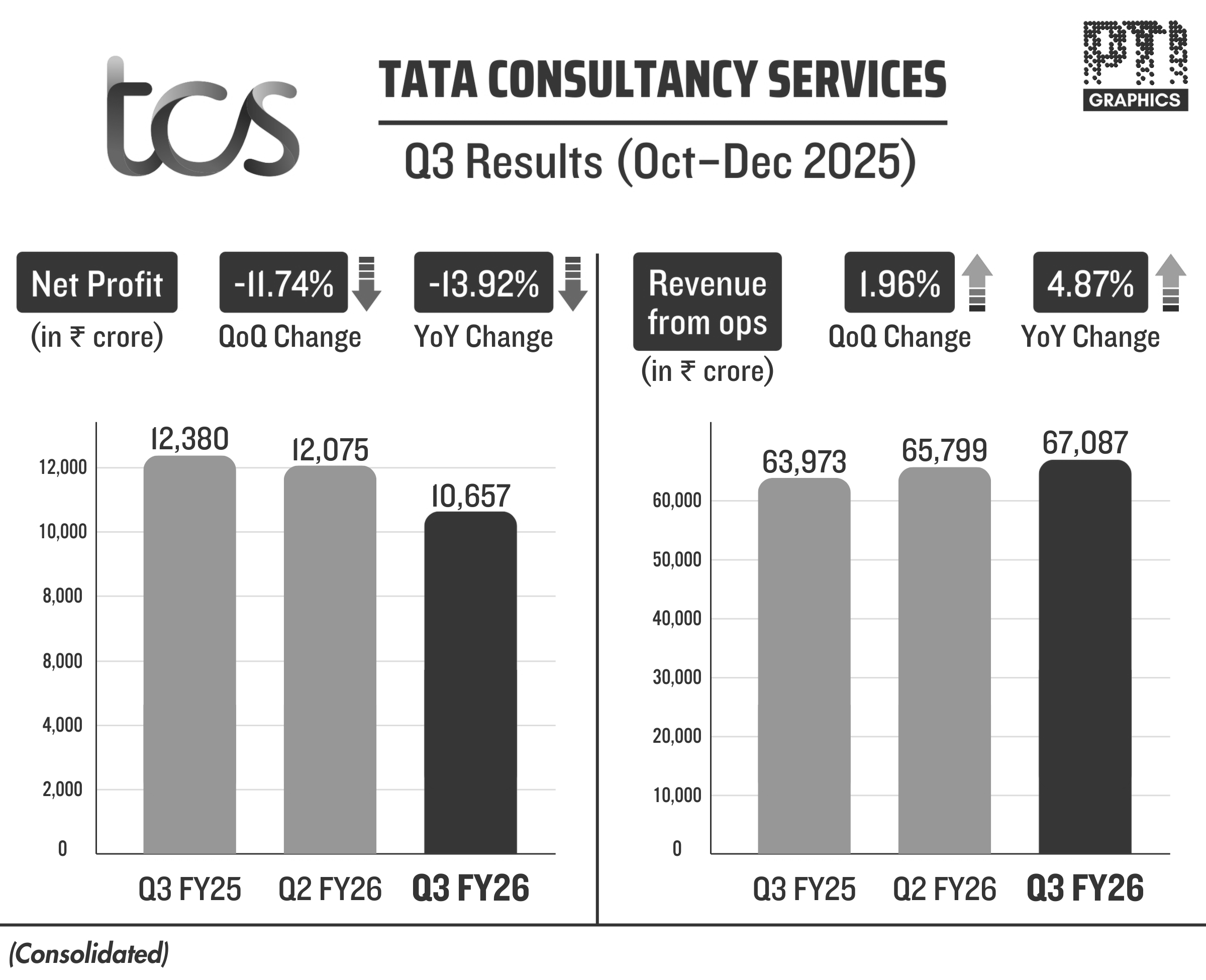
TCS Q3 profit drops 14 pc to Rs 10,657 Cr, headcount dips another 11,000
Tata Consultancy Services (TCS) delivered a mixed set of December-quarter results , with steady revenue growth and a sharp acceleration in AI-led business, but headline profit taking a hit due to a one-time statutory provision triggered by India’s new labour codes . The country’s largest IT services exporter reported a 13.91% year-on-year decline in consolidated profit to ₹10,657 crore , even as revenue from operations rose 4.86% to ₹67,087 crore , indicating that the earnings dip was more accounting-driven than demand-driven.
At the heart of the profit decline was a one-time “statutory impact” of ₹2,128 crore , which TCS said arose due to implementation of the labour codes during the quarter. The company clarified that excluding this provision, profit would have increased 8.5% to ₹13,438 crore , underscoring that the underlying business performance remained stable despite macro uncertainties.
The labour codes impact stems from changes in how companies account for employee-related benefits and long-term liabilities. According to recent clarifications, increased liabilities particularly on gratuity have to be recognised as “past service cost” , forcing immediate expense provisioning. This is why several large employers saw profit numbers pressured in the quarter. TCS disclosed that it set aside over ₹2,100 crore towards these provisions, including ₹1,800 crore for gratuity and ₹300 crore for leave encashment , reflecting the scale of the compliance-driven expense.
Despite the earnings shock, TCS management struck a confident tone on business outlook, pointing to stronger client conversations and improving decision cycles. CEO and Managing Director K Krithivasan said deal momentum and pipeline visibility indicate that FY26 is likely to be stronger than FY25 in international revenue growth , adding that 2026 could turn out to be a “good year” for the industry. The company’s optimism was also supported by the operating performance in the quarter operating profit margin held steady at 25.2% , aided by productivity gains and currency movements, even as wage hikes and brand-building spend remained headwinds.
A standout driver of growth this quarter was artificial intelligence and associated data-led programmes , which TCS highlighted as a major contributor to topline expansion. Chief Operating Officer Aarthi Subramanian said AI revenues grew 17% quarter-on-quarter , reaching an annualised run-rate of $1.8 billion a figure that signals AI has shifted from pilot-stage experimentation to scalable enterprise deployments. Reuters reports that AI revenues now form a meaningful chunk of TCS’s overall business, reinforcing the company’s positioning as clients accelerate digital transformation spending with AI at its core.
On the deal front, TCS reported new deal signings (TCV) of $9.3 billion in the quarter. While the figure reflects healthy order inflow and stable demand, it was slightly lower than last year, suggesting some clients continue to be cautious in committing to mega transformation projects. Still, management indicated that decision-making cycles have reduced compared to the past , hinting at improving confidence among global enterprises.
The quarter also remained notable for TCS’s evolving workforce strategy. Total headcount declined by 11,151 employees , taking the overall workforce to 5,82,163 . The company’s HR leadership attributed 1,800 exits to the restructuring initiative announced earlier, under which TCS had indicated workforce rationalisation in certain segments. This repeated decline in employee count after the significant reduction seen in the previous quarter suggests the company is actively recalibrating skills, tightening its bench, and improving productivity as automation and AI reshape delivery models across the IT sector.
Geographically, performance remained a mixed bag, but there were encouraging signals. North America TCS’s most important market showed improvement and returned to growth, which is significant given that global IT spending softness has been a major overhang in recent quarters. UK performance, however, continued to show pressure in constant currency terms. Importantly, Krithivasan said he expects North America to return to better growth, while also indicating that the company does not see material impact from a recent US policy decision to cap credit card interest rates at 10%.
Even as headline profit declined, TCS’s board reinforced shareholder confidence by recommending a dividend of ₹57 per share , including a special dividend of ₹46 , highlighting strong cash-generation ability. The stock ended the day higher, reflecting market acceptance of the company’s explanation that the profit fall was primarily a statutory, one-off impact rather than deterioration in demand fundamentals.
Overall, the December-quarter story of TCS is one of resilience amid transition . While earnings were dented by a rare compliance-led provision, the company’s steady margins, improving deal execution, and rising AI revenues suggest its core business trajectory remains intact. The coming quarters will now be watched for whether North America’s recovery sustains , TCV returns to stronger double-digit billion levels , and whether TCS can convert its fast-growing AI run-rate into broader, long-term enterprise transformation deals while navigating a new labour compliance regime and restructuring its workforce for the next phase of the technology cycle.