
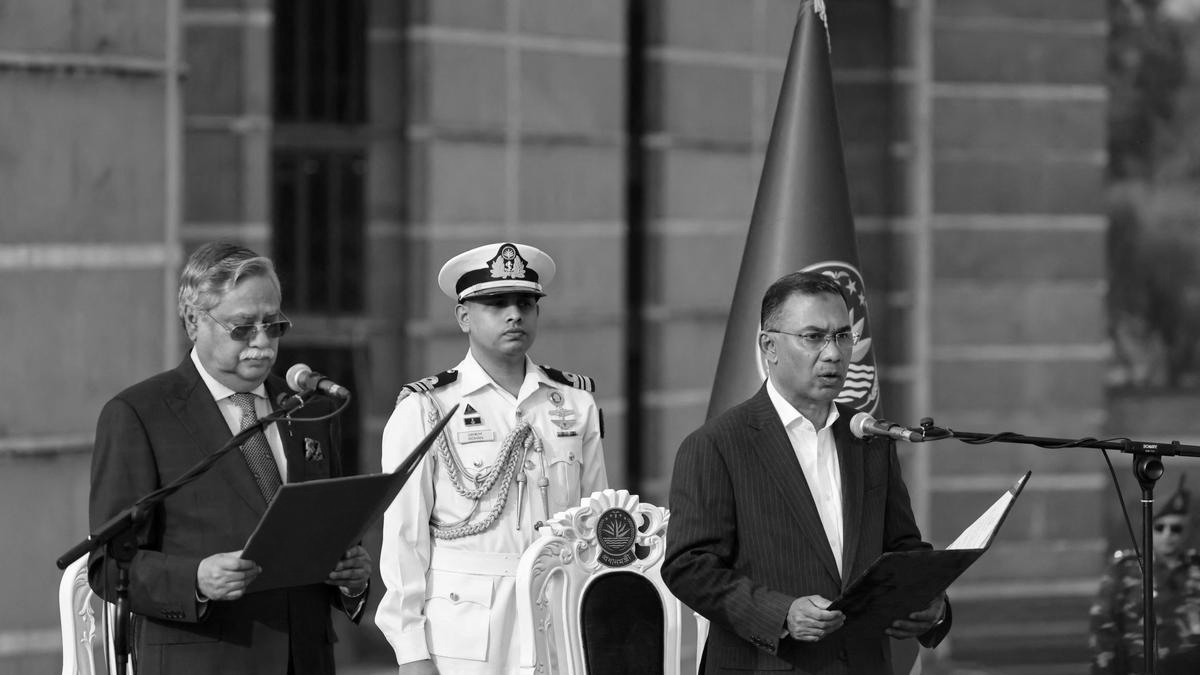
Tariq Rahman sworn in as Bangladesh PM, major challenges ahead
Bangladesh has stepped into a new chapter with Tariq Rahman officially sworn in as prime minister after the Bangladesh Nationalist Party (BNP) claimed a historic landslide in the 13th parliamentary elections, ending 18 months of interim governance. The outdoor ceremony at the South Plaza of the Jatiya Sangsad in Dhaka drew national leaders, foreign dignitaries, and observers, marking a dramatic shift in the country’s political landscape.
Rahman’s BNP won a commanding two-thirds majority with 209 seats, while the Jamaat‑e‑Islami alliance secured 68 seats and the NCP six. Jamaat MPs took their parliamentary oaths but boycotted the cabinet ceremony over constitutional disagreements and staged street protests in Dhaka, warning unrest could spread if post-election grievances were ignored .
India sent its top parliamentary envoy, Lok Sabha Speaker Om Birla , accompanied by Foreign Secretary Vikram Misri, who called the occasion “an important moment that will strengthen people-to-people ties and shared democratic values.” Prime Minister Narendra Modi was invited but could not attend due to talks with French President Emmanuel Macron in Mumbai. Leaders from Bhutan, Maldives, Pakistan, Nepal, Sri Lanka, China, UAE, Malaysia, Turkey, and Saudi Arabia were also present, underlining the event’s regional significance.
President Mohammed Shahabuddin administered the oath to Rahman, who promised to uphold the constitution, strengthen law and order, and promote inclusive governance. In his speech, Rahman stressed national unity , calling on all political forces to work together for Bangladesh’s future. The new cabinet includes 25 ministers and 24 state ministers , featuring minority representation from leaders such as Nitai Roy Chowdhury and Dipen Dewan , signaling an effort to broaden inclusivity.
Alongside the elections, a constitutional referendum on 12 February approved the July National Charter. A Supreme Court lawyer has now filed a writ petition challenging the results , scheduled for High Court review next week. After the polls, Rahman visited opposition leaders, including Jamaat chief Shafi Kur Rahman and student leader Nahid Islam , signaling a push for cooperation and reduced political tension.
International observers welcomed the polls, with the EU calling them credible and largely transparent and the Commonwealth describing them as acceptable and orderly , while urging unity and noting areas for reform.
Rahman faces domestic challenges, but for India, the focus is on how his government behaves on matters affecting bilateral and regional stability. While Bangladesh must tackle economic fragility and political tensions, New Delhi’s concern is Rahman’s approach to sensitive issues such as the Ganga water-sharing treaty , which expires later this year, and Bangladesh’s moves to strengthen ties with Gulf nations, China, and revive SAARC (South Asian Association for Regional Cooperation) . The issue of the extradition of former leader Sheikh Hasina , currently in India and convicted in absentia, also carries implications for bilateral relations. India will be watching closely, as Rahman’s decisions - not just his position - will shape the trajectory of Bangladesh-India relations.