
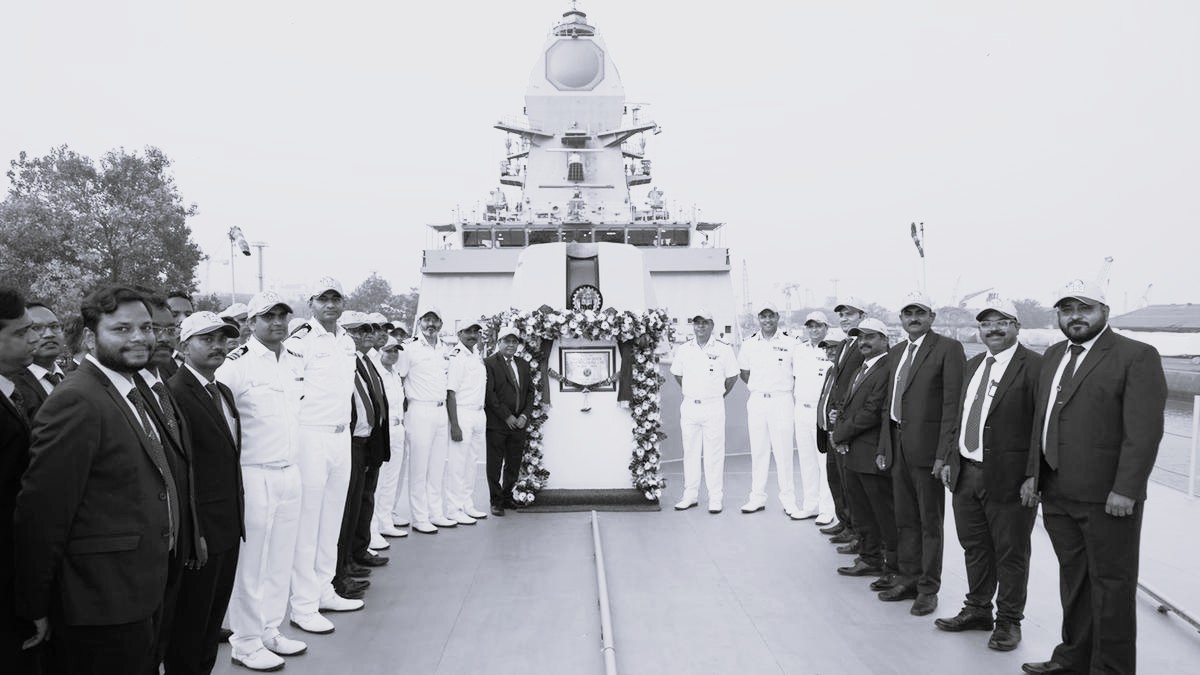
Taragiri delivered to Indian Navy, marks leap in indigenous shipbuilding
India has taken another strong step toward maritime self-reliance with the delivery of Taragiri (Yard 12653), the fourth warship of the Nilgiri-class (Project 17A). The vessel, built at Mazagon Dock Shipbuilding Ltd (MDL) in Mumbai, was formally handed over to the Indian Navy on 28 November 2025, marking a significant milestone in India’s quest for indigenous warship design and construction. This achievement reinforces the country’s commitment to developing a modern, mission-ready naval fleet capable of facing current and emerging maritime challenges.
Taragiri is a tribute to its predecessor, the former INS Taragiri, a Leander-class frigate that served the Indian Navy with distinction from 16 May 1980 to 27 June 2013 a remarkable operational life of 33 years. The new Taragiri represents a major evolution in naval technology, incorporating advanced stealth features, combat systems, automation, survivability, and firepower, truly reflecting the spirit of Aatmanirbharta (self-reliance) in defence manufacturing.
Designed by the Warship Design Bureau (WDB) and supervised by the Warship Overseeing Team (Mumbai), the Project 17A frigates mark a generational leap in indigenous shipbuilding. These vessels have been built using the Integrated Construction philosophy, enabling a seamless build process and ensuring that timelines were effectively met. The experience gained from constructing the earlier ships has helped reduce the build time of Taragiri to 81 months, compared to 93 months taken for the first vessel of the series, Nilgiri.
Project 17A ships are equipped with a Combined Diesel or Gas (CODOG) propulsion system, featuring both a diesel engine and a gas turbine that operate Controllable Pitch Propellers (CPP) on each shaft. They also feature a state-of-the-art Integrated Platform Management System (IPMS) for efficient control and monitoring of onboard equipment.
The frigate boasts a potent weapons and sensors suite, which includes: BrahMos Supersonic Cruise Missiles (SSM), MFSTAR multi-function radar and MRSAM air defense complex, 76mm Super Rapid Gun Mount (SRGM), 30 mm and 12.7 mm close-in weapon systems, Rockets and torpedoes for powerful anti-submarine warfare capabilities
Taragiri is the fourth P17A ship delivered to the Navy in just 11 months, showcasing India’s growing shipbuilding capability. The remaining three ships under Project 17A one at MDL and two at GRSE are expected to be delivered by August 2026.
With 75% indigenous content, the project has involved over 200 MSMEs, directly employing around 4,000 people and generating indirect employment for more than 10,000 others. The delivery of Taragiri is not only a technological accomplishment but also a boost to India's industrial ecosystem and defence economy.
In simple terms, INS Taragiri will act as a multi-role warship for the Indian Navy. It is designed to protect India’s waters, seas, and coastlines, and can handle threats from the air, sea, and under the water.
It can attack enemy ships and submarines, defend against missiles and aircraft, and support naval operations during conflicts or emergencies. With modern sensors and weapons, it can detect threats early and respond quickly, making it a key ship in keeping India’s maritime borders safe.
This modern warship stands as a clear indicator of India’s rising naval strength and unwavering commitment to self-reliance in defence manufacturing. The names of other three are INS Nilgiri, INS Himgiri, INS Udaygiri
Project 17A is an Indian Navy initiative to design and build a series of advanced stealth frigates indigenously. It is the follow-up to Project 17 (Shivalik-class frigates) and represents a generational leap in warship design, focusing on enhanced stealth, survivability, automation, and combat capability.