
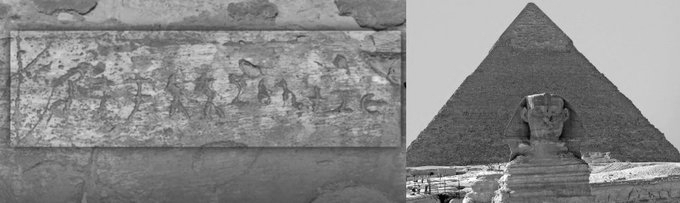
Tamil-Brahmi inscriptions found in Egypt’s Valley of the Kings reveal ancient India-Egypt trade
A landmark archaeological discovery in Egypt’s Valley of the Kings is rewriting the understanding of ancient global connections by providing some of the strongest evidence yet of bilateral cultural and trade links between India and ancient Egypt during the Roman period . Researchers have identified nearly 30 inscriptions in Indian languages, primarily Tamil‑Brahmi , carved inside rock‑cut tombs that date back to around 1600 BCE, revealing that Indian traders and travellers ventured far inland—well beyond coastal ports—to leave their mark on history.
The discovery was presented on February 11 by Swiss scholar Professor Ingo Strauch of the University of Lausanne and Professor Charlotte Schmid of the École Française d’Extrême‑Orient (EFEO) at the International Conference on Tamil Epigraphy in Chennai, organised by the Tamil Nadu State Department of Archaeology. The inscriptions span six of the tombs and include Telugu‑Brahmi, Prakrit , Sanskrit , and Gandhari‑Kharoshthi , indicating visitors from different regions of the Indian subcontinent, though Tamil inscriptions comprise a majority of the finds .
Among the most compelling evidence is the repeated appearance of the name “Cikai Korran,” inscribed at least eight times on the walls, entrances and corridors of five tombs. In Tamil, Cikai refers to a tuft or crown, while Korran is interpreted as leader or victorious one. One of the inscriptions reads “Cikai Korran vara kanta,” meaning “Cikai Korran came and saw,” a phrase that closely mirrors the stylistic conventions of Greek visitor graffiti also present at the site, suggesting that Indian travellers may have been familiar with broader Mediterranean traditions of marking their presence.
This discovery moves well beyond earlier evidence of Indian contact in Egypt, which was primarily limited to finds at coastal ports like Berenike and Quseir‑al‑Qadim where pottery shards with Tamil‑Brahmi texts such as paanai oRi (“pot suspended in a rope net”) were recovered, dating to around the 1st century CE and pointing to active Indian participation in Indo‑Roman maritime trade .
The presence of other Indian names—such as inscriptions reading “Kopāṉ varata kantan” (“Kopāṉ came and saw”) and “Cātaṉ” —reinforces the idea that these were not isolated scribblings but marks made by actual individual travellers or traders from the Indian subcontinent. Some of these names have parallels in other early Tamil‑Brahmi sites in India, indicating cultural continuity between domestic and overseas Indian communities of the period.
Experts emphasise that the inscriptions not only confirm the geographical reach of ancient Indian merchants , but also indicate they stayed for extended periods and were engaged and curious travellers , exploring major inland sites after landing at foreign ports. Senior epigraphist Y. Subbarayalu explained that, while classical authors like Ptolemy and Pliny testified to Roman trade with India, it was previously unclear whether Indian traders made reciprocal journeys. These inscriptions, he said, “provide proof of two‑way trade during the Roman period.”
Archaeologist V. Selvakumar of the Department of Maritime History and Maritime Archaeology noted that the Nile Valley and the Red Sea formed a connecting corridor between the Roman world and South Asia, making it feasible for Tamil merchant communities to travel deep inland after arriving by sea.
Professor Charlotte Schmid described the findings as “extraordinary,” not just for their historical implications but for what they suggest about script literacy , multilingualism and cultural exchange among merchant communities of the early centuries CE. She pointed out that the Tamil‑Brahmi inscriptions found in Egypt significantly increase the corpus of known Tamil‑Brahmi texts , which until now numbered only about a hundred at domestic archaeological sites.
The inscriptions also include a Sanskrit text referring to an envoy of a Kshaharata king , a dynasty that ruled parts of western India in the 1st century CE, further indicating the wide geographic origins of visitors.
Minister for Finance and Archaeology Thangam Thennarasu , who inaugurated the conference, highlighted that Tamil Nadu alone accounts for nearly 30,000 documented inscriptions in India , offering an unbroken historical record dating back to the 6th century BCE.
Scholars are already hailing this discovery as one of the most significant breakthroughs in the study of ancient Indo‑Mediterranean relations in recent decades , because it provides direct, tangible evidence of a connected ancient world in which Indian traders, travellers and cultural agents not only participated in global commerce but left their marks in the heart of another civilisation.