
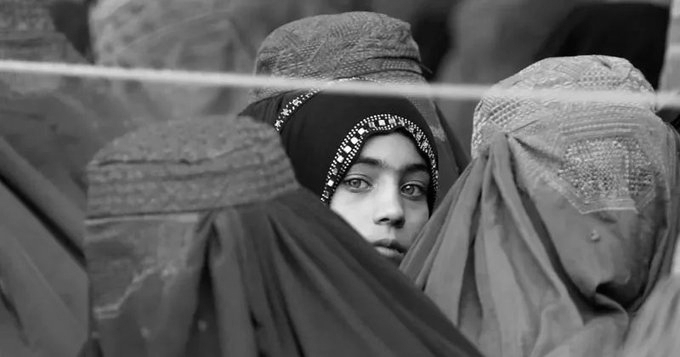
Taliban Enacts New Law: Silence Of Virgin Girl Counts As Consent For Marriage
In a chilling codification of patriarchal brutality , the Taliban regime in Afghanistan has formally enacted a sweeping new family law that has sent shockwaves across the international community. Taliban supreme leader Hibatullah Akhundzada approved the 31-article family law decree titled "Principles of Separation Between Spouses" in mid-May 2026, and what lies within its clauses is nothing short of a systematic dismantling of Afghan women's humanity , enacted not in the shadows, but proudly published in the Taliban's official gazette , signalling that this is not a quiet enforcement but a proud institutionalisation.
The document outlines rules covering child marriage, missing husbands, forced separation, apostasy, accusations of adultery , and other religious and legal matters. But it is one provision above all others that has ignited fury worldwide, Article 7 formally establishes that the silence of a "virgin girl" after reaching puberty may be interpreted as consent to marriage . The law then writes its double standard in cold ink: silence from a boy or a previously married woman does not automatically constitute consent. Only a girl's silence is weaponised against her.
Under the new regulations, fathers and grandfathers have been granted sole authority over child marriages, with marriages involving underage girls only annullable post-puberty with the explicit approval of a Taliban court , a near-impossible threshold designed to trap girls within marriages they never chose. The decree also invokes zihar , a classical Islamic concept in which a husband compares his wife to a female relative whom marriage would be forbidden, with Taliban judges authorised to compel husbands to fulfil religious penalties or grant divorce, using imprisonment and physical punishment to enforce compliance. And in a provision that strips away any remaining pretence of protection, the new rules permit husbands to beat their wives , provided it does not cause visible bodily harm.
The numbers behind this law are devastating. Almost a third of Afghan girls are married before the age of 18, with nearly one in ten married before they turn 15. A 2023 survey indicated child marriage had already climbed to 39% , reversing years of hard-won reductions achieved through international intervention. Desperate families, crushed by poverty, routinely arrange marriages involving infants as young as 20 days old , exchanging their baby daughters for cash to pay debts or simply survive another day. This decree does not merely permit such practices, it enshrines and protects them.
The voice of those resisting this law is unambiguous. "Child marriage is not marriage in any meaningful sense. A child cannot properly consent, and treating silence as consent is dangerous because it removes a girl's voice completely," political commentator Fahima Mahomed said. The international legal reckoning has already begun: the ICC issued arrest warrants against the Taliban leader and the Chief Justice on the charge of crimes against humanity, persecution on gender grounds . The UN has reported a 40% increase in the risk of violence against women and girls under the Taliban, with 14.2 million women needing protection and assistance. International organisations have described the Taliban's cumulative policies as a system of "gender apartheid" and this law is its latest and most brazen chapter.