
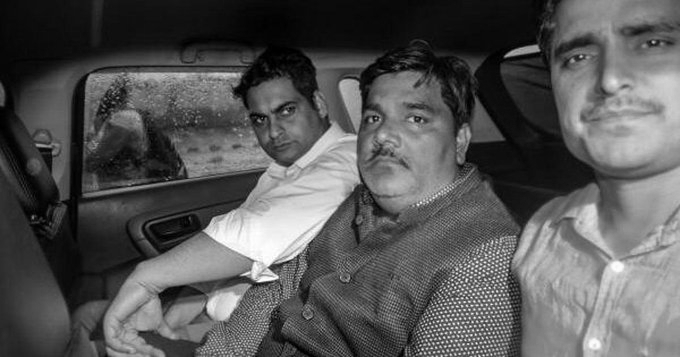
Tahir Hussain, Four Others Get Life Term for IB Officer Ankit Sharma's Murder
A Delhi court on Friday sentenced former AAP councillor Tahir Hussain and four co-convicts to life imprisonment for the murder of Intelligence Bureau (IB) officer Ankit Sharma during the 2020 Delhi riots, bringing a significant chapter of one of the capital's most high-profile riot cases to a close.
Additional Sessions Judge Praveen Singh pronounced the sentence after hearing arguments on the quantum of punishment. While the prosecution sought the death penalty, the court held that it had failed to establish that the convicts were beyond the possibility of reform, making life imprisonment the appropriate sentence.
The verdict was delivered in the physical presence of Hussain and the other four convicts amid tight security. The courtroom was attended by senior Delhi Police officials, including top Crime Branch officers, along with a large number of lawyers.
During the sentencing hearing, the Delhi Police argued that the brutality of the crime warranted capital punishment. Special Public Prosecutor Madhukar Pandey contended that Sharma was subjected to a merciless assault and abandoned without medical assistance, arguing that the convicts deserved no leniency. He maintained that those seeking mercy should have shown compassion to the victim.
On July 13, the court had convicted Hussain and the four others for Sharma's murder. Sharma, an IB officer, was attacked by a violent mob during the 2020 northeast Delhi riots, and his body was later recovered from a drain.
In its conviction order, the court held that Hussain was part of a heavily armed unlawful assembly that had gathered with the intent to engage in rioting, arson, looting and violence, culminating in Sharma's murder. The court observed that the prosecution had proved the members of the unlawful assembly were aware that their actions could result in loss of life.
Hussain was convicted under multiple provisions of the Indian Penal Code, including Sections 302 (murder), 365, 147, 148, 153A and 188, read with Section 149 relating to unlawful assembly.