
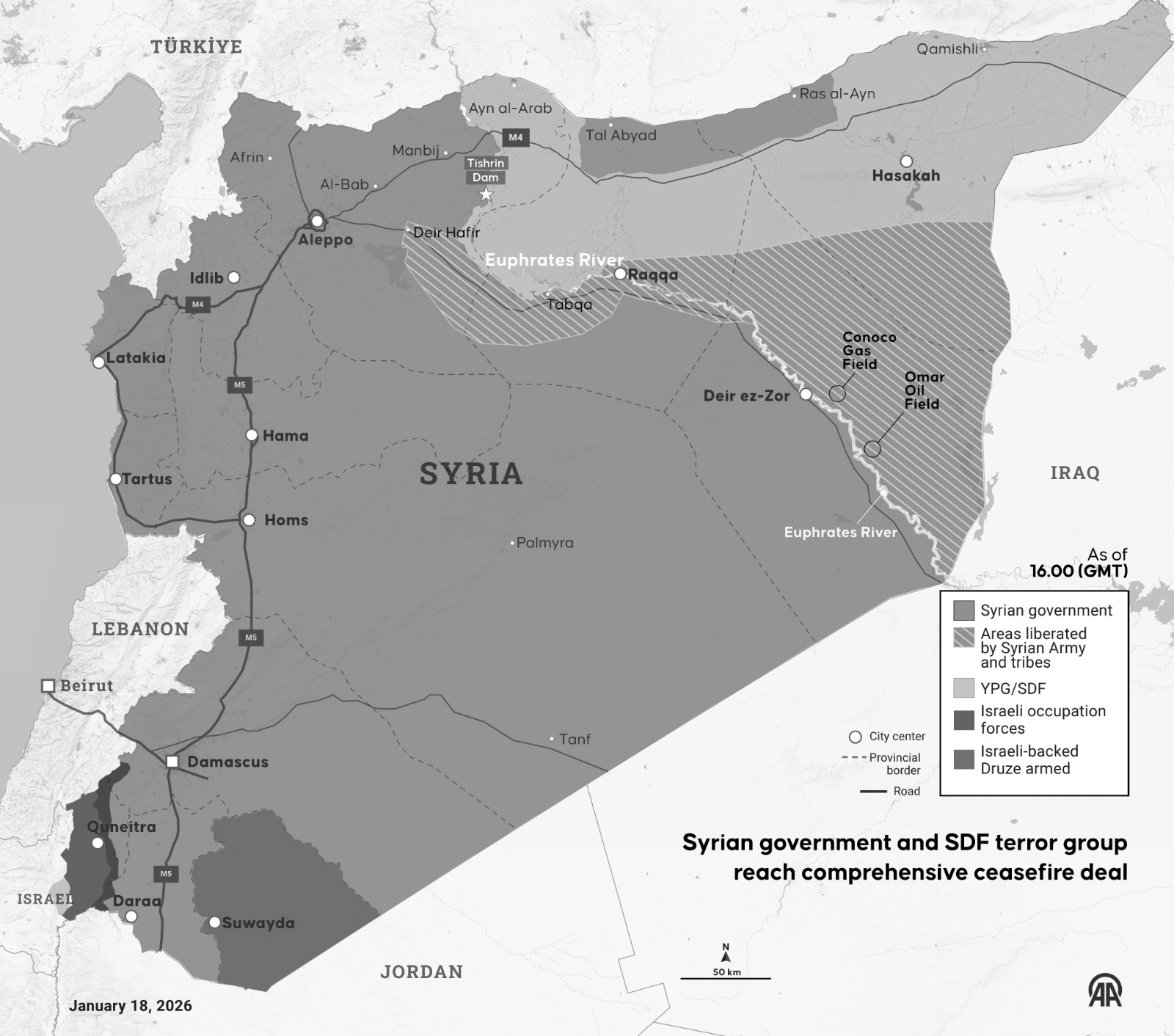
Syria agrees ceasefire with Kurdish-led forces after two weeks of clashes
Syria’s government and the Kurdish-led Syrian Democratic Forces (SDF) have agreed to an immediate ceasefire after nearly two weeks of intense fighting across northeastern Syria, in a deal that also includes a broader 14-point agreement to gradually integrate the SDF into Syria’s military and state institutions. The announcement comes after fierce clashes that left at least 23 people dead and tens of thousands displaced as government troops advanced into Raqqa, Deir el-Zour, and other contested regions.
The truce was announced on January 18 by Syrian President Ahmad al-Sharaa , who said the agreement marks “a new phase toward unified state institutions and national recovery,” stressing that “Kurds are an integral part of Syria.” He recommended “a complete ceasefire” to calm the situation and allow safe corridors for displaced civilians to return home.
A key meeting between al-Sharaa and a delegation from the Kurdish-led Autonomous Administration , headed by SDF commander Mazloum Abdi and attended by US officials, highlighted both sides’ desire to stabilize Aleppo and other frontline areas. However, no detailed measures were announced.
SDF leader Mazloum Abdi confirmed the group’s acceptance of the ceasefire, saying, “We agreed to withdraw from the Deir el-Zour and Raqqa regions to prevent this war from turning into a civil war… we will explain the terms of the agreement to our people.”
US envoy Tom Barrack welcomed the deal , calling it “a pivotal inflection point, where former adversaries embrace partnership over division,” and urging renewed dialogue and cooperation toward a unified Syria.
Under the 14-point agreement, the SDF will withdraw its forces east of the Euphrates River and begin to join the defense and interior ministries as individuals after vetting, while Damascus assumes full military and administrative control of key provinces, oil and gas fields, prisons, and border crossings previously run by the SDF. Kurdish fighters and civilian officials are to be offered roles within state institutions, and Hasakah province is to have a consensus-based governor appointment .
The deal also mandates the handover of Deir el-Zour and Raqqa provinces to Syrian government control and the transfer of responsibility for Islamic State detainees and their families in Kurdish-run facilities to Damascus.
The clashes were fueled by long-standing territorial and political tensions : the SDF had effectively administered large parts of northeastern Syria, including Raqqa, Deir el-Zour, Hasakah, and key oil and gas fields , with US backing since the fight against ISIS, while the post-Assad government under al-Sharaa sought to assert central authority over strategic provinces, resources, and infrastructure . Both sides accused each other of violating the earlier 2025 reintegration agreement, and local Arab tribes opposed to Kurdish administration further intensified the conflict.
The ceasefire and integration pact have been welcomed by regional governments , which said it could strengthen security, stability, and the aspirations of the Syrian people.
While celebrations have been reported in some areas, concerns remain about implementation and the future of Kurdish rights and autonomy, with isolated tensions still being monitored on the ground.