
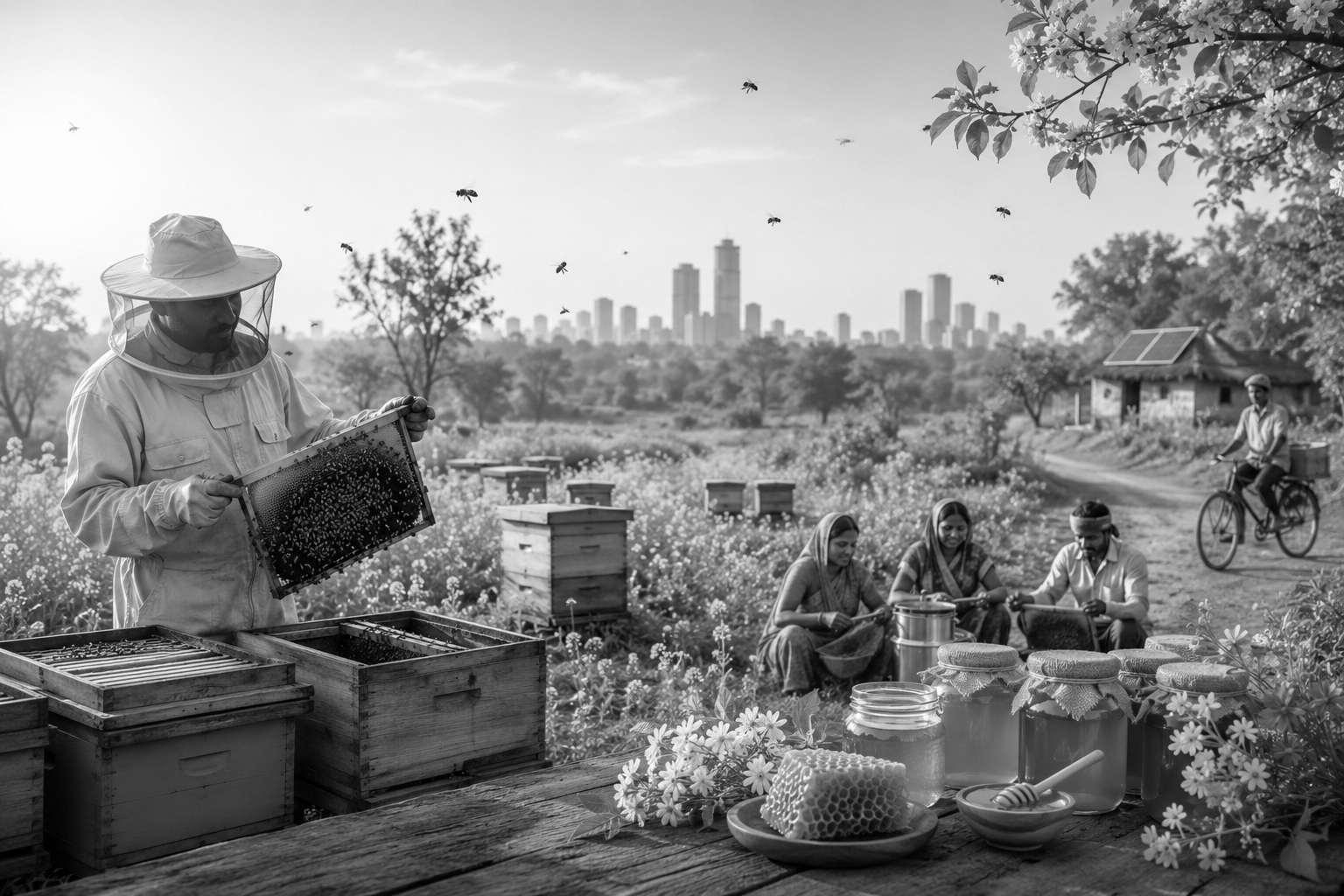
Sweet Revolution, Silent Transformation
While the world worries about climate change, collapsing biodiversity and rural unemployment, India’s answer is arriving with the sound of buzzing wings.
On World Honey Bee Day 2026, the Khadi and Village Industries Commission (KVIC), under the Ministry of Micro, Small and Medium Enterprises, organized a nationwide virtual celebration connecting beekeepers, scientists, students, officials and rural entrepreneurs from across the country. At first glance, the event appeared to be a routine government programme. In reality, it reflected something much larger: India’s attempt to build a development model where environmental conservation, rural employment and economic growth work together instead of against each other.
The programme, conducted virtually from KVIC headquarters in Mumbai and the Gandhi Darshan Office in New Delhi, carried this year’s global theme, “Bee Together for People and the Planet.” The symbolism was deliberate. Honeybees today are not merely producers of honey; they have become indicators of ecological health and silent pillars of food security.
Addressing participants virtually, KVIC Chairman Manoj Kumar said the online format itself reflected Prime Minister Narendra Modi’s emphasis on energy conservation, minimal expenditure and prudent use of resources. By avoiding unnecessary travel and fuel consumption, the event attempted to practice the same sustainability it preached.
But the larger focus remained India’s growing “Sweet Revolution.”
From White Revolution to Sweet Revolution
The intellectual roots of this mission go back to 2016, when Prime Minister Narendra Modi, while addressing a gathering in Banaskantha, Gujarat, declared that just as India witnessed a “White Revolution” through milk production, the country should now move toward a “Sweet Revolution” through honey and beekeeping.
At the time, many viewed it as political rhetoric. Nearly a decade later, however, the scale of implementation tells a different story.
Inspired by this vision, KVIC launched the Honey Mission in 2017. Since then, nearly 2.5 lakh bee-boxes and bee colonies have been distributed across India. According to KVIC data, between 2017-18 and 2025-26, these interventions increased honey production by more than 24,000 metric tonnes. In 2025-26 alone, estimated honey production reached 5,512 metric tonnes.
For a country struggling with rural distress and shrinking agricultural incomes, these numbers represent more than production statistics. Each bee-box often becomes an additional source of livelihood for farmers, women’s groups, tribal communities and unemployed rural youth.
The Hidden Economic Power of Bees
The most remarkable aspect of India’s Honey Mission is that it transforms a tiny insect into a large economic ecosystem.
Honey today is not just a kitchen product. It is part of a rapidly expanding global wellness and natural-food market. Rising health consciousness after the pandemic has sharply increased demand for organic sweeteners, immunity-boosting products and herbal foods. Honey has become valuable for food processing industries, cosmetic companies, pharmaceutical sectors and wellness brands. India is increasingly emerging as a major player in this market.
According to KVIC, honey exported by associated beekeepers during 2025-26 reached nearly Rs.31 crore. Indian honey is now being exported to countries such as the United States, Canada, UAE, Saudi Arabia, Oman, Singapore, Australia, Qatar, Israel and South Korea.
This export growth is important because it changes the image of rural India. Villages are no longer seen only as beneficiaries of welfare schemes; they are becoming participants in global value chains.
The honey economy also creates employment beyond beekeeping itself. Processing units, packaging industries, transport services, marketing networks, wax production and e-commerce platforms all become linked to this ecosystem. Even beeswax has emerged as a profitable product used in cosmetics, pharmaceuticals, candles and industrial applications.
For millions of small farmers facing unstable crop incomes, beekeeping offers a low-investment supplementary livelihood. Unlike many agricultural activities, it does not require large land ownership. A small wooden bee-box placed beside a mustard field or orchard can quietly generate recurring income.
In several regions, beekeeping earnings now support household expenses such as education, healthcare and migration costs.
Bees: The Invisible Agricultural Workers
Perhaps the most overlooked contribution of honeybees is not honey production, but pollination.
Scientists estimate that a significant portion of global food production depends directly or indirectly on pollinators. Fruits, vegetables, oilseeds and several cash crops rely heavily on bees for better yields.
In simple terms, bees help agriculture survive. Modern industrial farming, however, has created a dangerous ecological imbalance. Excessive pesticide use, monoculture cultivation, habitat destruction and climate change are rapidly reducing bee populations worldwide.
This is why World Honey Bee Day carries significance far beyond symbolic celebrations.
KVIC Chairman Manoj Kumar described honeybees as “protectors of nature and the agricultural ecosystem.” His statement reflects a growing realization that environmental conservation cannot remain separate from economic policy. By promoting beekeeping, India indirectly encourages biodiversity preservation, flowering vegetation and environmentally sustainable farming practices.
In a century obsessed with artificial intelligence, mega-industries and high-speed infrastructure, it is deeply ironic that humanity’s food systems still depend heavily on fragile insects flying from flower to flower.
A Different Model of Development
The Honey Mission also represents a philosophical shift in India’s development imagination.
For decades, development was associated with giant factories, urban expansion and centralized industrial growth. Beekeeping represents the opposite approach.
It is decentralized, environmentally integrated, low-cost and community-driven. It creates wealth without massive industrial infrastructure.
In many ways, the bee itself becomes a metaphor for cooperative growth. Every bee contributes individually but sustains the entire hive. Every flower visited strengthens a larger ecosystem.
India’s Sweet Revolution carries a similar aspiration: millions of small rural efforts collectively building a stronger economy. Yet challenges remain. India’s honey sector still faces concerns over adulteration, quality control, fragmented supply chains and lack of scientific training for beekeepers. Climate change and erratic weather patterns may also affect flowering cycles and bee survival in the coming years.
The long-term success of the Honey Mission will therefore depend not merely on distributing bee-boxes, but on creating sustainable ecosystems around research, training, fair markets and environmental protection.
Still, one reality is undeniable. At a time when development debates are dominated by billion-dollar investments and technological spectacle, one of India’s quietest revolutions is being built by farmers, flowers and bees.