
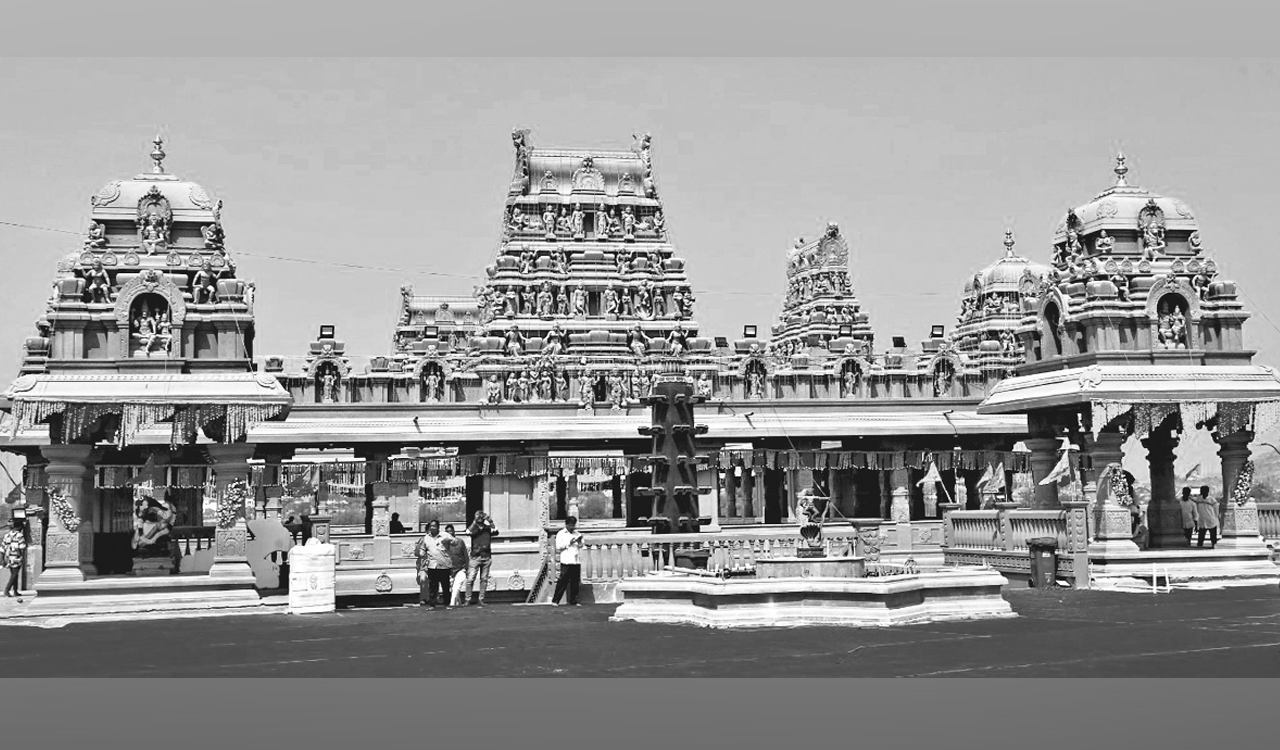
Swarnagiri: A Majestic Spiritual Jewel in the Heart of Telangana
The spiritual landscape of Telangana is currently witnessing a renaissance of Vedic culture and architectural brilliance. For decades, the temple town of Tirupati has been the primary destination for devotees of Lord Venkateswara. However, in recent years, the state of Telangana has begun to establish its own iconic landmarks that rival ancient structures in beauty and devotion. While the Yadadri Lakshmi Narasimha Swamy Temple has already earned global acclaim following its grand reconstruction, a new spiritual haven called "Swarnagiri" is now enchanting millions. Nestled atop the scenic Manepally Hills near Bhongir, this temple is not just a place of worship; it is an architectural masterpiece and a cultural beacon that is rapidly emerging as a "Kaliyuga Vaikuntam" for the modern age.
The Visionary Origin: A Labor of Devotion
The story of Swarnagiri begins not with a government project, but with the profound resolve of a single family. The Manepally family, led by the prominent businessman and philanthropist Sri Manepally Rama Rao , envisioned a sanctuary that would preserve the sanctity of the Sanatana Dharma while showcasing the pinnacle of Indian craftsmanship. Under the auspices of the Manepally Charitable Trust , the family dedicated approximately 22 acres of prime land on a hillock that overlooks the historic Bhongir landscape.
The name "Swarnagiri," which translates to "The Golden Hill," was chosen to reflect the inner radiance and spiritual wealth that the temple aims to bestow upon its visitors. The culmination of years of meticulous planning and construction occurred on March 6, 2024 , when the temple reached a historic milestone. The Prana Pratishtha (consecration) and Kumbhabhishekam ceremonies were performed by the revered Tridandi Sri Sri Sri Chinna Jeeyar Swamy . His involvement ensured that every ritual, from the foundation stone to the final installation of the deity, adhered to the ancient Agama Shastra traditions, infusing the hill with a divine energy that is palpable the moment one steps onto its grounds.
Architectural Grandeur: A Bridge Between Eras
What sets Swarnagiri apart from many contemporary temples is its commitment to classical aesthetics. As one approaches the hill, the silhouette of the temple evokes the grandeur of India’s most powerful historical empires. The architects and sculptors drew heavy inspiration from the Pallava, Chola, Vijayanagara, and Chalukya dynasties. These empires were the golden ages of temple building, and Swarnagiri serves as a revival of those techniques.
The temple is anchored by four massive Rajagopurams the royal entrance towers facing the cardinal directions. These towers are layered with hundreds of intricate carvings depicting celestial beings, musicians, and floral motifs, designed to draw the devotee’s eyes upward toward the heavens. Once inside, the Vimana Gopuram (the tower over the main sanctum) stands as a five-story masterpiece of symmetry and art. Unlike modern concrete structures, the stone work here is designed to last for centuries, using traditional interlocking methods. The temple pillars are a particular point of pride; they are not merely supports but canvases for the Dashavatara (the ten incarnations of Lord Vishnu) and various scenes from the Ramayana and Mahabharata. Walking through the mandapams is akin to walking through a stone-carved library of Indian mythology.
The Presiding Deity: The 12-Foot Lord of Swarnagiri
The heart of the temple is the Garbhalayam (Sanctum Sanctorum), which houses an idol of Lord Sri Venkateswara Swamy that is as awe-inspiring as it is serene. Standing at a magnificent 12 feet tall, the idol is actually larger than the world-renowned Dhruva Beram at Tirumala. The decision to commission such a large idol was to ensure that every devotee, regardless of where they stand in the queue, can have a clear and heart-filling Darshan of the Lord.
The black stone idol is a marvel of iconography. The Lord’s four arms carry the Sankha (conch) and Chakra (discus), while His lower hands are in the Abhaya (protection) and Kati (hand-on-hip) postures. The intricate details of His jewelry, the folds of His garment, and the serene, compassionate smile on His face are intended to instill a sense of deep peace. For many who find the journey to Tirumala difficult due to distance or crowd sizes, the Swarnagiri Lord offers a localized, yet equally powerful, spiritual alternative.
A Pantheon of Divinity: Sub-temples and Landmarks
Swarnagiri is a holistic spiritual complex that honors the entire lineage of the Vaishnavite tradition. Surrounding the main shrine are several sub-temples, each with its own unique energy:
Goddess Alamelu Manga & Goda Devi:
No Venkateswara temple is complete without His consorts. The shrines for the Mother Goddesses provide a space for prayers regarding prosperity and marital harmony.
Madanagopala Krishna:
A beautiful shrine dedicated to the Lord in His playful form as Krishna, complete with a flute that seems to resonate through the silence of the hills.
Sri Ramanujacharya & Garudalwar:
The temple honors the philosophical roots of the tradition by dedicating a shrine to Sri Ramanujacharya, the proponent of Vishishtadvaita, and to Garuda, the eternal vahana (mount) of Vishnu.
The 27-Foot Monolithic Hanuman:
Perhaps the most striking outdoor feature is the massive, single-stone statue of Lord Hanuman. Standing 27 feet tall, he stands as the Kshetrapalaka (guardian) of the hill, offering strength and courage to those who enter.
Vakula Matha Temple:
In a touching tribute to the Lord’s mother, a separate shrine is dedicated to Vakula Matha, allowing devotees to pay their respects to the maternal figure who, according to legend, arranged the Lord's wedding.
The Jala Narayana Murthy and Sacred Pushkarini
Water plays a vital role in temple purification rituals. The Pushkarini (temple tank) at Swarnagiri has been designed to be more than just a functional water body. In the center of the tank sits the Jala Narayana Murthy , a reclining idol of Lord Vishnu atop the serpent Adi Sesha, resting on the water. This represents the Kshira Sagara (the Ocean of Milk). During the evenings, the fountain and the surrounding lights create a shimmering reflection on the water, making it a favorite spot for meditation and reflection.
A Modern Spiritual Ecosystem
The Manepally Charitable Trust has ensured that Swarnagiri serves the community beyond just religious rituals. The temple features a traditional Goshala , where cows, sacred to the tradition, are cared for with devotion. The sounds of Vedic chanting from the Veda Murthis (statues representing the four Vedas) remind visitors of the oral traditions that have preserved Indian wisdom for millennia.
For those interested in the grand festivals, the temple houses a 40-foot chariot (Ratham). This massive wooden structure is used during the annual Brahmotsavams, when the Lord is taken out in a grand procession, drawing thousands of pilgrims from across the state. Furthermore, the Annadanam (free meal) hall ensures that no devotee leaves the hill hungry, embodying the principle that serving humanity is serving the Divine.
Accessibility and Practical Information
Despite being on a hill, Swarnagiri is designed for the modern pilgrim. It is located approximately 45-50 km from Hyderabad , making it a perfect day-trip destination. The TGSRTC has recognized the growing importance of this site and operates direct buses from major hubs like Uppal and JBS .
For those traveling by car, the drive along the Hyderabad-Warangal Highway (NH 163) is smooth, and the temple provides ample parking. Recognizing the needs of an aging population, the temple includes ramps alongside the traditional stone steps, ensuring that the elderly and physically challenged can reach the sanctum without difficulty.
A Legacy in the Making
Swarnagiri is more than just a new addition to the map of Telangana; it is a legacy being built in real-time. It represents a fusion of ancient Vedic wisdom and modern-day philanthropic spirit. Whether you are an architecture enthusiast looking to study the intricate carvings, a photographer seeking the perfect golden hour shot of the illuminated gopurams, or a devotee looking for a moment of quiet prayer before the 12-foot Lord, Swarnagiri offers something for everyone.
As the sun sets over the Bhongir hills and the temple lights begin to glow, the hill truly transforms into a "Golden Mountain." It stands as a testament to the fact that faith, when combined with art and vision, can create a space that transcends time, a space where every soul can find its way back to the divine.