
Sutlej–Yamuna Link Issue Remains Unresolved Despite Cordial Punjab–Haryana Talks
The decades-old Sutlej–Yamuna Link (SYL) canal dispute between Punjab and Haryana remained unresolved on Tuesday, even as the chief ministers of the two states agreed to continue dialogue to find a mutually acceptable solution to one of the country’s most contentious inter-state water-sharing issues .
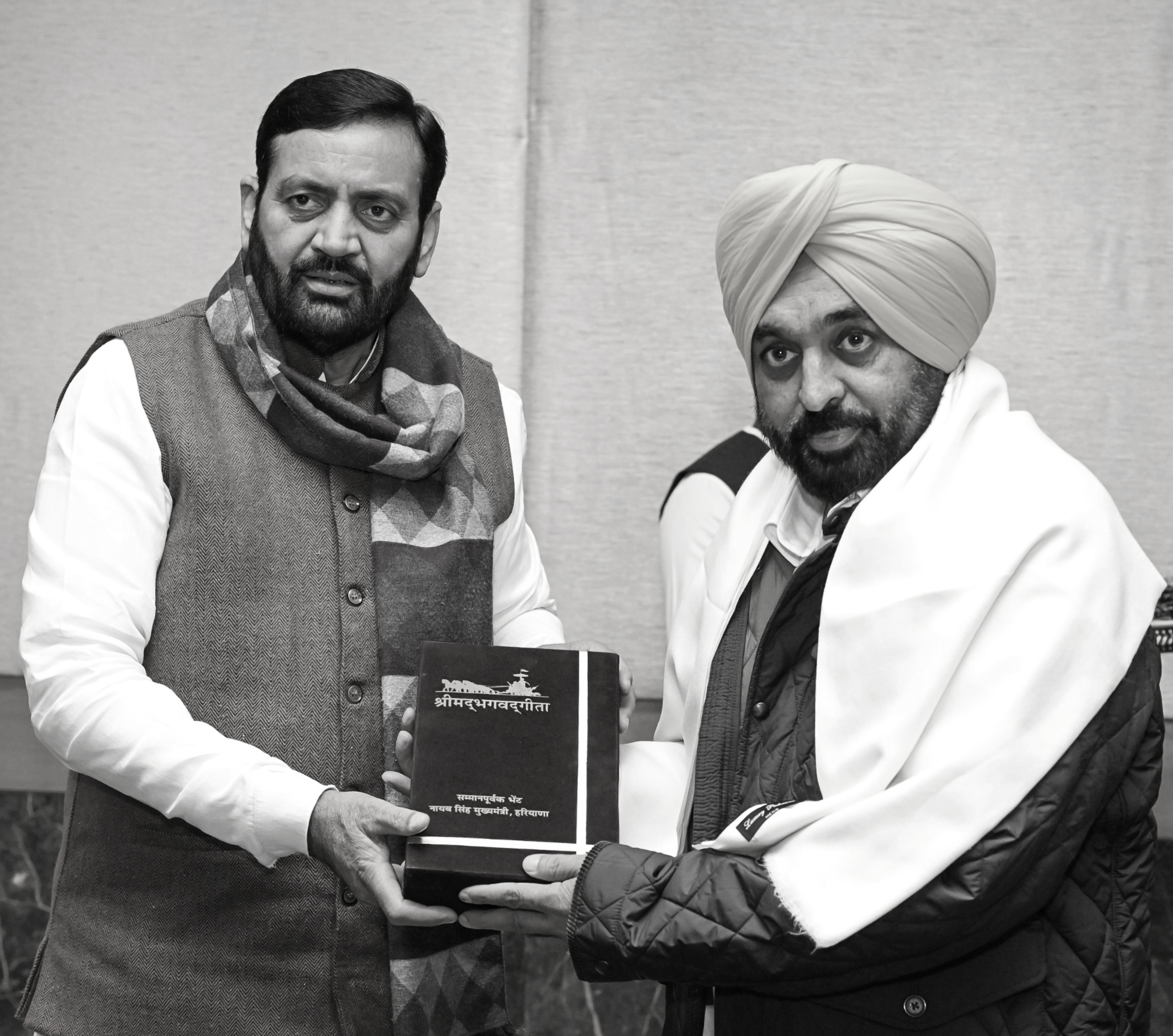
The issue was discussed during an hour-long meeting between Punjab Chief Minister Bhagwant Mann and Haryana Chief Minister Nayab Singh Saini here. While no consensus emerged, the two sides decided that officials of both states would hold further deliberations and brief the leadership on the progress of talks . Both chief ministers described the discussions as cordial .
The SYL canal was conceived to carry water from Punjab’s Sutlej river to Haryana’s Yamuna basin , enabling Haryana to receive its allocated share of water from the Ravi–Beas river system . The dispute traces its origins to the reorganisation of Punjab in 1966 , when Haryana was carved out as a separate state , necessitating a fresh allocation of river waters .
In 1976 , the Central government fixed water shares, allocating 3.5 million acre-feet (MAF) each to Punjab and Haryana . An agreement signed in 1981 by Punjab, Haryana and Rajasthan provided for the construction of the 214-km SYL canal , with Punjab responsible for a 122-km stretch . Construction began in 1982 but was repeatedly stalled due to strong public opposition in Punjab .
The issue gained further political and emotional significance after the 1985 Rajiv–Longowal Accord , which reaffirmed Punjab’s obligation to complete the canal. However, successive Punjab governments have argued that the state has no surplus water , citing rapid groundwater depletion , increasing agricultural demand , and the risk of serious law and order problems if the project is enforced.
In 2004 , the Punjab Assembly passed the Punjab Termination of Agreements Act , cancelling all water-sharing agreements related to the SYL canal. This was challenged by Haryana in the Supreme Court , which in 2016 struck down the Act as unconstitutional , ruling that a state legislature cannot unilaterally annul inter-state agreements .
Despite the court’s ruling, the canal remains incomplete , with Punjab maintaining that it cannot spare any water. Haryana, meanwhile, has consistently maintained that it is being denied its legally entitled share , pressing for completion of the canal to meet drinking water and irrigation needs .
Addressing reporters after the meeting, Mann reiterated that not even a single drop of Punjab’s rightful water could be allowed to be diverted, while emphasising the need for dialogue over confrontation . Describing Haryana as Punjab’s “brother, not an enemy” , he said any resolution must ensure that the rights of both states are protected.
Both chief ministers noted that the Supreme Court and the Central government have encouraged a mutually accepted resolution , and said the ongoing talks reflect a renewed effort to resolve the dispute through political and official-level engagement , even as core differences persist after nearly five decades .