
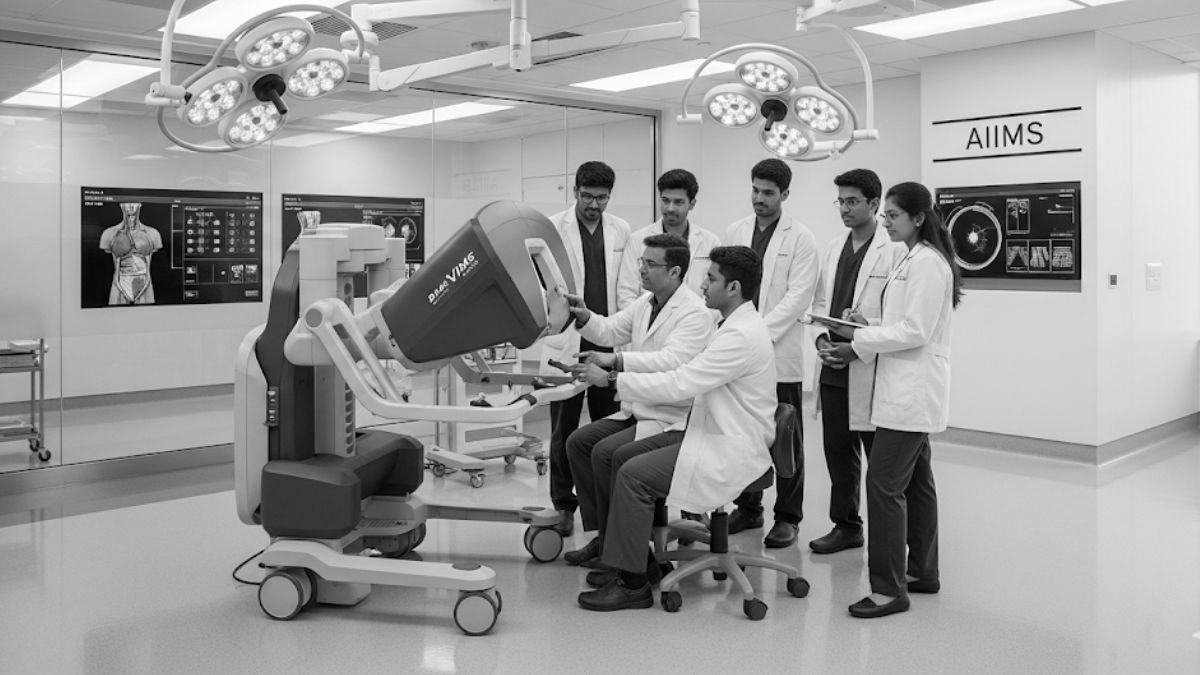
Surgery meets science: AIIMS sets up robot for next-gen surgeons
AIIMS Delhi has taken a major leap in surgical education by installing a state-of-the-art da Vinci Surgical Robot at its Skills, E-learning and Telemedicine (SET) facility. This cutting-edge robot, provided under a collaboration with Intuitive Surgicals, now joins the existing Hugo training robot from Medtronics, making AIIMS the only institution in India to have two surgical robots dedicated purely for training purposes. The addition of the da Vinci robot promises to revolutionize how surgeons, residents, nurses, and healthcare professionals learn and practise robotic-assisted surgery in a controlled, stress-free environment.
The SET facility has long allowed trainees to hone skills using manikins and simulators, but the new robotic system takes training to a new dimension. Surgeons can now gain hands-on experience in precision-driven, minimally invasive procedures across multiple specialties including urology, gynaecology, general surgery, surgical oncology, and head-and-neck surgery. By practising on robotic systems, trainees can improve accuracy, reduce surgical errors, and gain confidence before performing real operations, ultimately enhancing patient safety and outcomes.
AIIMS Delhi Director Dr. M. Srinivas highlighted that this initiative reinforces the hospital’s leadership in surgical education and innovation. “Previously, surgeons had to travel abroad and spend large sums to acquire robotic training. Now, they can get world-class experience right here at AIIMS,” he said. The move also allows experienced surgeons to mentor the next generation, creating a sustainable model for advancing robotic surgery in India.
This initiative is significant not just for training, but for India’s medical landscape as a whole. Robotic-assisted surgeries are faster, more precise, and less invasive than traditional procedures, often reducing patient recovery time. By establishing a domestic centre for robotic surgical education, AIIMS is reducing dependency on foreign training programs, improving accessibility, and setting a benchmark for other institutions. Experts say that this step could accelerate the adoption of robotic surgery nationwide, ultimately raising standards of care and positioning India at the forefront of medical technology.
In short, AIIMS Delhi is transforming surgical training from manikins to machines, equipping doctors with advanced tools, skills, and confidence. The future of precision surgery in India is now closer, safer, and smarter.