
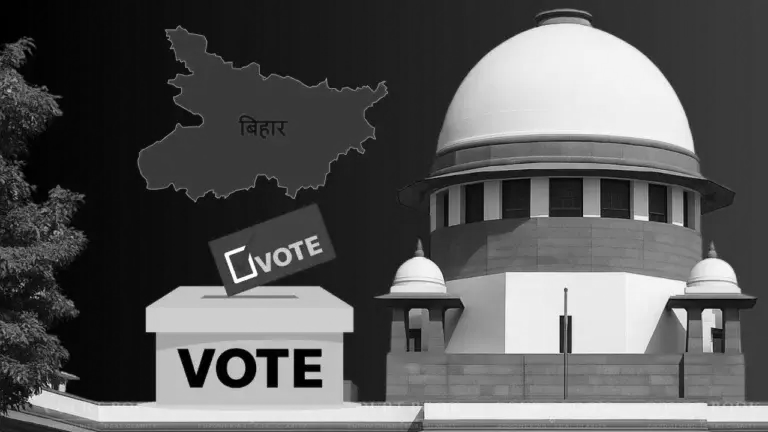
Supreme Court to hear Bihar SIR voter list petitions on November 4
The Supreme Court has scheduled November 4 to hear petitions challenging the Election Commission of India’s (ECI) special intensive revision (SIR) of electoral rolls in Bihar, raising concerns about transparency, accuracy, and fairness in updating voter lists. The matter has drawn attention from civil society groups, political activists, and legal experts, highlighting broader questions about electoral integrity.
Petitioners demand transparency:
In addition to the Association for Democratic Reforms (ADR), organizations including the People’s Union for Civil Liberties (PUCL) and the National Federation of Indian Women (NFIW) have challenged the SIR process. Petitioners allege that the revision led to significant voter exclusions, including the removal of approximately 65 lakh voters without adequate justification or notification.
The Supreme Court has directed the ECI to publish a district-wise, searchable list of the deleted voters, along with the reasons for each deletion, such as death, migration, or duplication. This measure aims to ensure transparency and accountability in the electoral process. The ECI has maintained that the SIR process is fair and that a five-day window remains for voters to file appeals against exclusions.
Legal support for excluded voters:
To assist those left out of the final voter list, the Court directed the Bihar State Legal Services Authority (BSLSA) to provide legal support. District-level legal service authorities will deploy paralegal volunteers and offer legal aid so that excluded voters can file appeals with the ECI. Justices Surya Kant and Joymalya Bagchi emphasized that accessible legal support is critical to protecting citizens’ right to vote.
Discrepancies in affidavits:
During hearings, the Court noted inconsistencies in affidavits submitted by individuals claiming wrongful exclusion. Senior advocate Rakesh Dwivedi, representing the ECI, pointed out that at least one affidavit was false, as the person had never submitted the required enumeration form. The bench expressed displeasure over such submissions, cautioning petitioners, including ADR’s advocate Prashant Bhushan, to exercise greater responsibility. Political activist Yogendra Yadav also raised concerns regarding wrongful voter exclusions.
Balancing efficiency and accountability:
The case underscores the challenge of updating voter lists efficiently while ensuring fairness and accuracy. While the ECI emphasizes the procedural correctness of the SIR, the Supreme Court’s intervention highlights the need for oversight and transparency. By mandating legal support for excluded voters, the Court seeks to balance administrative efficiency with democratic rights.
The next hearing on November 4 will further examine the ECI’s compliance with Court directives and the scope of petitions, including allegations of large-scale voter deletions. Civil society and political groups are expected to closely follow developments, as the case has implications for voter list integrity not only in Bihar but across India.