
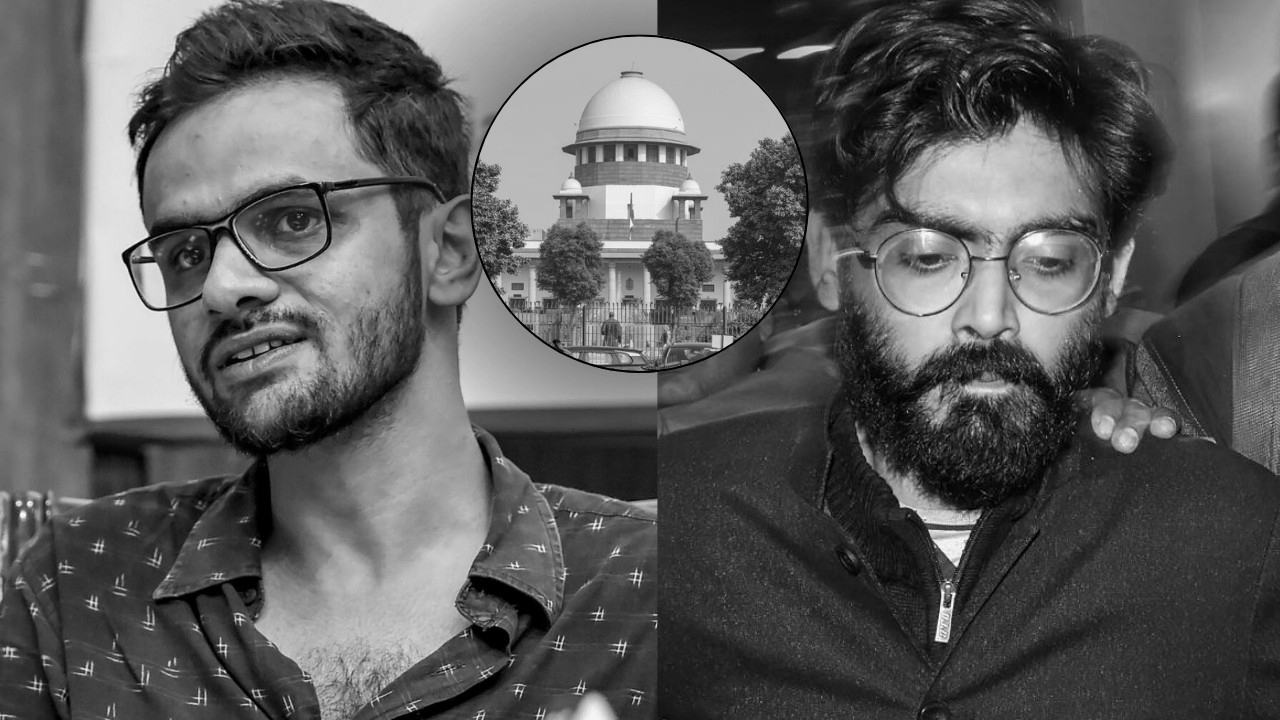
Supreme Court Denies Bail to Umar Khalid, Sharjeel Imam in Delhi Riots Case
More than five years after the 2020 North-East Delhi riots, the Supreme Court on Monday delivered a split verdict in the case linked to the alleged “larger conspiracy” behind the violence, denying bail to activists Umar Khalid and Sharjeel Imam while granting relief to five other accused . The decision has once again brought national attention to the riots, the use of the Unlawful Activities (Prevention) Act (UAPA) , and the issue of prolonged incarceration without trial.
The riots, which erupted between February 23 and 26, 2020 , left 53 people dead , injured over 200 , and caused widespread destruction of homes, shops, places of worship, and public property. The violence was concentrated in North-East Delhi localities such as Jaffrabad, Maujpur, Chand Bagh, Seelampur, Bhajanpura, and Gokulpuri, marking the worst communal unrest the capital had witnessed in decades.
The violence unfolded amid nationwide protests against the Citizenship Amendment Act (CAA) , passed in December 2019. Delhi emerged as a major centre of protest, with sit-ins and road blockades, including the prominent Shaheen Bagh protest. Tensions escalated in North-East Delhi following competing mobilisations near protest sites, eventually spiralling into large-scale communal clashes. Allegations of police inaction and delayed response , particularly during the early hours of the violence, later became a major point of contention, though the Delhi Police rejected these claims.
In the aftermath, the Delhi Police registered over 750 FIRs and arrested hundreds of people. Investigations were divided into individual riot-related cases and a separate “larger conspiracy” case , in which police alleged that the violence was pre-planned and orchestrated , rather than spontaneous. According to the prosecution, anti-CAA protests were allegedly used as a cover to mobilise crowds, block roads, provoke the state, and trigger violence , with the timing purportedly chosen to coincide with the visit of the then US President Donald Trump to India.
It is this conspiracy case that led to the arrest of Umar Khalid, Sharjeel Imam, Gulfisha Fatima, Meeran Haider, Shifa-ur-Rehman, Mohammed Saleem Khan, and Shadab Ahmed under the UAPA. The police have claimed that Umar Khalid played a central ideological and organisational role , citing alleged inflammatory speeches, digital communication records, and witness statements. Importantly, the prosecution does not allege that Khalid physically participated in the riots; the case against him rests on allegations of conspiracy, incitement, and coordination .
On Monday, a Supreme Court bench comprising Justice Aravind Kumar and Justice N.V. Anjaria denied bail to Khalid and Imam, holding that they stand on a “different footing” from the other accused based on the nature of allegations and material on record . At the same time, the court granted bail to Gulfisha Fatima, Meeran Haider, Shifa-ur-Rehman, Mohammed Saleem Khan, and Shadab Ahmed , observing that their alleged roles appeared comparatively limited .
The apex court noted that although Khalid and Imam have been in custody for over five years , prolonged incarceration alone does not automatically entitle an accused to bail under the stringent provisions of the UAPA . It held that the statutory bar on bail had not been crossed and clarified that delay in trial cannot be treated as a decisive factor in cases involving serious allegations. However, the court allowed both accused to apply for bail again after one year , depending on the progress of the trial.
Following the verdict, Umar Khalid reportedly expressed relief that bail had been granted to the five co-accused. According to his partner Banojotsna Lahiri , Khalid said he was happy that others would be reunited with their families, remarking privately, “This is my life now,” in reference to his continued incarceration.
The decision triggered sharp political reactions. Congress leader and Karnataka minister Priyank Kharge criticised the ruling, sarcastically remarking “Welcome to Viksit Bharat” and alleging selective application of justice. The BJP responded strongly, with spokesperson Shehzad Poonawalla stating that the Supreme Court had found the terrorism and conspiracy allegations to be prima facie valid , while BJP leader Pradeep Bhandari described the verdict as a setback for the Congress.
The case has also drawn international attention , with concerns raised over extended pre-trial detention . Legal observers note that the verdict reflects a case-by-case approach under the UAPA , rather than a blanket denial or grant of bail. With the possibility of renewed bail pleas left open, attention now shifts to the pace of trial proceedings , even as the 2020 Delhi riots continue to shape debates around dissent, policing, and civil liberties.