
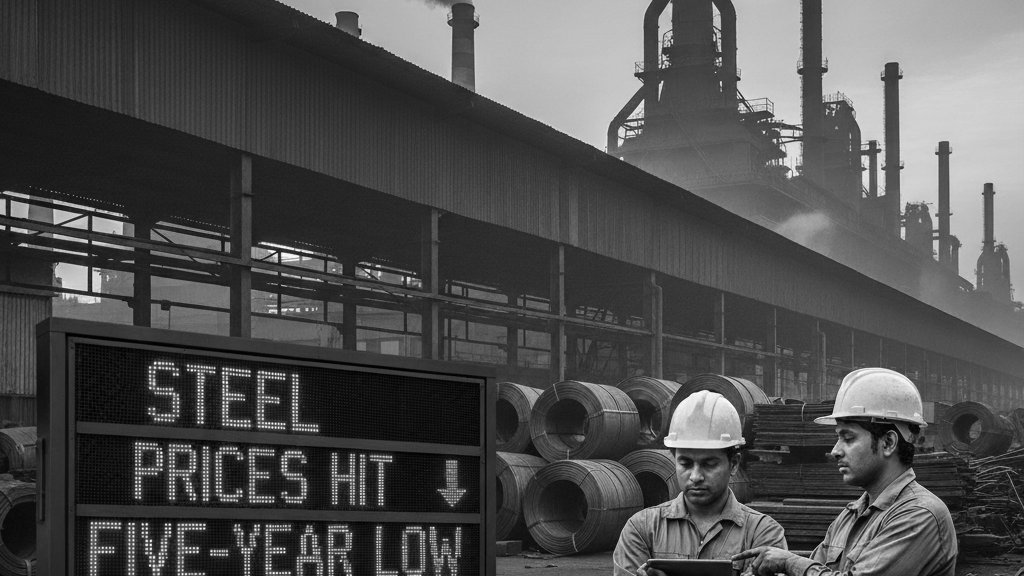
Steel prices touch five-year lows in India amid global oversupply: Tata Steel CEO
Steel prices in India touched their lowest level in five years in 2025 , despite strong domestic demand and production, T V Narendran , CEO and Managing Director of Tata Steel, said. Speaking to employees in Jamshedpur during New Year celebrations, Narendran described 2025 as a challenging year for the steel industry, affected by global trade disruptions and protectionist measures in several countries.
He highlighted the slowdown in China’s construction sector, a major steel-consuming industry, which led to a surge in Chinese steel exports for the second consecutive year. According to him, China exported more than 100 million tonnes of steel , roughly equivalent to India’s total annual production. Although large volumes of Chinese steel did not directly enter India, the global oversupply made exports difficult for Indian producers and kept domestic prices low.
Steel prices in India have been on a rollercoaster over the past five years. In 2020, amid the pandemic, hot-rolled coil (HRC) traded near ₹46,000-₹47,000 per tonne , while rebar hovered around ₹45,000 per tonne . Prices surged in 2021–2022 due to strong global demand and supply chain disruptions, with HRC sometimes crossing ₹70,000 per tonne . In 2023–2024, prices softened as global supply improved, but stayed above pre-pandemic levels. By 2025, prices slid again to ₹47,000-₹48,000 per tonne for HRC, matching the lows seen in 2020. Despite strong domestic demand, prices remained subdued due to external pressures.
Several factors contributed to the drop in steel prices. Rising imports from countries like South Korea and Japan added supply and kept prices under pressure. Global demand for Indian steel weakened as infrastructure and industrial activity in major markets slowed, reducing export opportunities and limiting pricing power. Prices of key inputs such as iron ore and coking coal eased during parts of 2025, reducing overall production costs and translating into lower finished steel prices.
To support domestic producers, the government introduced a three-year safeguard tariff of 11–12% on select steel imports. The measure aims to reduce the impact of cheap imports and stabilize prices. Following this announcement, steel sector stocks surged as investors anticipated improved pricing power for local producers. Industry representatives welcomed the tariff, seeing it as a key step to protect Indian steel manufacturers.
Analysts expect steel prices in India to stabilize and gradually recover in 2026 , aided by safeguard duties and continued strong domestic demand. However, sharp rebounds are unlikely until global oversupply reduces and international demand strengthens. Domestic consumption remains robust, driven by infrastructure projects, housing development, and industrial expansion. In the long term, fundamentals remain positive, with India poised to remain one of the world’s fastest-growing steel-consuming markets.
Steel became unusually cheap in India in 2025, the lowest in five years, n ot due to a fall in domestic demand, but because global oversupply and imports kept prices down. Government tariffs and strong local demand are expected to help prices recover slowly in 2026, while long-term prospects for the steel sector remain strong.