
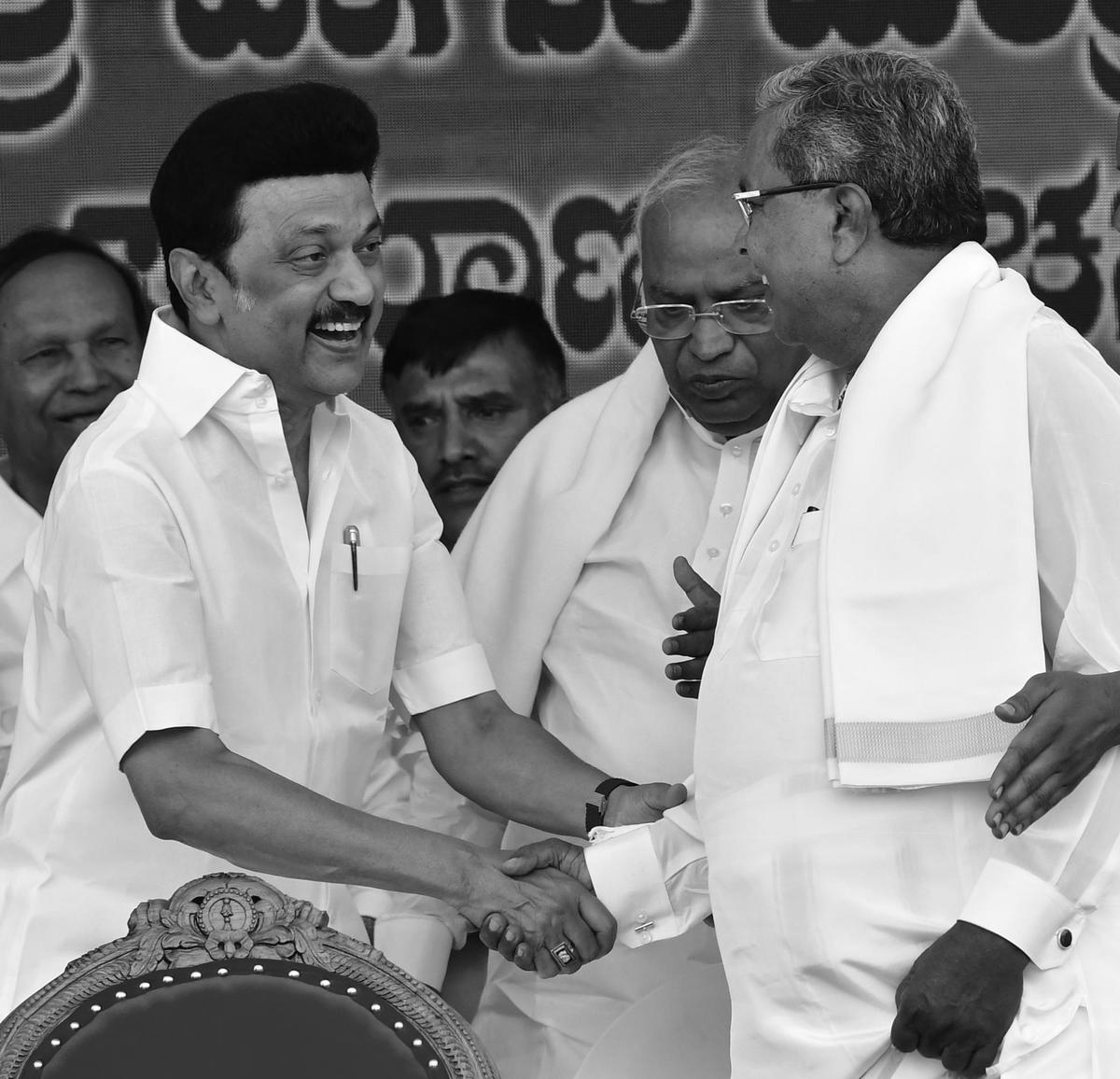
Stalin thanks Siddaramaiah for supporting Tamil Nadu’s federalism initiative
Tamil Nadu Chief Minister M. K. Stalin on Tuesday thanked Karnataka Chief Minister Siddaramaiah for backing Tamil Nadu’s initiative to strengthen Union–State relations, describing the support as an important step toward reinforcing cooperative federalism in India.
In a social media message, Stalin expressed appreciation for Siddaramaiah’s response to Part I of the report prepared by the High-Level Committee on Union–State Relations constituted by the Tamil Nadu government. He said the Karnataka leader had rightly underlined that strengthening India’s federal structure requires collective efforts from states.
“Unity in a diverse republic like India is sustained not through uniformity, but through constitutional trust, ” Stalin said while thanking Siddaramaiah for his “thoughtful endorsement” of the initiative.
Part I of the committee’s report, released in Tamil and English, was tabled in the Tamil Nadu Legislative Assembly on February 16, 2026. The report examines ten key subjects related to Centre–State relations, including language policy, the role of Governors, education, health, delimitation, elections and the Goods and Services Tax ( GST ).
The committee was constituted by the Tamil Nadu government in 2023 to examine evolving Centre–State dynamics and recommend ways to strengthen India’s federal framework. It is chaired by former Supreme Court judge Justice Kurian Joseph , with members K. Ashok Vardhan Shetty and M. Naganathan.
Key issues highlighted in the report reflect longstanding concerns raised by several states. These include delays in GST compensation, growing fiscal centralisation, and disputes over the powers of Governors, particularly regarding assent to state legislation and their role in state administration.
In his letter to Stalin, Siddaramaiah noted that federalism is not merely a political demand but part of the Constitution’s basic structure. He also cautioned that increasing centralisation in fiscal and legislative matters has disturbed the balance envisioned by the Constitution’s framers.
Observers say the report could add fresh momentum to the national debate on cooperative federalism by encouraging wider discussions among states on fiscal autonomy, institutional reforms and the balance of powers between the Union and state governments.
The committee met in New Delhi on February 22 to deliberate on Part II of its report, which is expected to cover ten additional chapters on Centre–State relations.