
Stable Supply, Rising Leakages: India’s LPG System Faces Ground-Level Challenge
India’s LPG supply continues to remain stable and sufficient , even as global geopolitical tensions put pressure on energy markets. Oil marketing companies are consistently delivering around 28 lakh cylinders daily , maintaining normal supply levels across the country. Authorities have reassured citizens that there is no shortage of cooking gas , urging consumers to avoid panic booking and rely only on official sources.
Yet, beneath this stability lies a growing concern widespread black marketing and last-mile delivery failures . Recent enforcement actions across states reveal that while supply at the national level is robust, distribution inefficiencies are enabling illegal diversion of cylinders .
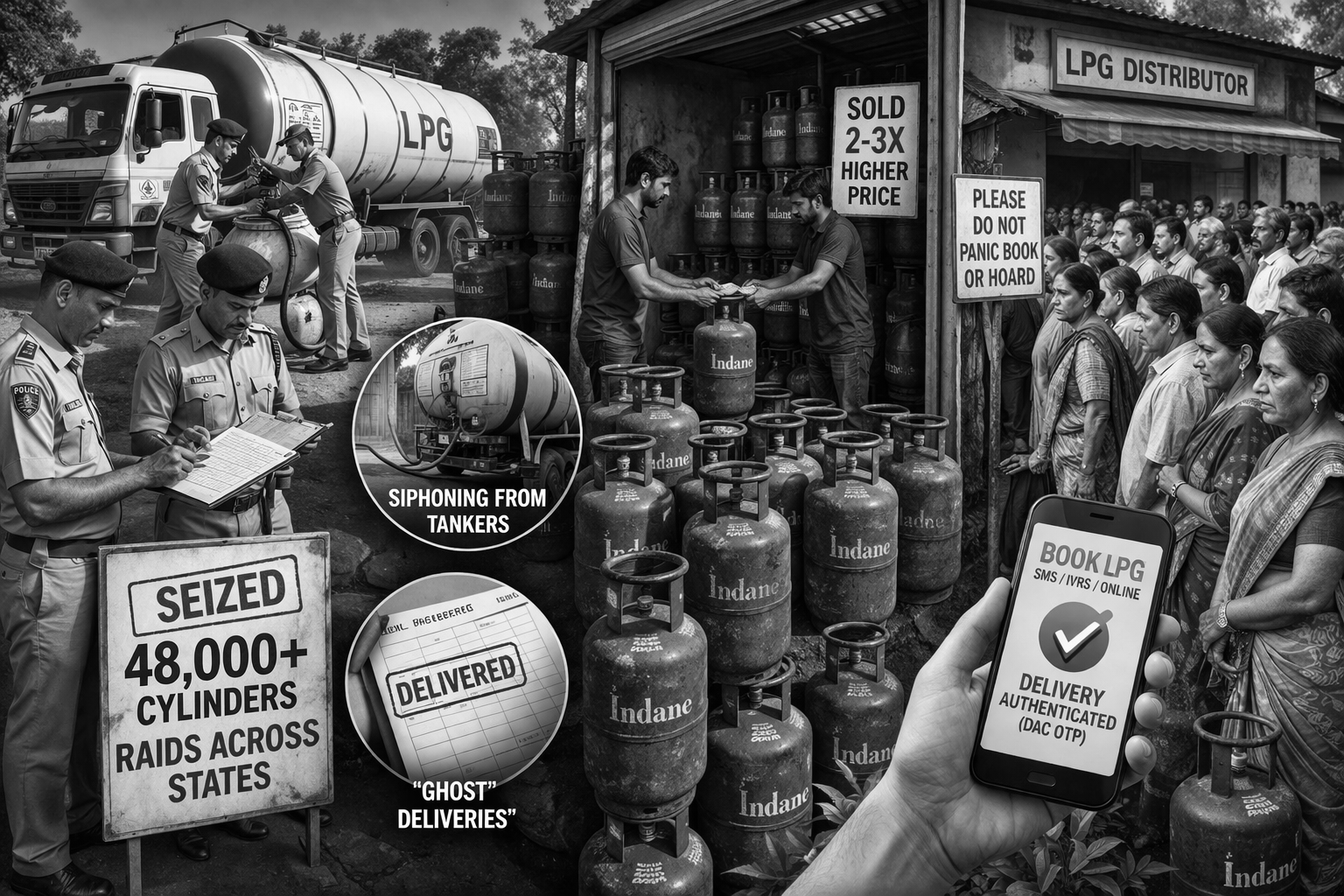
The scale of the problem becomes clear when looking at state-wise crackdowns . In Telangana , authorities seized over 700 cylinders in multiple operations, including a major illegal storage racket in Hyderabad. Rajasthan (Jaipur) reported 461 cylinders seized and 15 arrests , while Maharashtra (Sambhajinagar) exposed a high-level racket involving LPG siphoned from tankers worth nearly ₹20 lakh . In Jammu & Kashmir , around 75 cylinders were confiscated in anti-hoarding drives, and Delhi has witnessed repeated seizures linked to illegal resale networks. Nationwide, enforcement agencies have conducted tens of thousands of raids , resulting in the seizure of over 48,000 cylinders and hundreds of legal cases.
Investigations reveal that the black market operates through well-established and often sophisticated methods . One of the most common is “ ghost delivery ,” where cylinders are marked as delivered in official records but never reach consumers. In other cases, subsidized domestic cylinders are diverted to commercial establishments such as hotels and small businesses , where they are sold at two to three times the regulated price . More organized rackets involve siphoning LPG directly from transport tankers , while some distributors manipulate bookings or hoard stock to create artificial shortages.
The situation has been further intensified by panic buying and misinformation , especially during periods of global uncertainty. Sudden spikes in demand allow illegal operators to hoard supplies and sell them later at inflated rates, creating the illusion of scarcity despite adequate availability.
In response, authorities have stepped up enforcement through surprise inspections, large-scale raids, and digital tracking mechanisms such as Delivery Authentication Codes (DAC). Coordination between central agencies and state governments has also improved, leading to stricter action against erring distributors and illegal operators.
The current situation highlights a crucial reality: India’s LPG system is strong at the supply level but vulnerable at the distribution level . Ensuring transparency, strengthening last-mile monitoring, and reducing human intervention will be essential to closing these gaps.
Ultimately, India is not facing a shortage of LPG but a challenge of ensuring that supply reaches the right hands efficiently and fairly .