
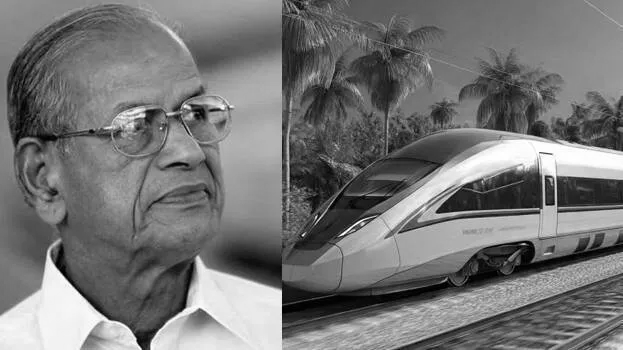
Sreedharan pushes Kerala high-speed rail plan despite Budget omission
Even as Kerala was left out of rail projects announced in the Union Budget, ‘Metro Man’ E Sreedharan on Monday formally set the proposed high-speed rail corridor in motion , signalling an attempt to build public confidence and groundwork ahead of formal central approval.
Sreedharan inaugurated a project office in Ponnani at 9 am, with his wife Radha lighting a ceremonial lamp. The office, he said, would serve as a public interface to explain the project, address concerns and lay the foundation for preparatory work.
“In the first phase, the office will be used to explain the project to people and clear their doubts,” Sreedharan said. Public meetings will begin from February 15 , starting in Malappuram and later extending to other districts along the proposed alignment.
With the office opening, official work on the project has commenced, he said, adding that staff would join in phases. “Whatever we do must benefit the people and not cause trouble. If problems arise, we must solve them and move forward,” he said.
The proposed high-speed rail corridor will run from Thiruvananthapuram to Kannur , spanning the length of Kerala, with 22 stations and a maximum operating speed of 200 kmph . Fieldwork to finalise alignment and station locations is scheduled to begin in April and is expected to be completed before June, ahead of the monsoon. Survey work will follow once public confidence is built.
“If people are taken into confidence, there is nothing to fear,” Sreedharan said, explaining his decision to move ahead without waiting for formal orders. “Time is money. We decided not to waste time,” he added.
Railway experts note that Union Budget inclusion is typically required at the funding and sanction stage, not during initial groundwork or DPR preparation. Sreedharan has projected the project as one to be implemented by the Railway Ministry , with the state government’s views to be sought after the Detailed Project Report (DPR) is prepared .
The initiative comes against the backdrop of Kerala’s earlier SilverLine semi–high-speed rail project , which faced widespread public opposition over land acquisition, environmental concerns and costs, and was eventually stalled. Sreedharan’s approach marks a shift in strategy, prioritising public engagement and technical groundwork before seeking formal approvals.
Widely known as India’s “Metro Man” for his role in executing the Delhi Metro and the Konkan Railway, Sreedharan’s involvement has lent credibility to the proposal, even in the absence of immediate Budget backing.
While he remains confident of eventual central approval, the Kerala government is currently pursuing a Regional Rapid Transit System (RRTS) along a similar north–south corridor, indicating that multiple transport models are under consideration for the state.