
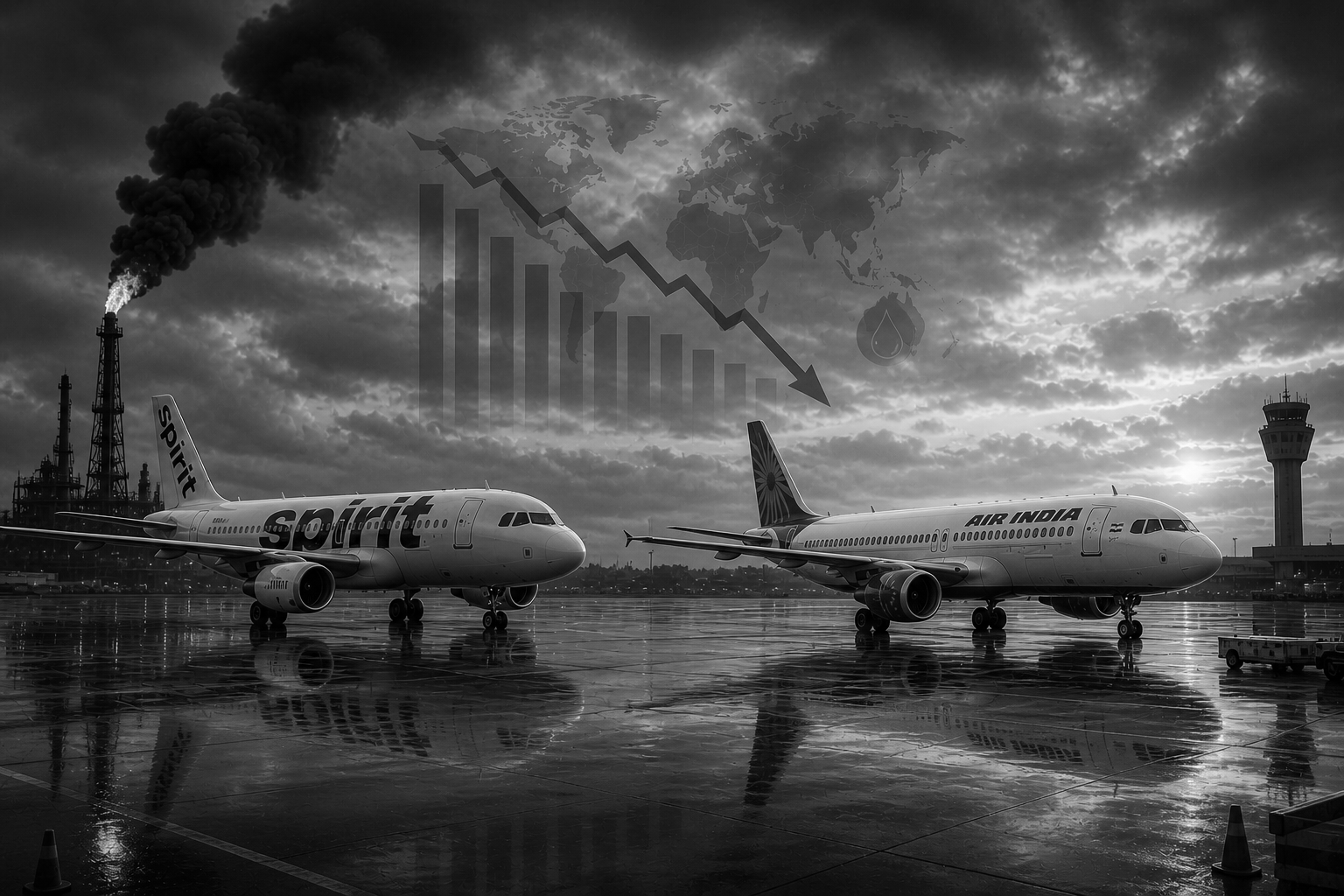
Spirit Airlines Collapse and Air India Cuts Expose Structural Strain in Global Aviation
The shutdown of Spirit Airlines after 34 years marks more than the fall of a single carrier it reflects a widening crisis across global aviation, where surging fuel costs, geopolitical disruptions, and fragile business models are converging to reshape the industry.
Spirit’s abrupt wind-down follows the collapse of a last-minute rescue effort backed by Donald Trump , but its deeper troubles stem from a sharp spike in Aviation Turbine Fuel (ATF) prices. Triggered by the ongoing West Asia conflict , disruptions in key oil supply routes such as the Strait of Hormuz have driven fuel costs sharply higher. For airlines, where fuel accounts for up to 40% of expenses, this surge has proven devastating.
While early signs suggest ATF prices may ease from May , the relief has come too late for Spirit. The airline’s ultra-low-cost model , dependent on thin margins and high passenger volumes, could not withstand the sudden escalation in operating costs. Its financial strain had already deepened after the COVID-19 pandemic , with losses exceeding $2.5 billion and multiple bankruptcy filings leaving it burdened with over $8 billion in debt .
The crisis, however, is not confined to one airline. In India, Air India has also begun cutting international flights through July , highlighting the global nature of the disruption. CEO Campbell Wilson cited a “massive rise in jet fuel prices” , combined with airspace restrictions , which have forced airlines to take longer routes, increasing fuel burn and rendering several routes unprofitable.
Airspace closures linked to the West Asia conflict have significantly altered flight paths, raising operational costs across carriers. Wilson acknowledged the situation remains “extremely challenging” , with no immediate resolution in sight unless geopolitical tensions ease and key transit corridors reopen.
The fallout is already visible. Spirit’s shutdown alone is expected to impact nearly 17,000 employees , according to legal representatives including Marshall Huebner , while its absence in major leisure markets could drive higher airfares and reduce competition. At the same time, Air India is projected to have incurred losses exceeding ₹22,000 crore in FY2026, underscoring the financial strain even on large, full-service carriers.
Beyond immediate disruptions, the crisis signals a structural shift. Rising fuel volatility, longer flight routes, and changing passenger preferences toward premium travel are challenging the sustainability of low-cost carriers worldwide.
Spirit Airlines’ collapse, coupled with operational cutbacks by major players like Air India, highlights a stark reality: even if fuel prices begin to soften , the aviation sector remains deeply vulnerable raising concerns that more airlines could face turbulence ahead if current conditions persist.