
Space Vision 2047: India Expands Space Technology for Development and Exploration
India is pursuing an ambitious Space Vision 2047 aimed at expanding the use of indigenous space technology for national development while building capabilities in human spaceflight, scientific research, navigation, communication and planetary exploration.
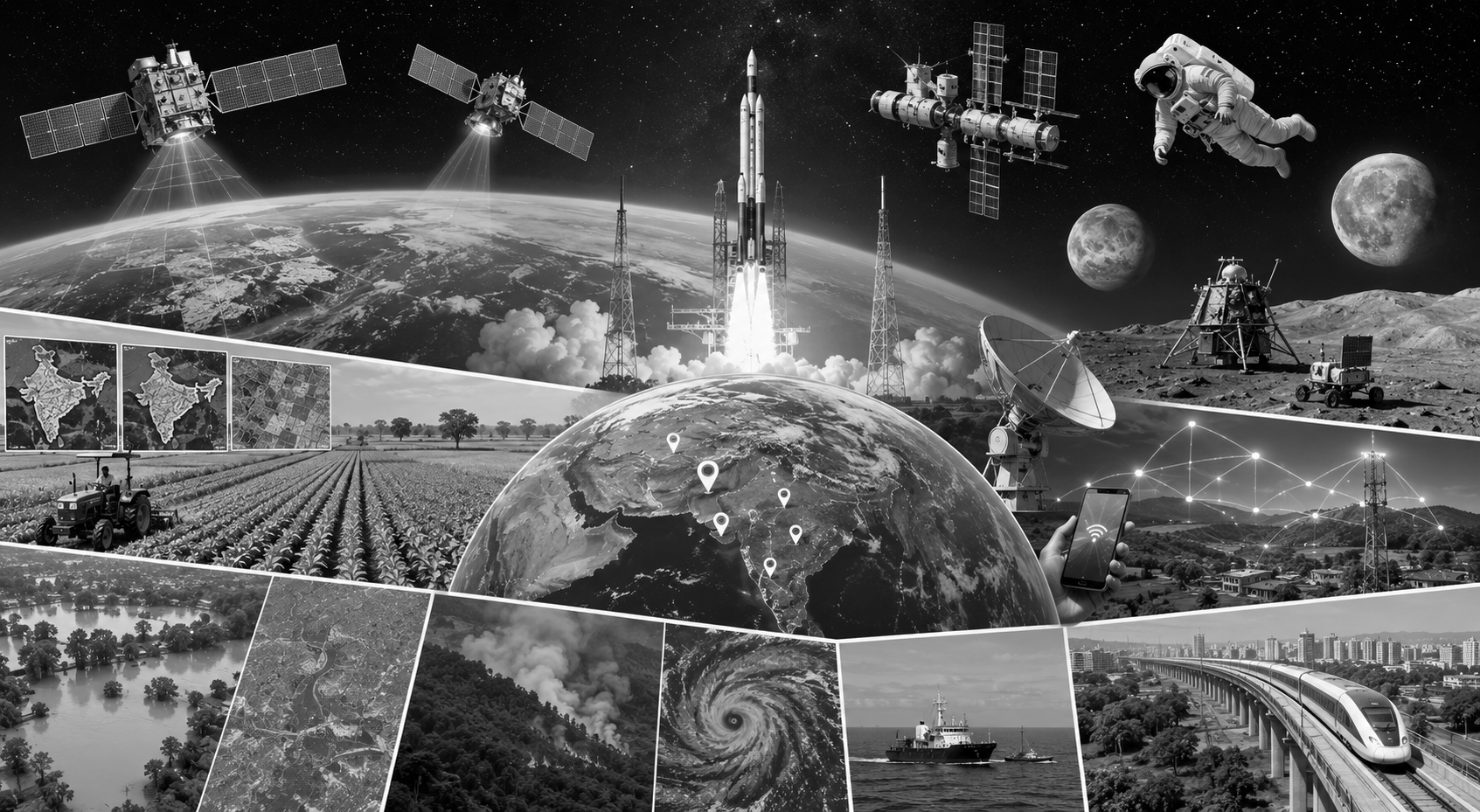
The roadmap envisages making space technology increasingly useful on Earth. ISRO's satellite systems are already being used for agriculture, including crop-area mapping, monitoring of rice, wheat and jute, crop-yield estimation and support for the Pradhan Mantri Fasal Bima Yojana. Earth-observation satellites also provide near-real-time monitoring of floods, landslides, cyclones, forest fires, droughts and Glacial Lake Outburst Floods, with data shared through the BHUVAN and National Database for Emergency Management portals.
Satellite technology is also supporting climate monitoring, rural development, water resources, infrastructure planning and programmes such as MGNREGA, PMGSY and RKVY. Satellite communication is being integrated with initiatives including BharatNet and Digital India, helping extend connectivity and enable applications such as tele-education, telemedicine and disaster management.
The next phase will bring more advanced communication technologies, including Direct-to-Device services, 5G/6G-based Non-Terrestrial Networks, NB-IoT over satellite and multi-orbit broadband systems. India also plans to strengthen NavIC for high-accuracy positioning across transport, aviation, agriculture, maritime operations, defence and smart cities.
Space Vision 2047 also sets major exploration milestones. India plans to establish the Bharatiya Antariksh Station (BAS), with its first module targeted for 2028 and the station expected to become fully operational by 2035. The five-module station is intended to support long-duration human missions and research in areas including life sciences, medicine and advanced technologies.
The roadmap includes Gaganyaan follow-on missions, Chandrayaan-4, Chandrayaan-5/LuPEX, the Next Generation Launch Vehicle (NGLV), a third launch pad and the Venus Orbiter Mission. A crewed Indian lunar mission is envisaged for 2040, while Chandrayaan-4 will develop lunar sample-return capabilities.
The government is simultaneously opening the sector to private companies through the Indian Space Policy 2023, funding and technology-transfer initiatives, strengthening India's space economy and positioning the country for a larger role in the global space industry.
Overall, Space Vision 2047 seeks to turn space technology into a broader engine of development, combining everyday applications on Earth with advanced missions that could take India towards sustained human presence in space and eventual lunar exploration.