
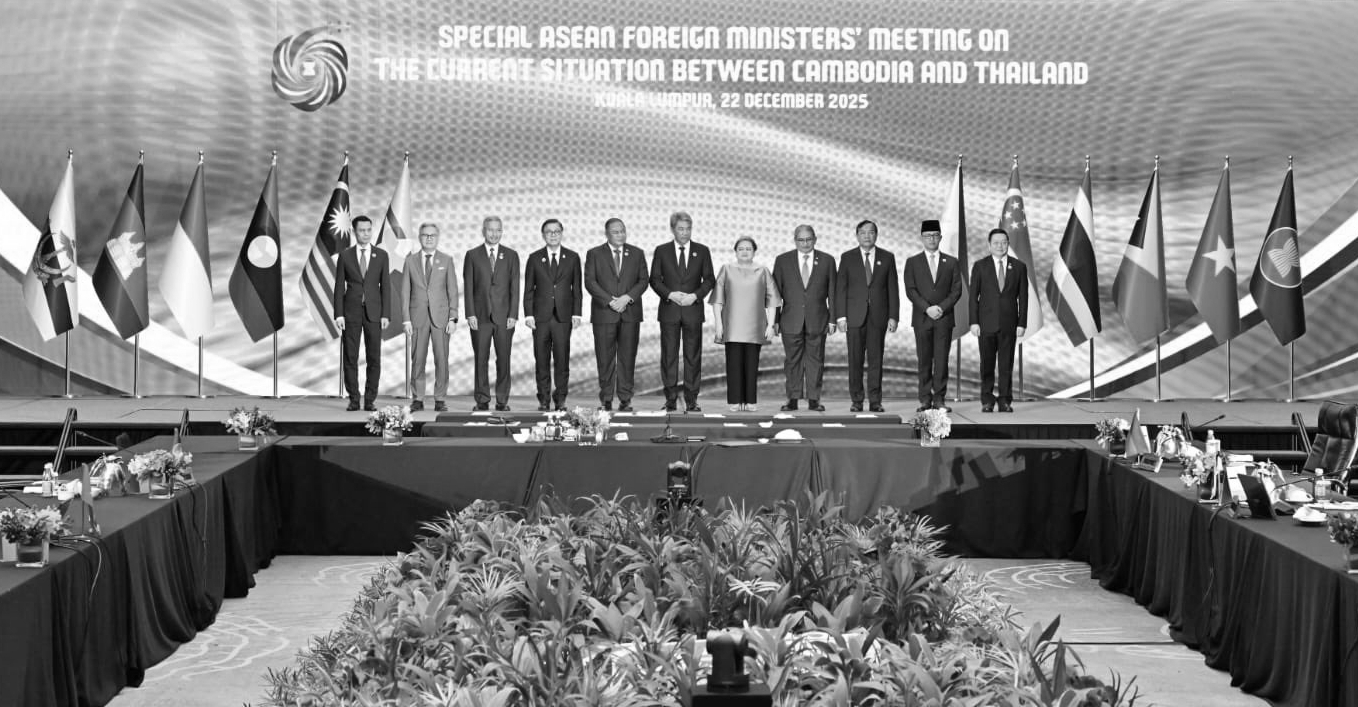
Southeast Asian ministers meet in Malaysia over Thailand–Cambodia border tensions
Foreign ministers from Thailand, Cambodia, Malaysia, Indonesia, Singapore, the Philippines, Brunei, Vietnam, Laos, and Myanmar met in Kuala Lumpur on Monday under the Association of Southeast Asian Nations (ASEAN) framework to address escalating tensions between Thailand and Cambodia following renewed fighting along their disputed border.
The meeting marks the second time this year that ASEAN has been used as a platform to promote de-escalation between Thailand and Cambodia. The first time was during the October 2025 ASEAN summit in Malaysia , where a ceasefire agreement and mechanisms for border management were formalised following clashes in July. This underscores the regional bloc’s role in conflict management through dialogue and consensus rather than enforcement.
The latest clashes have undermined a ceasefire brokered by Malaysia and backed by US President Donald Trump in July, which ended five days of intense combat. That agreement was later formalised with additional provisions at an ASEAN summit in Malaysia in October, attended by Trump. The truce called for the withdrawal of heavy weapons, the removal of landmines, and the release of detained soldiers.
The conflict stems from a long-running territorial dispute along the Thailand–Cambodia border, rooted in colonial-era boundary demarcations, conflicting maps, and unresolved interpretations of past international rulings. Several sections of the border remain un-demarcated, and the issue is compounded by nationalist sentiment and the legacy of landmines left from Cambodia’s decades-long civil war, which ended in 1999.
The current round of violence began on December 8, a day after a border skirmish injured two Thai soldiers. Since then, fighting has erupted on multiple fronts, with Thailand conducting airstrikes using F-16 fighter jets and Cambodia launching thousands of BM-21 rockets from truck-mounted systems capable of firing salvos of up to 40 rockets. Officials on both sides say more than two dozen people have been killed in the past week, while over 500,000 civilians have been displaced.
The escalation has drawn international concern. The US Department of State on Sunday urged both countries to end hostilities, withdraw heavy weapons, halt the emplacement of landmines, and fully implement the Kuala Lumpur Peace Accords, including provisions for humanitarian demining and mechanisms to address border disputes.
Thai Foreign Minister Sihasak Phuangketkeow said he spoke with US Secretary of State Marco Rubio and reaffirmed Thailand’s commitment to working towards a ceasefire. He added that Bangkok would engage constructively at the ASEAN meeting in Kuala Lumpur.
Cambodia’s Foreign Minister Prak Sokhonn also plans to attend the talks, with Phnom Penh reiterating its position that differences should be resolved through peaceful means, dialogue, and diplomacy.
Landmines have emerged as a particularly sensitive issue. Thailand has lodged protests alleging that Cambodia recently laid new anti-personnel mines, accusations Phnom Penh has denied, saying the explosives are remnants of past conflicts. The Thai navy said on Sunday that one of its marines suffered serious injuries after stepping on a landmine and claimed to have discovered abandoned weapons and explosive ordnance in what it described as a former Cambodian stronghold.
Thailand said it would raise the matter with Cambodia and Zambia, the current chair of the Anti-Personnel Mine Ban Convention (Ottawa Convention), citing concerns over alleged violations. Although Zambia is an African country, it holds the rotating chairmanship of the convention, giving it a leadership role in addressing compliance and facilitating action. Cambodia has not yet responded to the latest claims.
ASEAN officials say the Kuala Lumpur meeting aims to prevent further escalation, restore confidence between the two sides, and encourage adherence to agreed ceasefire commitments, even as deep-rooted border disagreements continue to challenge lasting peace.