
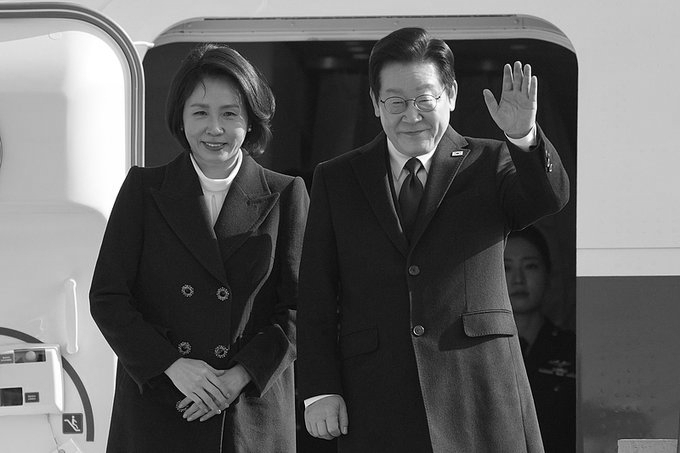
South Korean president Lee Jae-myung begins four-day state visit to China, reaffirms One China policy
South Korean president Lee Jae Myung began a four-day visit to China on Sunday at the invitation of Chinese president Xi Jinping , marking his first trip to Beijing since taking office in June and the first by a South Korean leader in over six years . The visit comes amid heightened tensions between China and Japan over Taiwan and efforts to stabilise ties with Seoul, China’s largest trading partner. Lee reaffirmed South Korea’s consistent respect for the One China policy , highlighting his government’s commitment to Beijing while pursuing closer diplomatic and economic engagement. Bilateral trade between the two countries stands at around 307 billion dollars annually, nearly one fifth of South Korea’s total trade, underlining the economic stakes of the visit.
Lee arrived with first lady Kim Hye Kyung and a large delegation of officials and business leaders, reflecting the administration’s focus on diplomacy and economic engagement.The trip follows Lee’s November summit with Xi in Beijing, a preparatory meeting that laid the groundwork for this full four-day state visit, making this their second encounter in two months and signalling an accelerated effort to reset strained relations. Ahead of the visit, Lee gave an interview to China’s state broadcaster CCTV from Seoul’s Cheong Wa Dae, stressing that the visit aims to minimise past misunderstandings and elevate bilateral ties, while praising Xi as a reliable neighbour .
His remarks come amid recent Chinese military drills around Taiwan, Beijing’s anger over planned US arms sales, and rising regional tensions after Japanese prime minister Sanae Takaichi suggested Japan’s military could intervene if China were to act against Taiwan. Trade remains central to the visit . South Korea exports mainly semiconductors, petrochemicals, refined petroleum, display panels, machinery, automobile parts, steel, and battery materials for electric vehicles. China exports electronic components, telecommunications equipment, industrial machinery, intermediate goods, consumer goods, textiles, chemicals, and rare earth materials crucial for South Korea’s tech and green energy industries. Both governments are also seeking to expand cooperation in services and emerging sectors such as tourism, digital trade, AI, green energy, electric vehicles, supply chains, and cultural industries like entertainment and gaming.
Security on the Korean Peninsula is another key focus. South Korea is seeking China’s support to curb North Korea’s nuclear ambitions without framing it as a demand. Beijing, North Korea’s main ally and economic lifeline, is expected to encourage restraint and dialogue while avoiding actions that could destabilise the North or increase US influence nearby. China is likely to take a pragmatic approach to South Korea’s US alliance, accepting it while quietly seeking assurances that Seoul will not fully align with US strategies perceived as targeting China. South Korea emphasises that its US cooperation is defensive and not aimed at confrontation with Beijing.
The visit’s schedule outlines concrete steps for both sides. On Monday , Lee will hold a summit with Xi Jinping to discuss security, trade, technology, and regional stability, followed by meetings with Zhao Leji, chairman of China’s National People’s Congress, and Premier Li Qiang. On Tuesday , Lee is set to attend a Korea-China economic forum and later travel to Shanghai to participate in a venture and startup summit promoting collaboration between young entrepreneurs. Cultural visits to historical sites highlighting shared Korea-China history are also planned. On Wednesday and Thursday , Lee will finalise agreements, review progress on MOUs in technology, trade, and green energy, and prepare joint statements emphasising cooperation, peaceful dialogue on the Korean Peninsula, and strengthened economic relations.
If successful, the talks will give South Korea diplomatic breathing space, stabilise ties with China, protect economic interests, and maintain its alliance with the United States. China gains deeper economic engagement and keeps Seoul from drifting fully into the US camp. Rather than dramatic breakthroughs, the visit is designed to reduce risks, calm regional tensions, and secure practical outcomes benefiting citizens in both countries while keeping channels open on North Korea and broader security issues.