
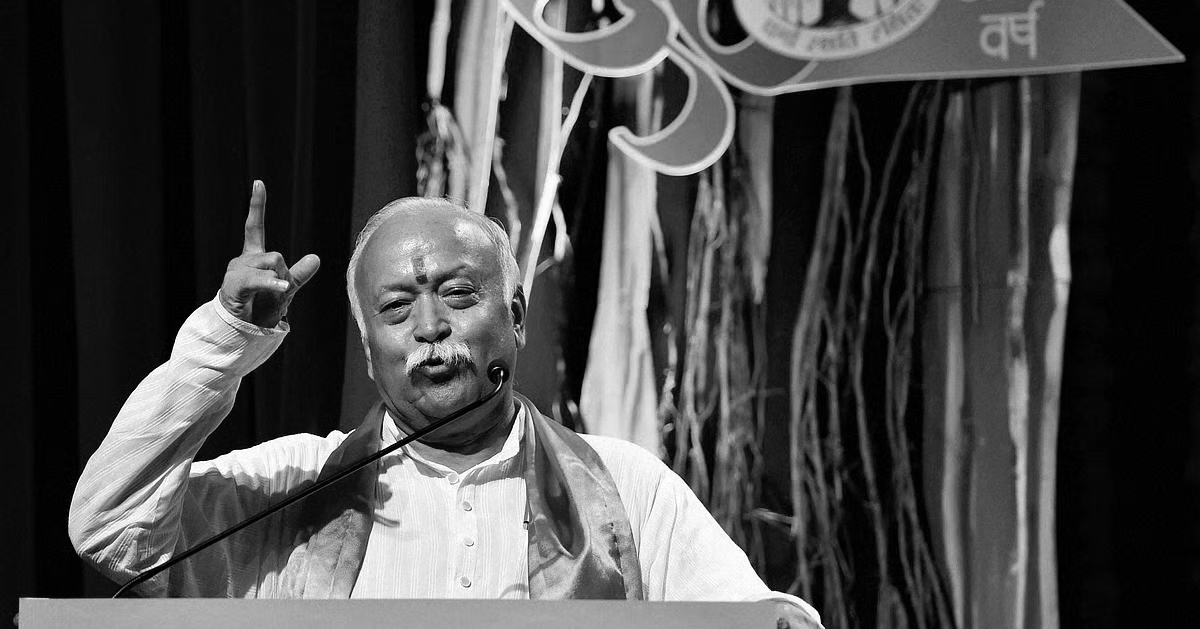
Some Bharatiya people don’t know their own languages: RSS chief Bhagwat
Rashtriya Swayamsevak Sangh (RSS) chief Mohan Bhagwat on Sunday voiced concern over the declining use of Indian languages, remarking that the situation has reached a point where “some Bharatiya people do not know our own languages.”
He was speaking at the launch of the English translation of Shri Dnyaneshwari, originally composed in Marathi by Sant Dnyaneshwar, where he urged society to reflect on the gradual erosion of linguistic and cultural roots. The newly released translation brings to a wider readership one of the most revered commentaries on the Bhagavad Gita, known for presenting complex spiritual concepts in language accessible to common people.
Bhagwat said India once witnessed a time when communication, learning and daily life were conducted in Sanskrit. He noted, however, that the language is now being taught abroad by foreign scholars, while many Indian children struggle with basic vocabulary in their mother tongues. Increasing use of a hybrid mix of English and native languages at home, he said, has contributed significantly to the weakening of fluency in Indian languages.
He clarified that English-medium education was not to blame. Instead, he attributed the shift to the declining practice of speaking Indian languages within families. Even seers, he said, are increasingly turning to English to connect with younger audiences a trend he described as understandable but reflective of changing linguistic preferences.
Emphasising the richness of Indian languages, Bhagwat said many cultural and spiritual ideas do not translate fully into English. He cited the example of Kalpavruksha, the mythological wish-fulfilling tree, noting that such concepts lose depth when expressed without their native cultural context. He referred to Sant Dnyaneshwar’s decision to compose Dnyaneshwari in Marathi as a reminder of how knowledge becomes meaningful when conveyed in familiar language.
Bhagwat also highlighted the Indian philosophical tradition of unity in diversity, observing that the Bhagavad Gita integrates both knowledge and action rather than placing one above the other. “Like a bird that cannot fly without two wings, we need both knowledge and karma and faith is the bird itself,” he said.
He stressed the need to translate ancient texts into English to make them available to global readers, while expressing hope that such translations would encourage more people to read the original works. Despite differences in languages, customs, food habits and sects, he said, India’s spiritual traditions emphasise interconnectedness, a concept increasingly being acknowledged by modern science as well.
Bhagwat concluded by urging families, institutions and society at large to revive the use of Indian languages in daily life, saying this was essential to preserving the cultural identity and philosophical depth that form the foundation of India’s civilisational heritage.