
Smart Cities Mission: 31 Cities Done, 43 Near Completion, RTI Shows
Nearly a decade after its launch, the Centre’s Smart Cities Mission has delivered visible urban transformation in 31 cities , while projects in 43 others are nearing completion , according to a recent RTI response from the Ministry of Housing and Urban Affairs . The reply highlights both the scale of progress achieved and the uneven pace of implementation across the country, with work in the remaining 26 cities still ongoing.
Launched in 2015–16 , the Smart Cities Mission was conceived as a flagship urban renewal programme aimed at improving the quality of life, infrastructure efficiency and sustainability in 100 selected cities. Unlike traditional city-wide redevelopment, the Mission focused on area-based development, targeting specific zones within cities for intensive upgrades that could later be replicated elsewhere. The approach sought to modernise cities without large-scale demolition, blending technology with existing urban fabric.
On the ground, the Mission has brought about tangible changes in urban management and civic services. Cities have implemented Integrated Command and Control Centres to monitor traffic, utilities, public safety and emergency response in real time. Improvements have been recorded in water supply systems, smart roads, intelligent traffic management, underground cabling, LED street lighting, solid waste management, and digital delivery of civic services. Public spaces such as parks, lakefronts, pedestrian zones and heritage precincts have also been redeveloped, improving liveability and urban aesthetics.
Urban mobility has been a key focus, with several cities developing smart roads, cycling tracks, electric vehicle infrastructure and modern bus systems to reduce congestion and promote sustainable transport. Public safety measures, including extensive CCTV surveillance and emergency response networks, have strengthened law enforcement and disaster management capabilities. In education and healthcare, cities have introduced smart classrooms, digital libraries and e-health centres, expanding access to essential services.
The Mission’s history reflects its ambitious scale. Cities were selected in four phases between 2016 and 2018, with an initial completion target of 2021. However, the deadline was extended multiple times first to June 2023, then to June 30, 2024, and finally to March 31, 2025 due to the complexity of projects, funding cycles and disruptions such as the COVID-19 pandemic.
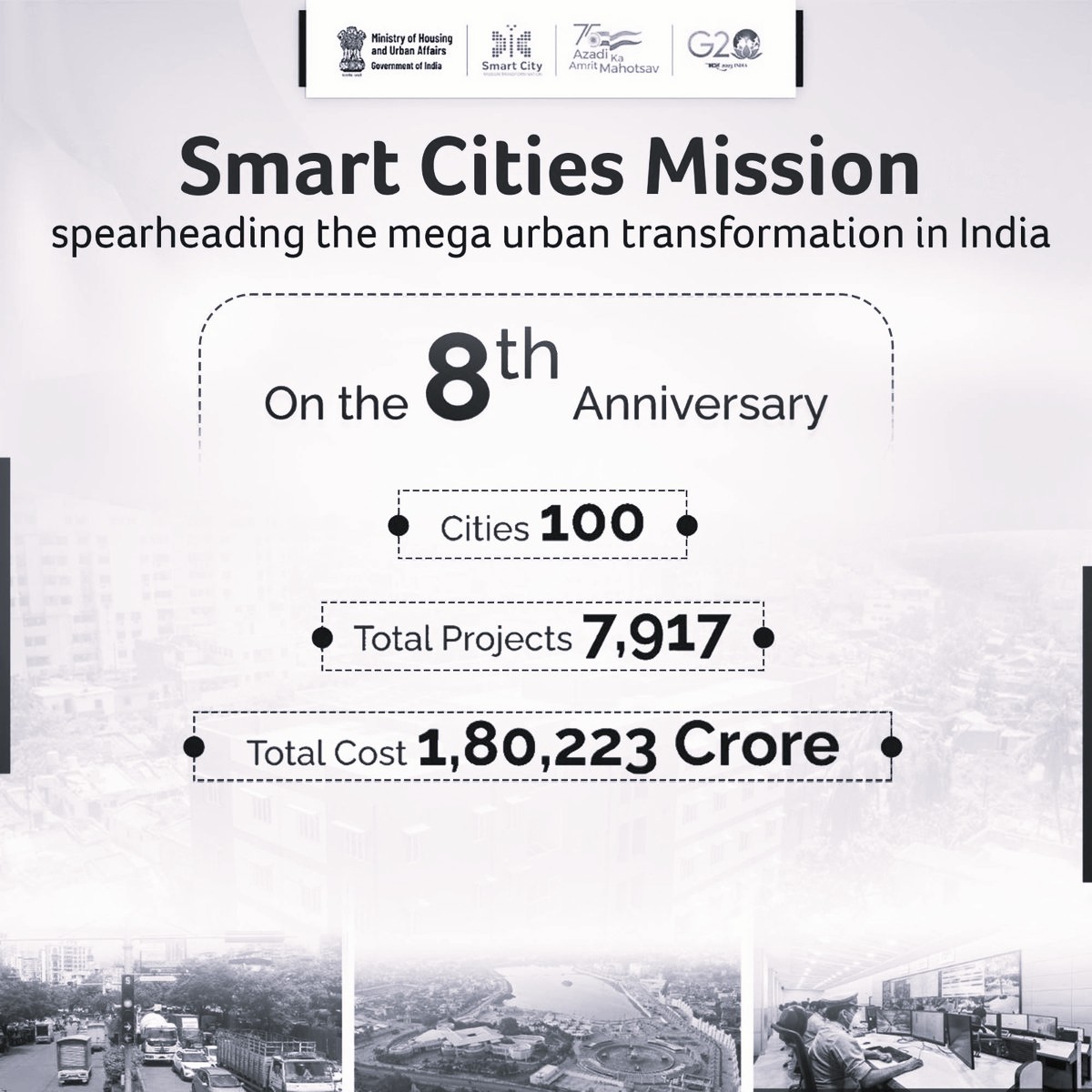
According to official data, 8,067 projects accounting for about 94 per cent of the total sanctioned works have been completed across all 100 cities, involving an investment of around ₹1.64 lakh crore . Of these, 31 cities have been declared fully transformed, with cumulative spending of ₹59,385 crore . Cities such as Indore, Surat, Varanasi, Bhopal and Rajkot have emerged as major beneficiaries, recording high project completion rates and substantial investments in urban infrastructure.
Despite these achievements, the RTI reply underscores continuing challenges. Progress has varied significantly across regions, with delays reported in several cities due to administrative bottlenecks, land issues and implementation hurdles. While 43 cities are close to completing their projects, work in 26 cities, including Port Blair, Kakinada, Tirupati and Srinagar, is expected to take additional time.
As the Mission approaches its extended deadline, urban experts note that its long-term success will depend not only on project completion but also on maintenance, institutional capacity and sustained funding. Even so, the Smart Cities Mission has reshaped India’s urban development discourse, setting new benchmarks for technology-driven governance and citizen-centric planning.