
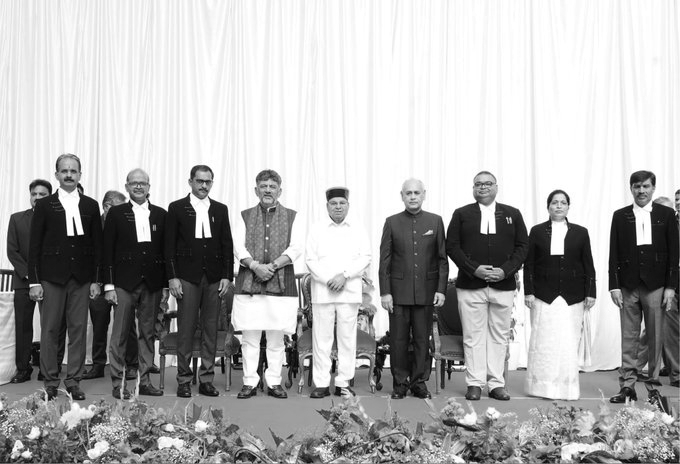
Six New Additional Judges Take Oath at Karnataka High Court, Bench Strength Rises to 54
The Karnataka High Court's working strength rose to 54 judges on Sunday after six newly appointed additional judges took oath at the Glass House of Lok Bhavan in Bengaluru, providing an immediate boost to the court's capacity to handle its caseload.
Governor Thaawarchand Gehlot administered the oath to Raghavendra Seetharam Srivatsa, Hema Kulkarni, Subramanya Rangarao, Thadagavadi Prakash Vivekananda, Bakkeswara Pramod and Hombe Gowda Shanthi Bhushan. Chief Minister D K Shivakumar and High Court Chief Justice Vibhu Bakhru attended the ceremony, along with other judges, advocates, senior officials and dignitaries.
The appointments follow the Supreme Court Collegium's recommendation of the six advocates on June 2, 2026, followed by the Centre's notification of their appointment as additional judges.
Their induction takes the court's working strength from 48 to 54, against a sanctioned strength of 62, leaving eight vacancies. The appointments are also part of a wider judicial-strengthening exercise in which the Centre recently notified 30 judges and additional judges across four High Courts, including six for Karnataka.
But why additional judges when permanent vacancies already exist? The distinction lies in the Constitution. Article 224 allows High Courts to appoint additional judges for a specified period, not exceeding two years, particularly to address a temporary rise in workload or a backlog of cases. Article 217, meanwhile, governs permanent High Court appointments.
During their tenure, the six additional judges exercise the same judicial powers as other High Court judges. Their appointment does not automatically become permanent after two years. They can, however, be considered for permanent appointment through the prescribed process involving the Supreme Court Collegium, government procedures and the President.
Thus, the eight existing vacancies do not automatically convert these six appointments into permanent positions. If the judges are subsequently appointed permanently, they could continue beyond their additional-judge tenure.
For now, their elevation strengthens the bench immediately while leaving open the possibility of a longer-term expansion of Karnataka's permanent judicial strength.