
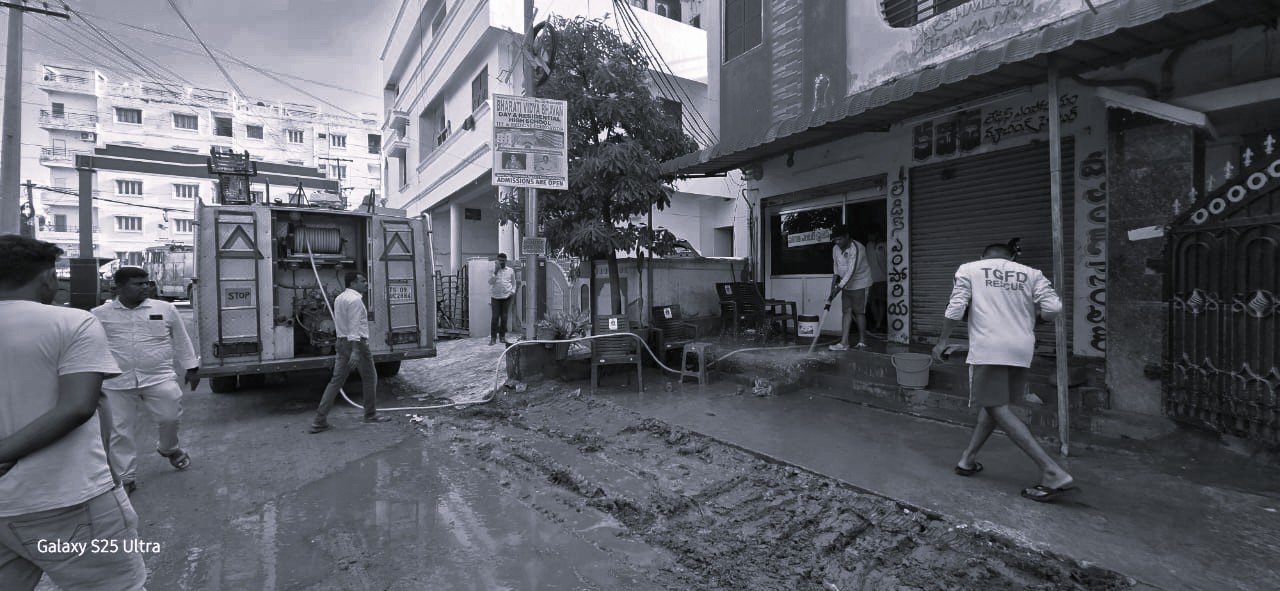
Six fire engines deployed as Hanumakonda district races to restore flood-hit areas
The district administration has intensified restoration work in several colonies of Hanumakonda that were heavily inundated due to the recent unexpected heavy rains. With large volumes of slush and mud blocking roads, homes, schools and public spaces, district officials are continuing emergency operations on priority to make affected localities habitable again. Acting on the directions of District Collector Sneha Sabharish, special teams have been deployed across Sammayya Nagar, Amaravathi Nagar, Jawahar Nagar, Gopalapur and other affected residential pockets. Fire department personnel have been working continuously since Saturday morning.
Rapid response teams deployed
Around six fire engines have been pressed into service for high-pressure flushing, while nearly 30 fire personnel under the supervision of District Fire Officer Sudarshan Reddy are engaged in slush removal. Officials said that severe mud accumulation inside houses and civic facilities has made it difficult for residents to return. The Greater Warangal Municipal Corporation is directly supervising the relief measures. Fire engines from Warangal, Parakala, Vardhannapet and Narsampet have been moved to support the operations. Slush water is being flushed into existing drainage channels while solid material is being transported in municipal tractors and dumpers to dumping yards.
Background & Context
In the last three years, the Warangal-Hanumakonda region has been repeatedly affected by intense rainfall episodes during retreating monsoon phases. Disaster management experts have been flagging this as a pattern linked to extreme rainfall events driven by climate variability. Urban expansion without proportional storm-water drainage upgrades has made low-lying colonies extremely vulnerable. According to local municipal officials, more than 25 colonies in this region have reported recurrent localized flooding in the last five monsoons.
After the Telangana urban flooding episodes in 2020 and 2022, the State Disaster Response and Fire Services Department has adopted a “multi-engine deployment protocol” where rapid fire flushing teams are mobilised first to prevent vector breeding and fast-track public mobility restoration. Hanumakonda is among the districts where this model is now being actively executed.
Residents get partial relief, recovery may take days
Officials said it would take another three to four days for all mud clearance work to be completed, after which normal traffic movement and educational institutions are expected to resume without major disruption. The administration is coordinating with health, sanitation and engineering wings to ensure there is no secondary health impact post-flooding. District officials said the first priority is to make public spaces livable, restore basic access and prevent waterlogging-based health risks. Residents expressed relief as visible cleanup began, though they said preventing repeat flooding must now become a long-term policy focus.