
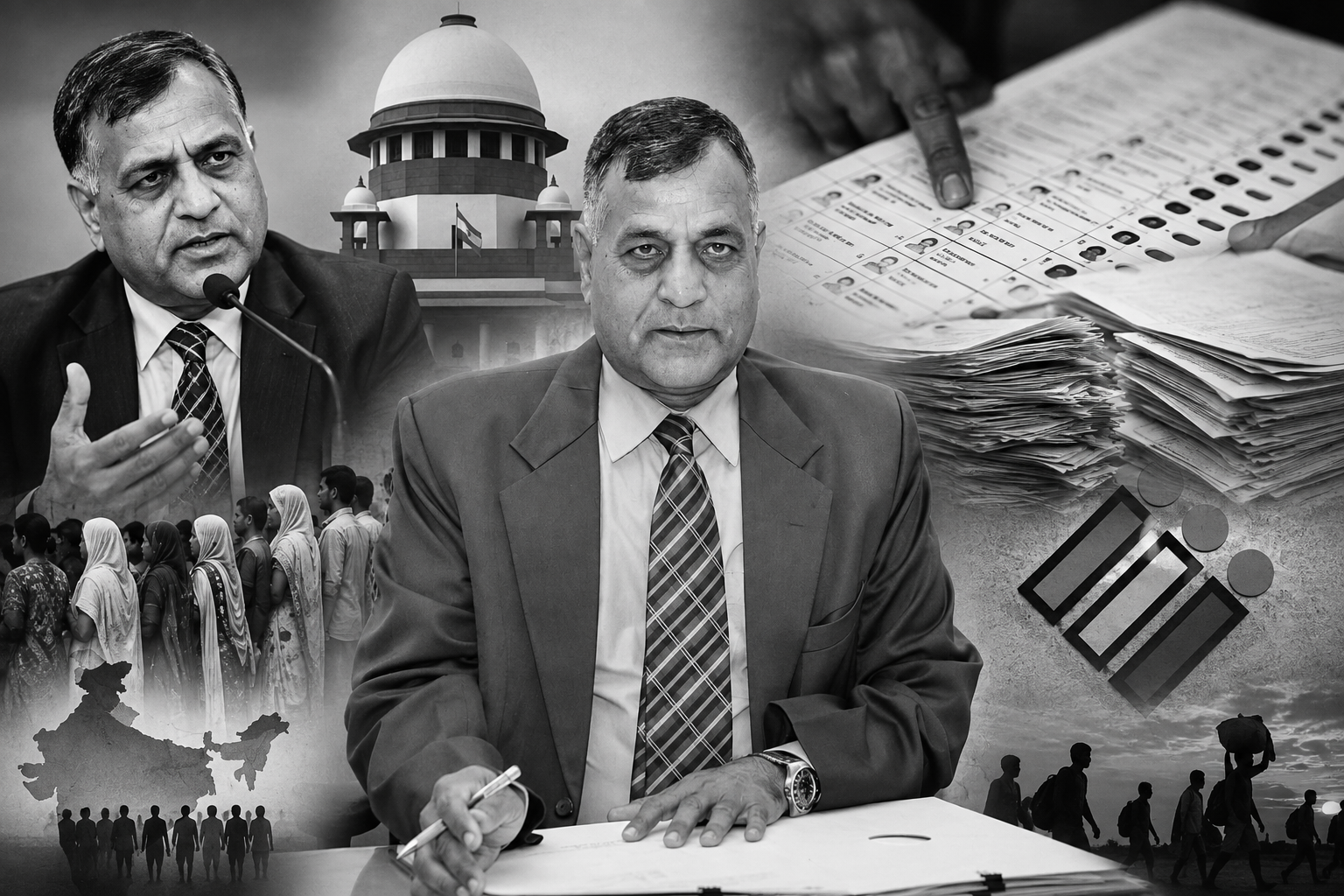
SIR Is Legal but ‘Not Fair’, Says Former Election Commissioner Ashok Lavasa
Former Election Commissioner Ashok Lavasa has raised serious questions over the fairness of the Election Commission’s ongoing Special Intensive Revision (SIR) of electoral rolls, arguing that the fact that an exercise is legally permissible does not automatically make it just or fair.
Speaking on Thursday, September 3, at the Prof. Jagdeep Singh Chhokar Memorial Lecture organised by the Association for Democratic Reforms (ADR) in New Delhi, Lavasa said the central issue was whether SIR, while legally authorised, was fair to millions of citizens. “Of course it is legal. But is it fair? That is the question. Because that is what justice is all about,” he said.
Lavasa argued that constitutional bodies, statutory institutions and governments must uphold not only the letter of the law but also its spirit. Describing SIR as an “unfair procedure” imposed on millions, he warned against a “might is right” approach and said justice required institutions to consider the consequences of their actions.
His remarks come amid a nationwide expansion of SIR following the exercise in Bihar, where the Election Commission cited deceased voters, migration, duplicate entries and other discrepancies as reasons for comprehensive verification. The ECI invoked Article 324 of the Constitution and Section 21(3) of the Representation of the People Act, 1950, while the Supreme Court on May 27, 2026, upheld the Commission’s authority to conduct the Bihar revision.
Lavasa questioned the rationale behind around 13 crore names being excluded from draft electoral rolls across states and Union Territories. The figure, however, represents draft-stage exclusions and should not be treated as 13 crore permanent deletions. Names classified as deceased, shifted, absent or duplicated can be restored through the claims-and-objections process.
The scale has nevertheless triggered concerns over whether genuine voters can easily challenge exclusions. In Delhi alone, around 47.58 lakh names were reportedly excluded from the draft roll, while substantial exclusions have also been reported in Maharashtra and Odisha.
Another contentious issue is documentation. During the Bihar proceedings, the Supreme Court allowed Aadhaar to be considered as an additional identity document while clarifying that it is not proof of citizenship.
The ECI has also cited the identification of alleged nationals from Bangladesh, Nepal and Myanmar, while opposition parties have accused the exercise of targeting voters politically. Those allegations remain disputed.
Lavasa warned that with around 33% of people not voting, a cumbersome revision could further “disenchant” citizens with democracy. The broader test, therefore, is whether SIR can improve electoral accuracy without excluding genuine voters —making fairness, transparency and accessible remedies as important as the legality of the exercise.