
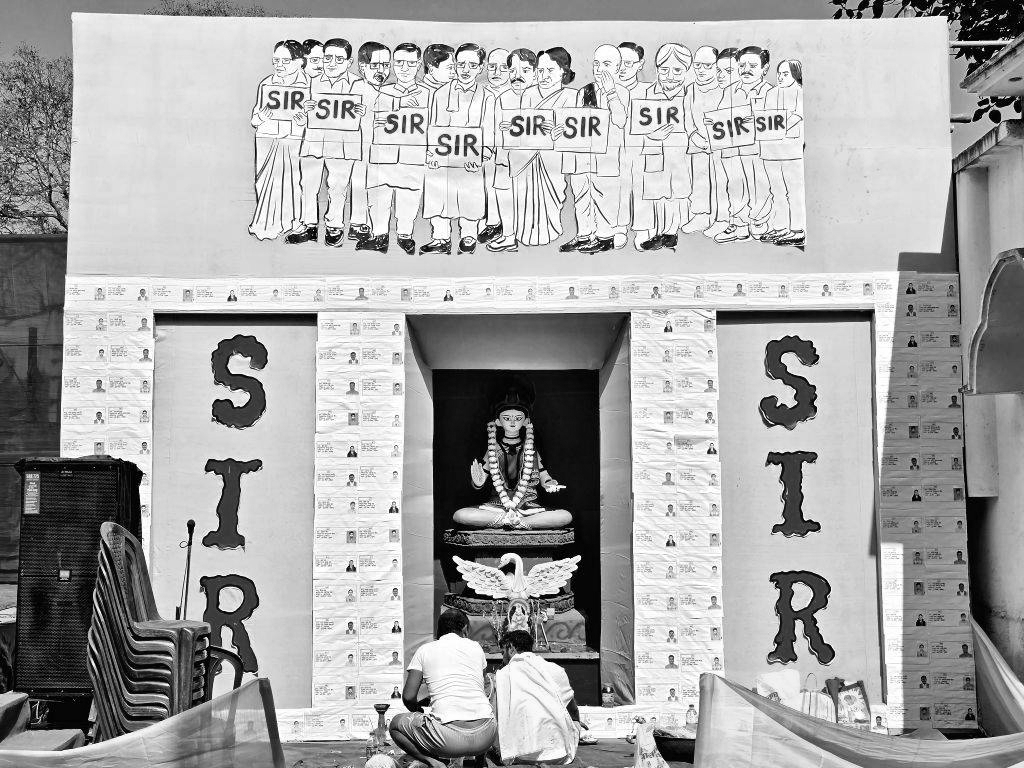
SIR finds its way into Saraswati Puja pandals as Puja theme
What began as a routine administrative exercise has evolved into one of the most contentious political issues in West Bengal ahead of the 2026 Assembly elections . The Special Intensive Revision (SIR) of electoral rolls ordered by the Election Commission of India has triggered protests and sharp political polarisation across the state.
Unlike annual revisions, SIR is an intensive, door-to-door verification exercise aimed at cleaning electoral rolls by removing duplicate, shifted, deceased or ineligible voters while updating genuine entries. In West Bengal, the process formally entered its critical phase in December 2025 , when the draft electoral rolls were published.
The numbers immediately drew attention. The draft rolls showed the deletion of nearly 58 lakh names , reducing the electorate from around 7.66 crore to 7.08 crore voters . Election officials clarified that these deletions were provisional , subject to claims, objections and hearings , and that eligible voters could seek restoration by submitting documents. Still, the scale of the deletions fuelled anxiety and political mobilisation.
Operationally, the exercise has been massive. Nearly 79,000 Booth-Level Officers (BLOs) were deployed across roughly 80,600 polling booths , conducting house-to-house enumeration , distributing fresh forms to all electors , and digitising records. The SIR has also pushed high digital integration , including QR-based document uploads, online voter status checks and real-time monitoring dashboards initiatives rarely used so extensively in earlier revisions.
Politically, the fault lines are stark. The ruling All India Trinamool Congress (TMC) has framed SIR as a threat to voter enfranchisement , with Chief Minister Mamata Banerjee alleging that crores of legitimate voters risk exclusion. The opposition Bharatiya Janata Party (BJP) , meanwhile, argues the revision is necessary to ensure electoral integrity and remove illegal entries.
Beyond party politics, the process has seeped into everyday life. Student protests, most notably at Ballygunge Science College , transformed Saraswati Puja pandals into visual critiques of SIR, depicting fear, documentation anxiety and erasure. Elsewhere, including Behala , rival student groups clashed over politicised celebrations, forcing police intervention and highlighting how deeply the issue has entered youth and cultural spaces.
The unrest prompted further institutional intervention. Following a Supreme Court direction in January , the Election Commission instructed district officials to adjourn hearings if violence occurs and register FIRs against those disrupting the process underlining concerns over law and order during revisions.
As West Bengal inches closer to a high-stakes election, SIR has moved far beyond a technical exercise . For the Commission, it is about accuracy. For political parties, it is about numbers. For citizens and students, it has become a question of identity, anxiety and the right to vote . In Bengal’s charged political landscape, even the electoral roll has become a site of contest.