
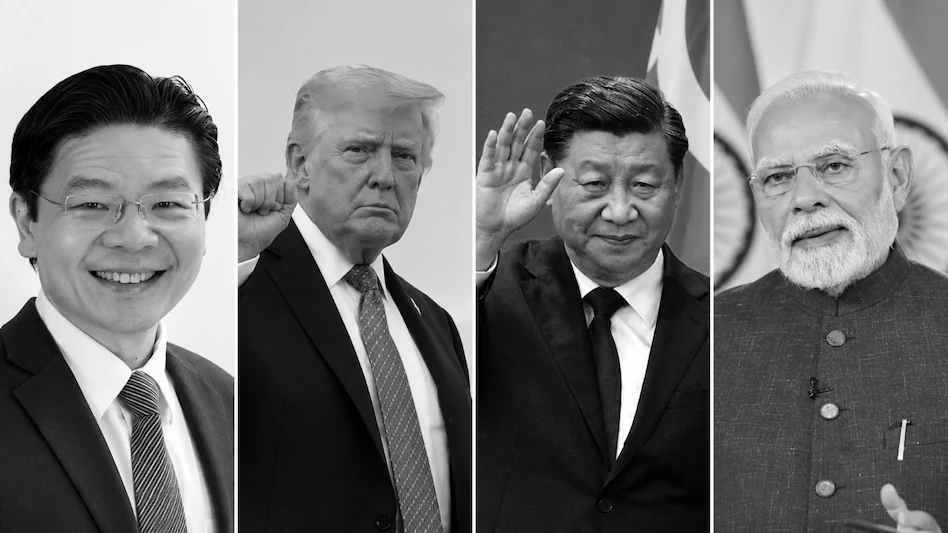
Singapore PM Lawrence Wong Gets 64% Pay Hike: How Does His Salary Compare With Modi, Trump And Xi?
Singapore Prime Minister Lawrence Wong is set to receive a 64% increase in his annual pay, taking his benchmark salary to S$3.6 million, or about US$2.85 million (roughly Rs 26.9 crore), from October 15. The increase is expected to make him the world’s highest-paid political leader by a wide margin.
Wong’s current annual salary is S$2.2 million. The revised framework follows an independent review of Singapore’s political salaries, which had remained unchanged for 15 years. The government said the changes are intended to keep political remuneration competitive and help attract capable people into public service.
However, there is an important distinction between the new benchmark and the immediate pay increase. The S$3.6 million figure is the revised Prime Minister’s salary under the framework, calculated at twice the MR4 ministerial benchmark of S$1.8 million. Existing ministers will not immediately be moved to the new benchmark. Instead, they will receive a one-off increase of up to 9%, depending on performance and responsibilities.
Wong has also said he will donate the full increase in his own salary to good causes for five years, assuming he remains prime minister. He said political salaries are a sensitive and emotional issue, but argued that Singapore needs to ensure it can continue attracting high-calibre leaders.
Singapore’s government has long defended its unusually high political salaries, saying they are designed to attract talent from the private sector and senior civil service while maintaining high standards of governance and integrity. The revised system also links parts of ministerial remuneration to national economic and social indicators.
The gap with other major political leaders is striking. Hong Kong Chief Executive John Lee earns about US$719,000 a year, while Swiss President Guy Parmelin receives around US$606,000. Hong Kong is a special administrative region of China, so the comparison is not directly equivalent to that of sovereign heads of government.
US President Donald Trump receives US$400,000 annually, a presidential salary that has remained unchanged since 1999. Wong’s new annual package will therefore be roughly seven times Trump’s presidential salary.
In the UK, Prime Minister Andy Burnham is reported to earn around US$230,000 annually, putting his remuneration far below Wong’s revised package.
China offers an even sharper contrast. President Xi Jinping’s official basic annual salary is reported at roughly US$22,000, based on a 2015 pay revision that raised his monthly salary to 11,385 yuan. The figure is only his official salary and does not represent other state-provided facilities or resources.
In India, Prime Minister Narendra Modi earns about Rs 1.66 lakh a month, or approximately Rs 20 lakh a year, according to reported salary details. His pay includes a basic salary of Rs 50,000, along with various allowances. He also receives official accommodation, security and other facilities associated with the office.
That means Wong’s revised annual salary of roughly Rs 26.9 crore would be more than 130 times Modi’s reported annual salary. The comparison, however, should be treated carefully because countries structure political compensation differently, with some providing extensive official facilities and benefits separately from salary.