
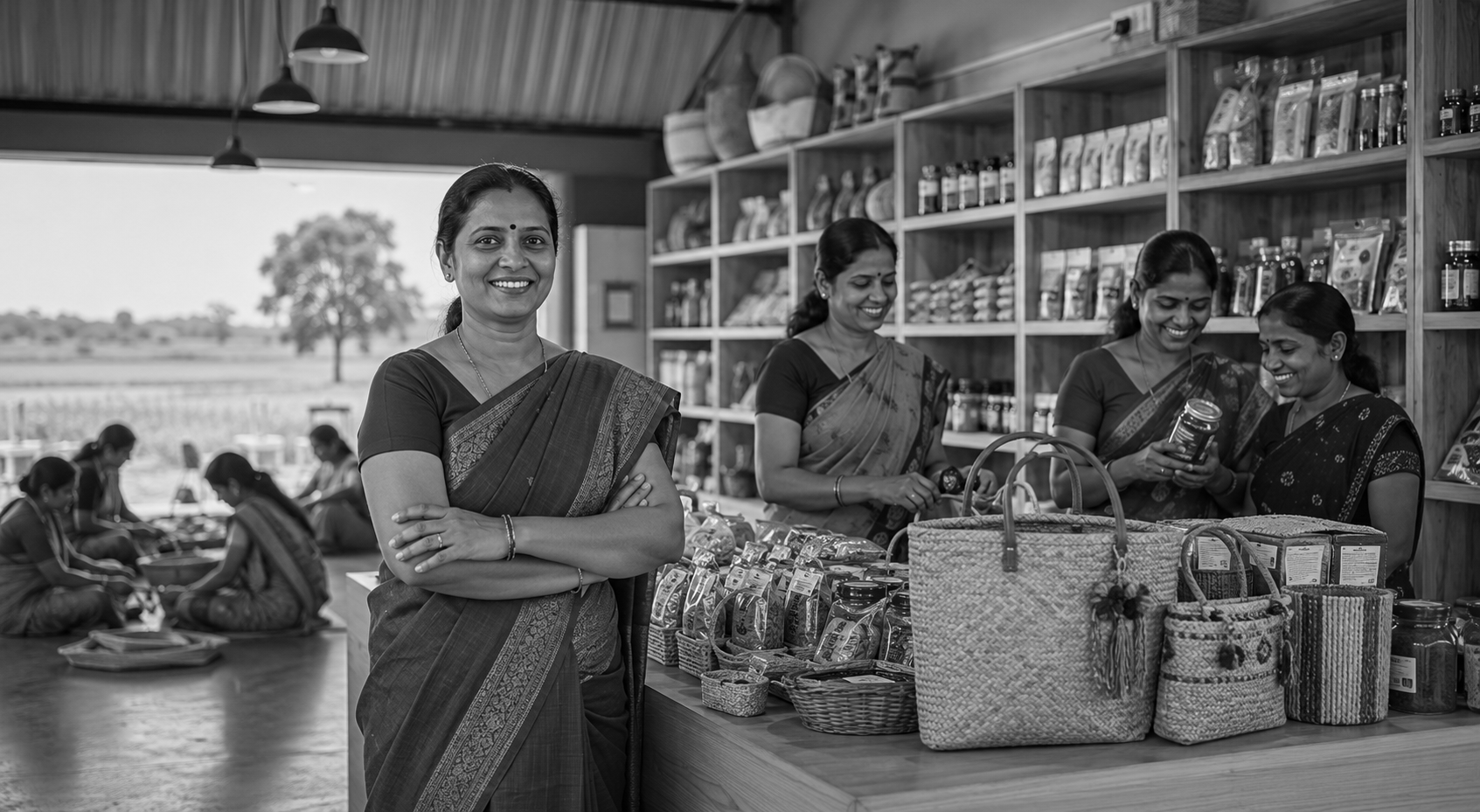
SHE-MARTs and the New Rural Economy: Women Driving India’s Market Transformation
For nearly three decades, India’s rural women-led Self-Help Group (SHG) movement has been celebrated as one of the country’s most successful social and financial inclusion experiments. Millions of women who once had little access to banking, credit, or independent income gradually entered local economic systems through collective savings, microfinance, and small livelihood activities.
But while the SHG revolution transformed rural participation in finance, one challenge remained unresolved markets .
Women could produce pickles, handicrafts, millet snacks, textiles, bamboo products, forest goods, and processed foods, but selling those products at scale remained a struggle. Many depended on local weekly markets, temporary government fairs, or middlemen who often dictated prices and profits.
Now, the Union Government believes it has found the next phase of that transformation.
Through the newly proposed SHE-MART initiative Self Help Entrepreneurs-Marketing Avenues for Rural Transformation the Centre is attempting to move rural women from the margins of local production into the mainstream of organized retail, branding, aggregation, and enterprise ownership.
Announced in the Union Budget 2026–27 and now under active policy formulation, SHE-MARTs are being projected as a major evolution of India’s SHG ecosystem under the Deendayal Antyodaya Yojana–National Rural Livelihoods Mission (DAY-NRLM) .
More than another welfare scheme, policymakers increasingly see SHE-MARTs as a blueprint for building a women-led rural market economy .
A New Phase in India’s SHG Journey
The Ministry of Rural Development recently held a two-day national consultation in Bhubaneswar, Odisha, to finalize operational guidelines for the programme. The event brought together senior officials from State Rural Livelihood Missions, representatives from NABARD , financial institutions, development practitioners, and sector experts to discuss the architecture of the initiative.
The discussions reflected a clear shift in policy thinking.
Traditional SHGs were largely designed around savings, microcredit, and livelihood promotion. Women borrowed small amounts to start activities like tailoring, dairy farming, poultry, handicrafts, or food processing. The model improved financial inclusion and created localized income opportunities, but rarely enabled women to control the larger value chain.
SHE-MARTs aim to change that equation entirely.
Under the proposed framework, women’s collectives would not merely produce goods but would also manage retail operations, branding and packaging, inventory systems, customer outreach, aggregation networks, digital payments, and potentially even e-commerce distribution. In policy terms, this marks a transition from a credit-linked livelihood model to a market-linked enterprise ecosystem .
Why the Government Believes the Timing Is Right
The Centre’s confidence stems from the enormous scale already achieved by DAY-NRLM.
India’s SHG movement today covers crores of rural households, making it one of the world’s largest women-centric development networks. Over the years, the government successfully created institutional structures such as village organizations and cluster-level federations that now provide the foundation for larger enterprise-based interventions.
The SHE-MART initiative is also closely tied to the government’s ambitious Lakhpati Didi mission, which aims to create financially independent rural women earning more than ₹1 lakh annually.
Government-linked estimates indicate that over 2.5 crore women had already crossed the Lakhpati Didi threshold by September 2025, while the Centre is targeting 3 crore additional Lakhpati Didis by 2029 .
Officials believe that helping women produce goods is no longer enough; the next challenge is enabling them to access organized markets and capture greater value from their products.
Odisha Emerges as a Model
The choice of Odisha as the venue for the consultation was symbolic.
The state’s Mission Shakti programme has emerged as one of India’s strongest women-led grassroots enterprise models. Over the years, women’s groups in Odisha have managed procurement systems, food distribution networks, local enterprises, and public service delivery with increasing efficiency.
During the consultation, Dr. Monica Priyadarshini , State Mission Director of Odisha Livelihoods Mission, highlighted the state’s experience in building decentralized enterprise systems through women-led institutions.
The meeting also explored convergence opportunities with VB-GRAM-G , particularly around women-centric infrastructure and rural market support systems.
Not Another Subsidy-Driven Scheme
One of the strongest messages emerging from the Bhubaneswar consultation was that SHE-MARTs should avoid becoming another subsidy-heavy government retail experiment.
Addressing the event virtually, Shri T. K. Anil Kumar , Additional Secretary in the Ministry of Rural Development, emphasized that the future of DAY-NRLM lies in enterprise development and market integration . He argued that SHE-MARTs must evolve into professionally managed, community-owned business ecosystems rather than welfare-driven outlets.
Similarly, Swati Sharma , Joint Secretary, MoRD, said the consultation was designed as a working platform for States and Union Territories to identify implementation gaps and suggest practical improvements before nationwide rollout.
The consultations focused heavily on financing structures, governance systems, technology integration, retail management, monitoring frameworks, and business sustainability. Participants repeatedly stressed that professional management and commercial viability would determine whether the programme succeeds.
How SHE-MARTs Differ From Traditional SHGs
The most fundamental difference lies in the role women are expected to play.
In the earlier SHG framework, women were largely treated as beneficiaries of credit-linked schemes. In the SHE-MART model, they are being positioned as entrepreneurs, retail operators, brand creators, market managers, and leaders of community-owned enterprises.
Unlike individual SHGs operating in isolation, SHE-MARTs are expected to function through Cluster-Level Federations (CLFs) that combine multiple SHGs across regions. This structure would allow larger inventory pools, better logistics management, improved bargaining power, and more consistent branding.
Experts believe this federated approach could finally address one of the biggest weaknesses of the SHG ecosystem fragmented production with weak market visibility.
The Budget Push Behind the Initiative
While the government has not yet announced a separate standalone budget exclusively for SHE-MARTs, the initiative is expected to draw funding from expanded allocations under DAY-NRLM and women empowerment programmes.
Budget 2026–27 significantly increased allocations for rural livelihood missions, with estimates placing the DAY-NRLM programme component at around ₹17,280 crore , reflecting nearly a 20 percent increase over the previous year.
Some policy analyses estimate the broader allocation to be closer to ₹19,200 crore , signaling a major expansion in support for women-led rural enterprise ecosystems.
The broader Gender Budget allocation also rose substantially this year, reflecting stronger policy emphasis on women-centric economic participation.
The Challenges Ahead
Despite widespread optimism, experts caution that the success of SHE-MARTs is far from guaranteed.
India has experimented with SHG retail models before, but many struggled due to poor inventory management, inconsistent product quality, weak branding, limited digital integration, and overdependence on government support.
Competing with private retail chains and maintaining supply consistency across rural regions will require sophisticated management systems that many grassroots institutions are still developing.
There are also concerns about balancing professionalization with community ownership. Excessive bureaucratic control could dilute the decentralized nature of the initiative, while weak governance could undermine commercial sustainability.
A Defining Test for Rural Economic Policy
Yet, despite the challenges, policymakers believe SHE-MARTs could become a defining intervention in India’s rural development story.
For decades, the SHG movement succeeded in bringing rural women into financial systems. SHE-MARTs now aim to integrate them into organized markets and formal retail supply chains.
If executed effectively, the initiative could create a nationwide network of women-led rural enterprises capable of transforming local economies, strengthening rural manufacturing, expanding digital commerce, and reducing dependence on middlemen.
More importantly, it could fundamentally alter how rural women participate in India’s growth story not merely as beneficiaries of development programmes, but as owners of businesses, managers of markets, and drivers of economic transformation.