
Sensex slips for third straight session, loses 367 pts on FPI outflows
Indian equity markets extended their losing streak for the third consecutive trading session on Friday, dragged down by sustained foreign portfolio investor outflows, thin year-end volumes and the absence of strong domestic triggers.
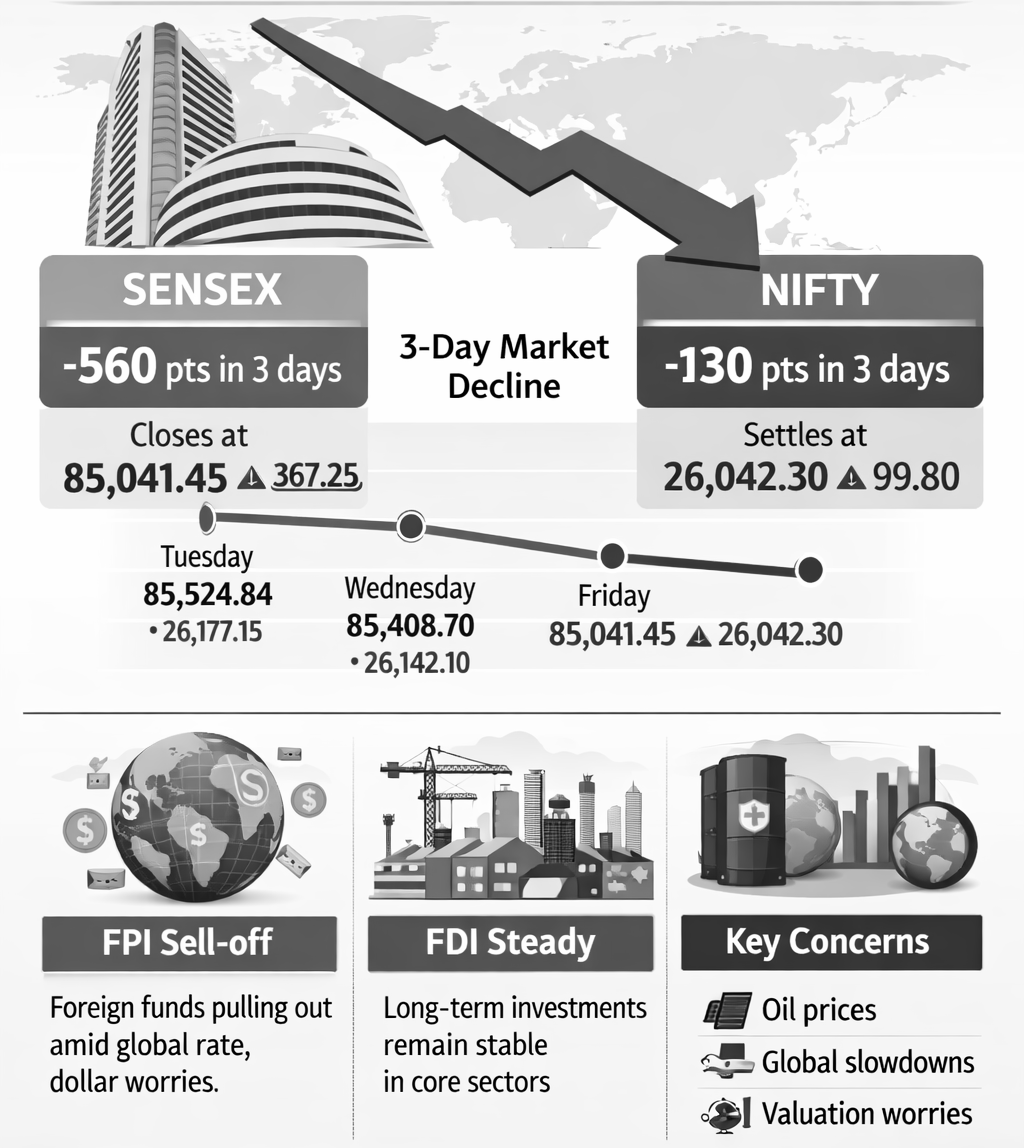
The benchmark BSE Sensex fell 367.25 points, or 0.43 per cent, to close at 85,041.45 , while the NSE Nifty declined 99.80 points, or 0.38 per cent, to settle at 26,042.30 . During intraday trade, the Sensex had dropped nearly 471 points, reflecting cautious investor sentiment.
The slide began on Tuesday , when the Sensex edged lower by 42.64 points to 85,524.84 , while the Nifty climbed modestly to 26,177.15 in lacklustre trade as markets grappled with muted cues. The downward trend continued on Wednesday , with the Sensex slipping 116.14 points to close at 85,408.70 , while the Nifty fell 35.05 points to 26,142.10 . Markets remained closed on Thursday for Christmas before extending losses again on Friday.
Overall, the Sensex has now shed over 480 points across the last three trading sessions , underscoring the sustained pressure on benchmarks.
A key factor weighing on sentiment has been persistent foreign portfolio investor (FPI) selling . Foreign investors have remained cautious in the last quarter due to elevated global interest rates, a strong US dollar and uncertainty over the timing of rate cuts by major central banks. These short-term capital outflows have capped market upside despite stable domestic fundamentals.
In contrast, Foreign Direct Investment (FDI) inflows have remained steady in the previous quarter , signalling long-term confidence in India’s economic prospects. While FPIs react swiftly to global risk sentiment, FDI reflects strategic, long-term investments into sectors such as manufacturing, infrastructure and services.
Compared to global markets, Indian equities have shown relative resilience . While several overseas markets have seen sharper volatility amid growth concerns and geopolitical tensions, Indian indices have largely remained range-bound, supported by steady buying from Domestic Institutional Investors and retail investors through mutual fund SIPs.
Sector-wise, IT stocks continued to face pressure due to weak global demand outlook, while select banking, metal and commodity stocks provided limited support. However, valuation concerns, crude oil price movements and global macro uncertainty have kept investors cautious.
Market experts expect indices to remain volatile but range-bound in the near term, with foreign fund flows, global interest-rate cues and crude prices acting as key triggers. While short-term sentiment remains subdued, steady domestic participation and stable FDI trends continue to provide underlying support to the markets.