
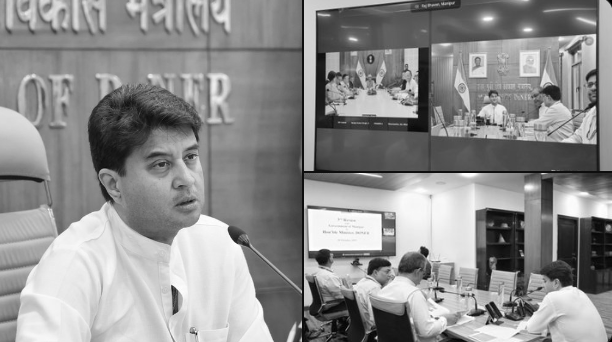
Scindia’s Manipur blueprint marries tradition, tourism, and transformation
Union Minister for Development of North Eastern Region, Jyotiraditya M. Scindia, chaired the third review meeting on Manipur’s Development Roadmap in the presence of Governor Ajay Kumar Bhalla, senior officials from the Ministry of Development of North Eastern Region (MDoNER), and the state government. The meeting aimed to assess the progress of ongoing projects, identify new opportunities, and align Manipur’s growth strategy with Prime Minister Narendra Modi’s vision of an Aatmanirbhar Bharat.
A major highlight of the meeting was Scindia’s plan to revive the sport of polo, calling it both a symbol of heritage and a vehicle for new economic opportunity. He announced that Manipur would be positioned once again as India’s Polo Capital through the establishment of world-class training institutions and coaching centres. The idea is to make polo a central pillar of sports-linked tourism, while empowering local youth and showcasing the state’s unique cultural identity on the global stage.
Polo holds a deeply rooted history in Manipur. Known locally as Sagol Kangjei , the sport originated in the region centuries ago and is regarded as the birthplace of modern polo. Played on Manipuri ponies, it was an integral part of royal and cultural life, later introduced to the British in the 19th century, who carried it to the rest of the world. The Imphal Polo Ground is considered one of the oldest existing polo fields globally. Reviving this sport, therefore, is not merely about tourism, it is about restoring Manipur’s pride and global identity through its timeless heritage.
The meeting also focused on empowering artisans and weaving communities, key pillars of Manipur’s traditional economy. Scindia announced the establishment of 250 mini and 200 mega production units to strengthen the state’s handloom and handicraft sector. He emphasised that these initiatives would preserve traditional craftsmanship while creating new livelihood opportunities, transforming Manipur into a thriving hub of creative enterprise.
Infrastructure and connectivity were equally high on the agenda. Plans include the creation of an Integrated Textile Park with a Design and Technology Institute to promote skill development and innovation. Scindia also underscored the importance of linking Manipur’s Vibrant Villages with the PM Gati Shakti framework, enhancing logistics connectivity, promoting rural tourism, and improving last-mile access across remote areas.
In the agricultural sector, the minister reviewed the state’s palm oil cultivation initiative, setting a target of 10,000 hectares over the next four years to boost agri-based livelihoods and advance self-reliance. He directed officials to speed up the implementation of logistics and industrial infrastructure projects while encouraging private investment to unlock Manipur’s economic potential.
Scindia reiterated that the Ministry of Development of North Eastern Region will continue to act as a proactive facilitator, ensuring that all projects deliver tangible results. He called for accelerated execution and outcome-based evaluation across all departments to ensure inclusive and sustainable growth.
This third review meeting builds upon the progress of the two earlier sessions held this year, which focused on tourism, sports, handloom, and infrastructure in the first round, and on polo tourism circuits, Loktak Lake rejuvenation, weaving clusters, and Vibrant Villages in the second. Scindia emphasised that the government’s continuous engagement reflects a model of partnership, purpose, and progress aimed at transforming Manipur into a self-reliant state with strong cultural and economic foundations.
Meanwhile, Manipur continues under Presidential Rule, which was first imposed in February 2025 following the resignation of Chief Minister N. Biren Singh. Parliament extended it for another six months from August 2025, keeping the state under direct central governance until at least February 2026. Because the legislative assembly is under suspended animation, elections can be held once the Election Commission certifies that the situation allows free and fair polling.
Though the government has indicated that normalcy is gradually returning, the timing of the next elections will depend on the restoration of stability and security. Political observers believe the polls could take place in late 2025 or early 2026, depending on ground conditions. The central government is cautious but hopeful of reinstating a popular government soon, possibly within the next few months.
Through this series of developmental interventions, the Centre is trying to ensure that Manipur not only rebuilds peace but also emerges as a model of self-reliant growth, where heritage meets modern enterprise, and culture fuels opportunity.