
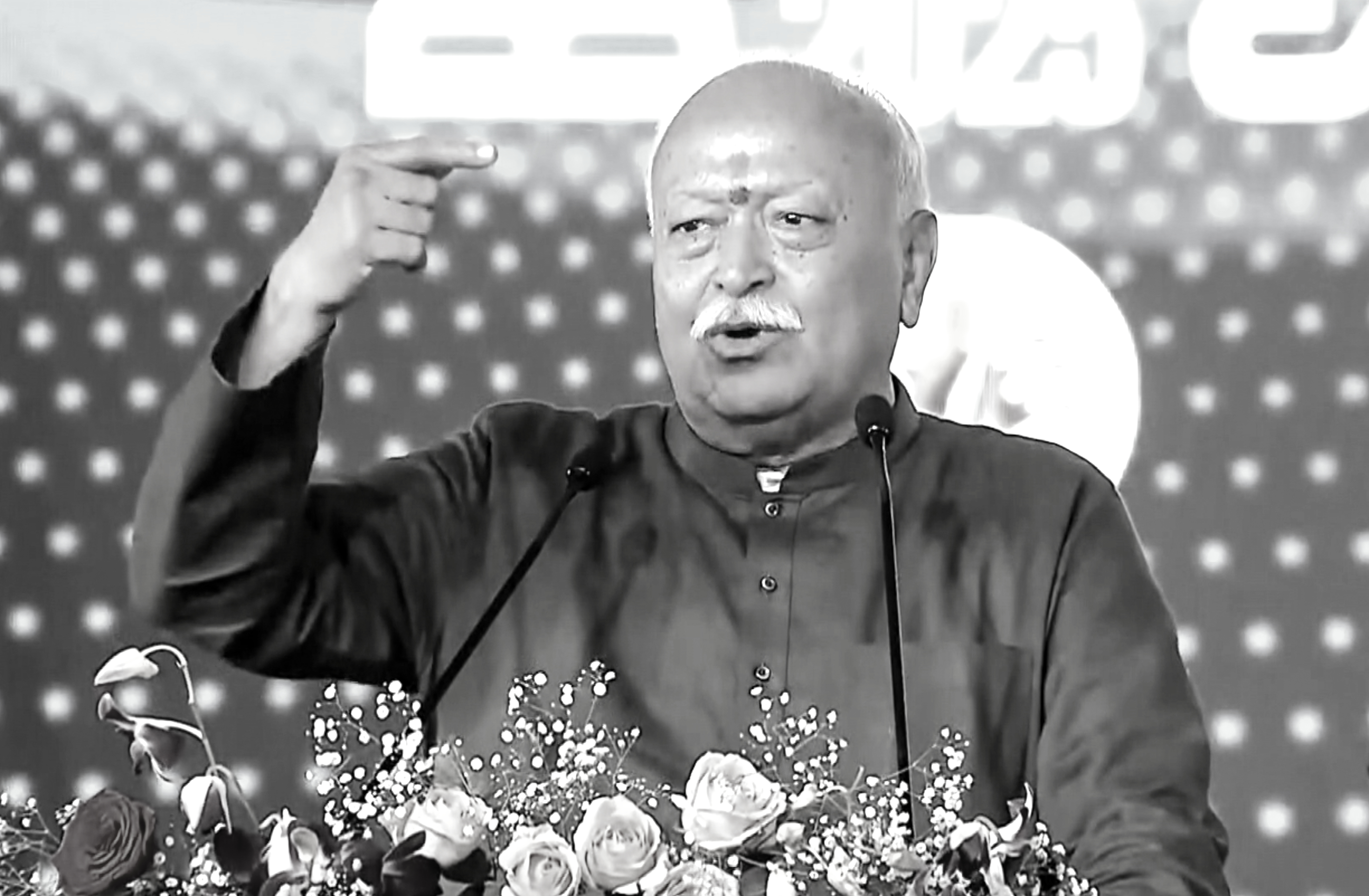
Science and Dharma Aim for Same Truth, Says Mohan Bhagwat
Rashtriya Swayamsevak Sangh (RSS) chief Mohan Bhagwat on Friday said there is no inherent conflict between science and dharma , asserting that both aim to understand truth, though their methods differ.
Speaking at the Bharatiya Vigyan Sammelan here, Bhagwat said dharma is often misunderstood as religion , but it is actually the law governing creation . “Whether one accepts it or not, no one can function outside it,” he added, noting that imbalance in dharma can lead to destruction .
He said science has historically maintained distance from dharma, assuming it had no role in empirical inquiry, a stance he described as fundamentally incorrect.
According to Bhagwat, the main difference between science and spirituality lies in methodology. Science relies on external observation, experimentation, and repeatable experience. Spirituality or dharma emphasizes inner experience and personal verification, which can be experienced by anyone.
Bhagwat also highlighted parallels between modern scientific studies of consciousness and ancient Indian philosophical concepts, such as ‘Sarvam Khalvidam Brahma’ (everything is Brahman) and ‘Prajnanam Brahma’ (consciousness is Brahman).
Stressing the importance of language , he said Indian languages uniquely capture dharmic concepts , and knowledge scientific or spiritual should be shared in people’s mother tongues . Citing Finland , he noted students there study in their mother tongue up to eighth grade, supported by dedicated teacher training. “Education in mother tongue enhances intellectual development and understanding,” he said.
On India’s global role, Bhagwat said the country should combine material progress with dharmic perspectives, aspiring not just for economic and strategic strength but also to be a world teacher, offering guidance on challenges like environmental protection.
He concluded that while science and dharma may use different approaches, their ultimate goal of understanding reality is the same, making the two complementary rather than conflicting .