
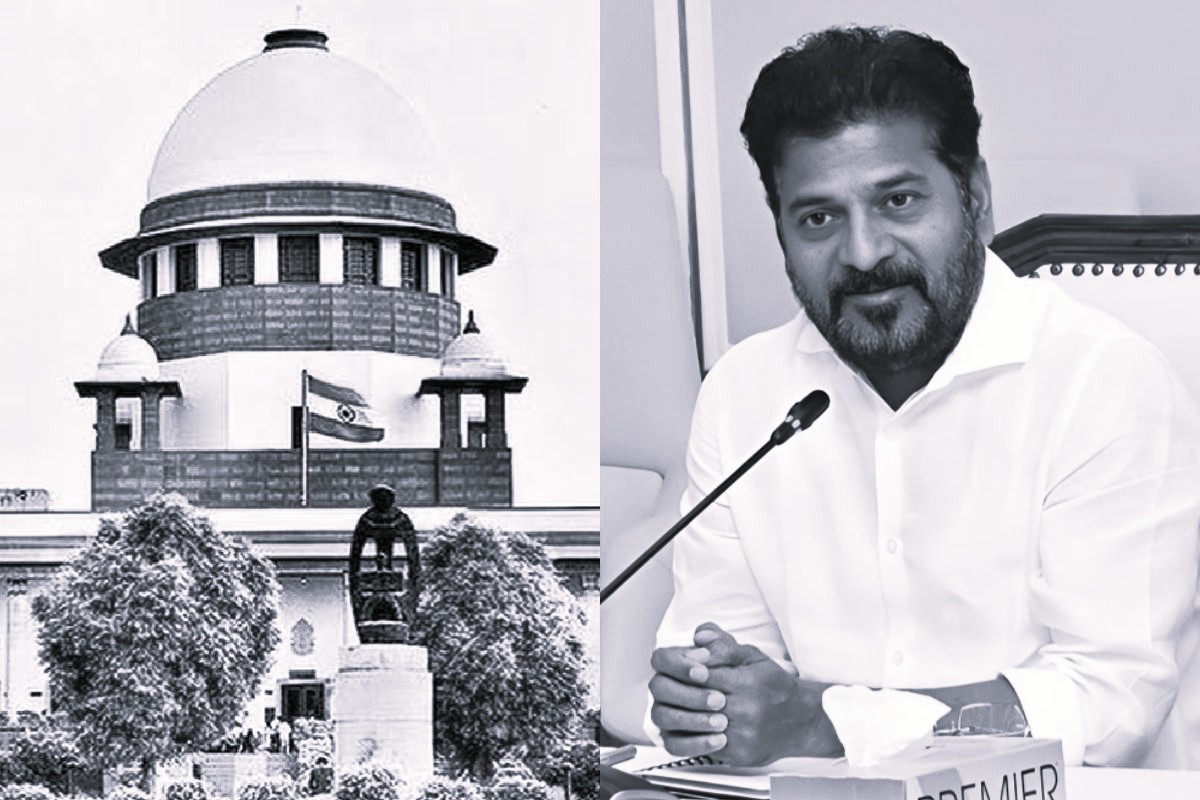
SC Upholds Quashing of SC/ST Case Against Telangana CM Revanth Reddy
Telangana Chief Minister Revanth Reddy received major relief from the Supreme Court , which upheld the Telangana High Court’s decision quashing a 2016 FIR filed against him under the SC/ST (Prevention of Atrocities) Act and relevant IPC provisions. The apex court dismissed an appeal challenging the High Court order, effectively ending a prolonged legal dispute.
A bench comprising Chief Justice Surya Kant , Justice Joymalya Bagchi , and Justice Vipul M. Pancholi observed that the High Court had carefully examined the facts and found no prima facie evidence against the Chief Minister. The bench held that the High Court’s reasoning was legally sound and appropriate to the circumstances, while clarifying that the ruling should not be construed as a “clean chit.” The Chief Justice also remarked that political battles should be fought in the public sphere rather than through courts , reinforcing the judiciary’s consistent position against the misuse of legal proceedings for partisan disputes.
The case dates back to 2016, when an FIR was registered at Gachibowli Police Station naming Revanth Reddy as the third accused. The complainant, linked to the SC Mutually Aided Cooperative Housing Society in Gopanpally village, alleged that Reddy’s brother Kondal Reddy and others trespassed on society land at his instigation, demolished two rooms using earth-moving machinery, attempted to occupy the property, and made caste-based remarks.
In 2020, Reddy approached the High Court seeking quashing of the case, arguing that he was not present at the site during the alleged incident. After reviewing the evidence, the High Court dismissed the criminal case, stating that the allegations lacked sufficient proof linking him to the offence. During earlier proceedings, the Supreme Court had also taken serious note of allegations made against the High Court judge and warned the petitioner and lawyers against undermining judicial dignity; contempt proceedings were later closed after apologies were tendered.
Legal observers say the ruling reinforces the principle that criminal law must not be invoked without credible evidence , particularly in politically sensitive matters, and reiterates the court’s view that political disputes should be resolved through democratic processes rather than litigation.