
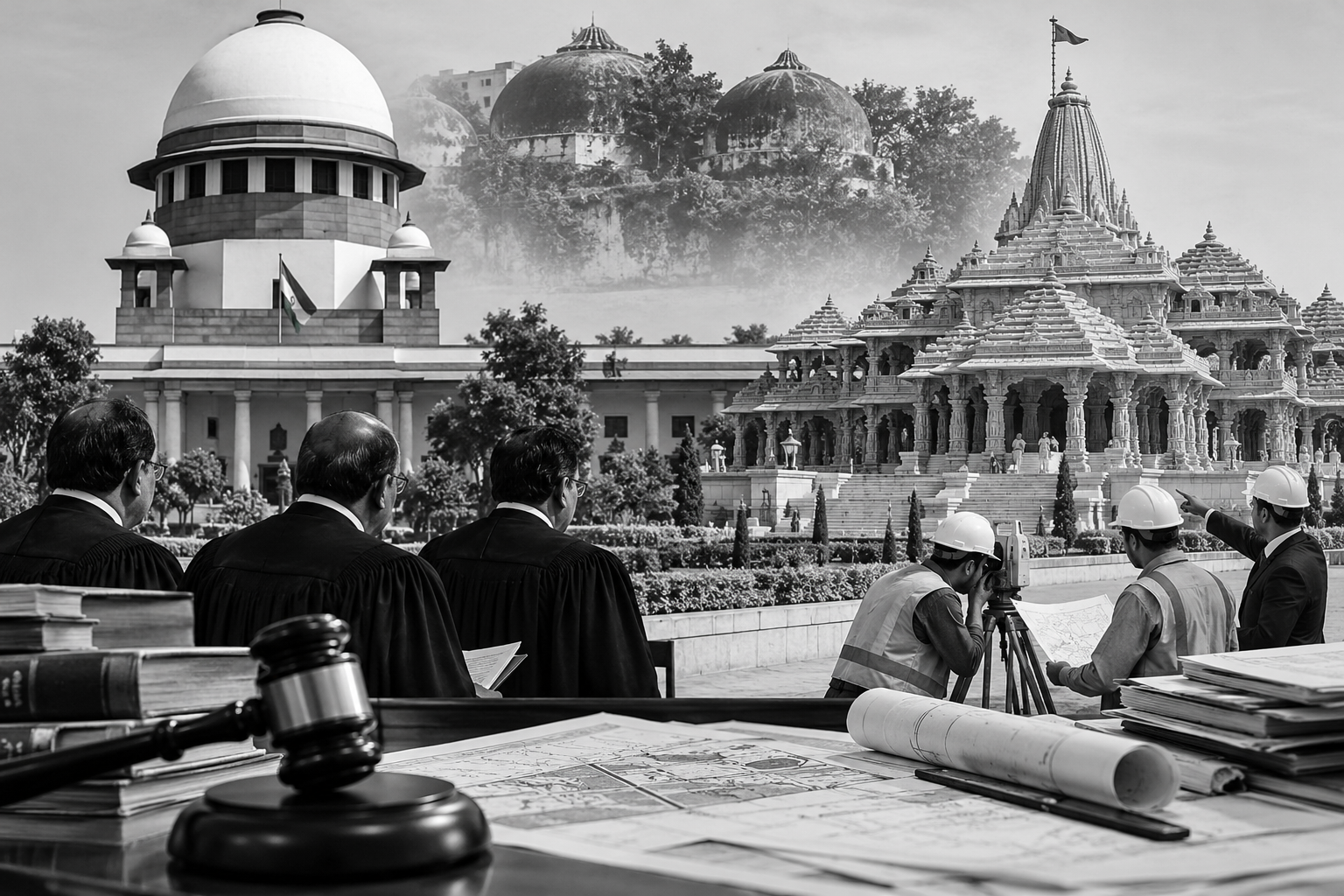
SC to Examine Plea for Independent Survey of Ram Temple Premises
A fresh petition filed in the Supreme Court has brought the decades-old Ayodhya land dispute back into the legal spotlight, seeking an independent examination of whether the Ram Temple currently standing in Ayodhya has been constructed on the exact premises adjudicated by the apex court in its landmark November 9, 2019 verdict. The petition, filed by the Shri Ram Janmbhoomi Case Trust, seeks the appointment of a court-supervised committee comprising survey, revenue, archaeological and technical experts to establish the precise boundaries, coordinates and geographical extent of the land covered by the judgment.
According to the Supreme Court's cause list, the plea is scheduled for hearing on November 2 before a bench headed by Chief Justice Surya Kant, along with Justices Joymalya Bagchi and V. Mohana. The petitioner has sought an independent survey to compare the adjudicated property with the premises on which the temple has been constructed. It has also requested appropriate directions if material discrepancies are identified, although the petition does not establish that any construction irregularity has occurred.
The plea seeks preservation and production of original maps, land surveys, revenue records and construction plans by the concerned authorities and the Shri Ram Janmbhoomi Teerth Kshetra Trust, the separate organisation overseeing temple construction and management.
The dispute dates back several decades, with Hindu and Muslim parties advancing competing claims over the site where the 16th-century Babri Masjid stood before its demolition on December 6, 1992. The litigation intensified following the placement of idols inside the structure in December 1949. Subsequent suits were filed by Hindu worshippers, Nirmohi Akhara and the Sunni Central Waqf Board. In 2010, the Allahabad High Court ordered a three-way division of the disputed 2.77-acre property among the three claimants.
On November 9, 2019, a five-judge Constitution Bench unanimously overturned that division, directing the disputed land to be handed over to a trust for temple construction and ordering the Centre to allot five acres of alternative land to the Sunni Waqf Board for a mosque. The verdict followed examination of historical records, possession claims and archaeological evidence, including the ASI report. The court also held that the 1949 placement of idols and the 1992 demolition were unlawful.
The petition also raises questions about the distinction between the 2.77-acre disputed property and the larger 67.703-acre area acquired by the Centre in 1993. The government subsequently transferred the acquired area to the temple trust for development, making the identification of the original adjudicated premises particularly relevant to the requested survey.
Citing concerns over implementation, the petitioner has invoked the need for independent technical verification, with provisions such as Section 75 and Order XXVI Rule 9 of the Code of Civil Procedure offering a framework for court-appointed investigations. However, the court must consider whether such an exercise is necessary to implement its final judgment without reopening the settled title dispute.