
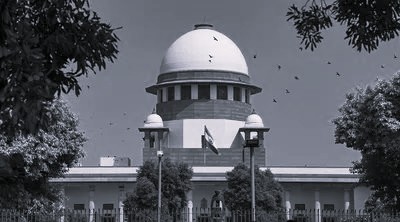
SC Status Ends After Conversion to Another Religion: Supreme Court
In a significant ruling that sharpens the legal boundaries between religion and caste identity , the Supreme Court has held that individuals who convert to religions other than Hinduism , Sikhism , or Buddhism will lose their Scheduled Caste (SC) status entirely. A bench of Justices Prashant Kumar Mishra and N.V. Anjaria upheld the Andhra Pradesh High Court’s decision, reiterating that the Constitution (Scheduled Castes) Order, 1950 clearly limits SC recognition to specific religions. The court stressed that this rule is absolute , leaving no room for exceptions, and that a person cannot simultaneously practice another faith while claiming SC-linked reservations or protections , including those under the SC/ST (Prevention of Atrocities) Act . The judgment reinforces the view that caste-based safeguards are rooted in a particular religious framework and cannot be extended beyond it under existing law.
The case arose from a petition filed by Chintada Anand , a pastor who alleged an attack in 2021 and sought relief under the SC/ST Act. However, the court found that he had converted to Christianity and continued functioning as a pastor without reconverting to his original religion. Evidence showed that the incident occurred while he was conducting prayer services , confirming that he was practicing Christianity at the time. The bench concluded that conversion and SC status are mutually exclusive , and therefore, he could not invoke legal protections meant for Scheduled Castes. The ruling is expected to influence ongoing debates around caste recognition among converted communities, especially those who argue that social discrimination persists despite a change in religion, even as the court maintained a strict constitutional interpretation.
In a separate but equally important decision, the Supreme Court extended relief to women officers in the armed forces, directing that those serving under the Short Service Commission (SSC) who were denied Permanent Commission be treated as having completed 20 years of service for the purpose of pension benefits . A bench led by Justice Surya Kant , along with Justices Ujjal Bhuyan and N. Kotiswar Singh , noted that many women officers were released early due to systemic gaps, including lack of transparency and unclear evaluation standards in the selection process. While the court declined to order reinstatement, it made it clear that financial entitlements cannot be denied on that basis. The order, which comes into effect from November 1, 2025, applies to officers who participated in selection processes between 2019 and 2021, marking a crucial step toward greater gender fairness within the armed forces.