
SC Sets Expert Oversight for 400 Pending MSME Applications in Taj Trapezium Zone
The Supreme Court on Thursday allowed the Taj Trapezium Zone (TTZ) Authority to process around 400 pending applications seeking permission to establish non-polluting Micro, Small and Medium Enterprises (MSMEs) in the ecologically sensitive area surrounding the Taj Mahal.
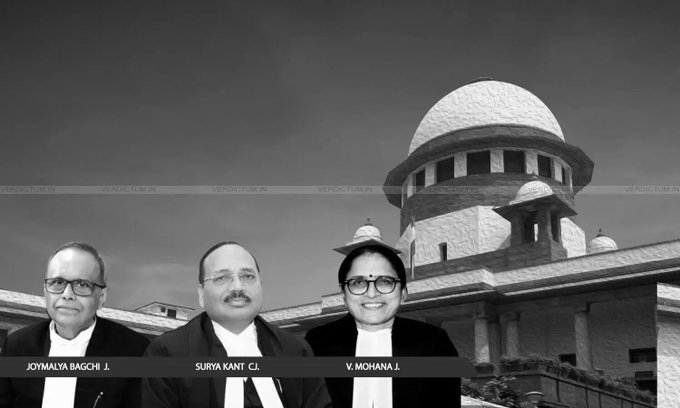
A bench comprising Chief Justice of India Surya Kant and Justices Joymalya Bagchi and V Mohana directed that every proposal be scrutinised by experts nominated by the Central Empowered Committee (CEC) and representatives of the National Environmental Engineering Research Institute (NEERI).
The court ordered that one CEC-nominated expert and one NEERI representative must be present at every meeting considering the applications. If either expert concludes that a proposed unit cannot be classified as non-polluting, the application cannot be approved without the Supreme Court's permission.
However, if both experts and the TTZ Authority agree that an industry is non-polluting, the application can be processed and taken to its logical conclusion in accordance with the law, without being referred back to the top court.
The court also directed that decisions be uploaded on the CEC website to enable members of the public to submit objections or suggestions. Such representations must be considered before a final decision is taken.
The bench noted that key initiatives, including the TTZ Vision Document, a cumulative impact assessment and NEERI's final report defining non-polluting industries, are still pending. However, it said the delay should not prevent the processing of applications already received.
The TTZ covers nearly 10,400 sq km around the Taj Mahal and has faced stringent environmental restrictions since the Supreme Court's 1996 order banning coal and coke use and directing 293 industries around Agra to shift to natural gas.
The ruling seeks to balance environmental protection with local livelihoods and economic activity. While it does not permit unrestricted industrial development, the court has created a regulated mechanism for allowing potentially non-polluting MSMEs, with expert oversight and public scrutiny. The decision underscores that the precautionary principle will remain central to industrial activity in the sensitive zone.