
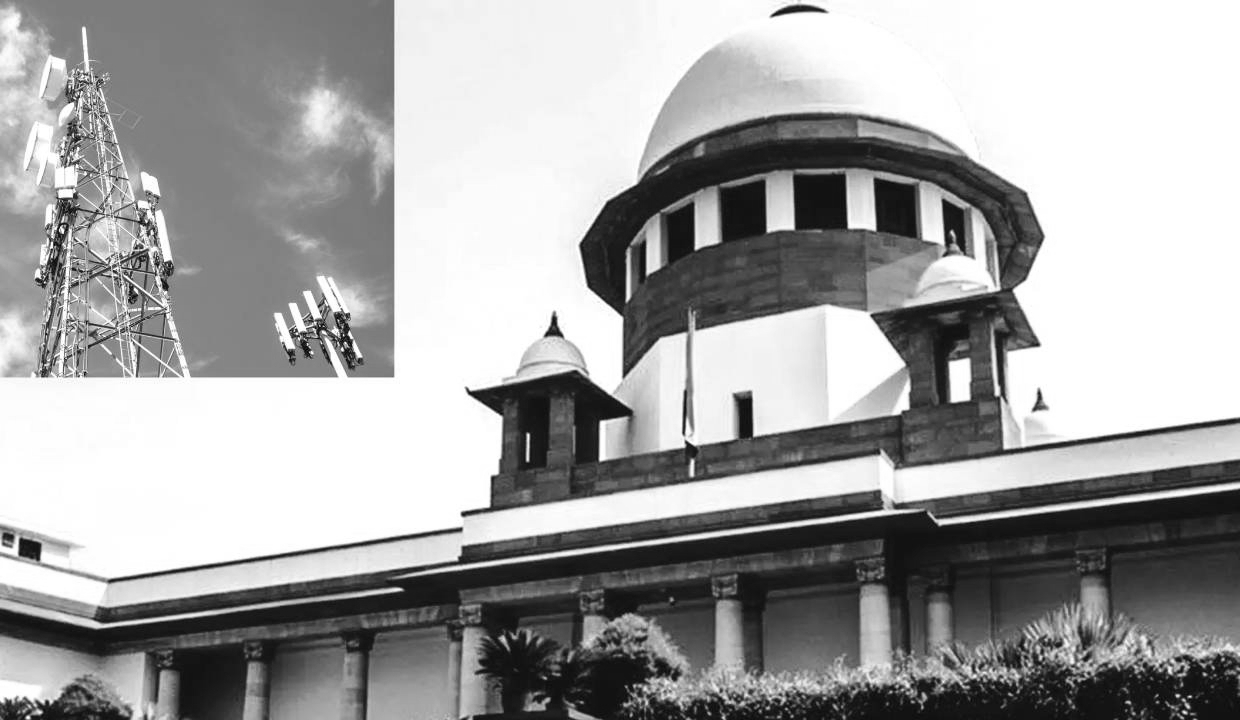
SC says telecom spectrum not an asset, cannot be part of insolvency proceedings
The Supreme Court of India has delivered a landmark ruling clarifying that telecom spectrum allocated to service providers cannot be treated as an asset under the Insolvency and Bankruptcy Code (IBC) , reinforcing the principle that spectrum remains a sovereign public resource held in trust by the Union government. The verdict, delivered by a bench comprising Justices P. S. Narasimha and A. S. Chandurkar , establishes that while telecom operators may record spectrum usage rights as intangible assets in their financial statements, such accounting treatment does not confer ownership or proprietary rights.
The Court emphasized that the Union government is the owner and trustee of spectrum, while the Telecom Regulatory Authority of India (TRAI) functions as the sector regulator. Together, they occupy the entire regulatory domain of telecommunications. Spectrum allocation and usage are governed by a comprehensive legal framework including the Indian Telegraph Act, 1885 , the Wireless Telegraphy Act , and the TRAI Act, 1997 , along with associated rules and licensing conditions. Because this specialised statutory regime governs telecom operations, the Court held that insolvency proceedings cannot override or restructure rights related to spectrum usage.
The ruling arose from insolvency proceedings involving Aircel Group entities , which entered the corporate insolvency resolution process after defaulting on licence fee payments. The companies argued that spectrum usage rights should form part of the asset pool available to creditors during resolution. Rejecting this interpretation, the Supreme Court overruled the earlier decision of the National Company Law Appellate Tribunal (NCLAT) , holding that spectrum cannot be subjected to insolvency proceedings because telecom firms do not possess ownership rights over it. The Court also reiterated that insolvency mechanisms cannot be used to override sovereign functions performed under special statutes.
A key element of the judgment is its recognition of spectrum as a scarce and high-value national resource . Radio spectrum forms the backbone of wireless communication and is essential for mobile connectivity, broadband services, satellite communications and emerging technologies such as 5G and the Internet of Things (IoT) . Governments allocate spectrum through auctions to ensure efficient utilisation and transparency, and telecom operators pay enormous sums to access it. India’s major auctions illustrate its economic significance: the 2010 3G auctions generated over ₹1 lakh crore, while the 2022 5G spectrum auction raised more than ₹1.5 lakh crore, enabling next-generation digital infrastructure.
Spectrum governance has long been politically and economically sensitive in India. Controversies surrounding telecom licensing and allocation practices in the late 2000s,including debates over pricing and transparency during the UPA era triggered nationwide scrutiny and prompted reforms that shifted allocation toward market-based auctions . These reforms strengthened accountability, enhanced public revenue and reinforced the principle that spectrum is a national asset rather than a tradable corporate commodity.
By excluding spectrum from the insolvency asset pool, the Supreme Court’s ruling has significant implications for the telecom sector and financial institutions. Telecom operators cannot monetise spectrum rights during insolvency proceedings, and compliance with licensing obligations remains paramount. For banks and lenders, recovery prospects in telecom insolvency cases may be constrained because spectrum cannot be treated as collateral or liquidated assets. At the policy level, the judgment strengthens sovereign control over critical national resources and insulates telecom regulation from potential encroachment by insolvency law.
The decision draws a clear boundary between corporate insolvency processes and the state’s stewardship of national resources. By affirming that spectrum, despite its commercial exploitation, remains a public trust resource governed by a specialised legal regime, the Court has provided long-awaited clarity for regulators, telecom operators and lenders. The ruling not only resolves a key legal ambiguity but also safeguards a resource central to India’s digital economy , connectivity expansion and future technological growth.