
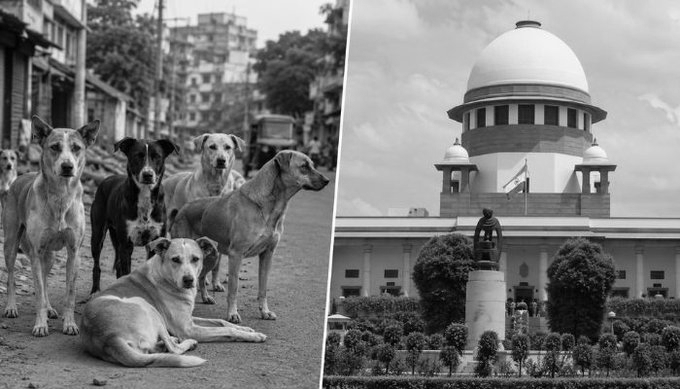
SC Refuses To Reopen Stray Dog Orders, Upholds Public Safety Over Animal Rights
The Supreme Court of India refused to recall or modify its earlier directions on the relocation and sterilisation of stray dogs , firmly placing public safety above animal rights and declaring that the right to live with dignity includes the right to live without the threat of dog attacks.
A bench of Justices Vikram Nath, Sandeep Mehta, and N.V. Anjaria dismissed all petitions challenging the SOPs issued by the Animal Welfare Board of India (AWBI) , saying "we dismiss all the applications." The court referenced "deeply disturbing incidents" of children mauled, elderly targeted, and international travellers attacked, holding the state squarely responsible for these failures.
The bench cited 1,084 dog bite cases in a single month in Rajasthan's Sri Ganganagar and nearly 2 lakh cases in Tamil Nadu in the first four months of 2026 alone, also noting repeated incidents in airports and residential colonies .
The court ordered that rabid, incurably ill, or aggressive dogs can be euthanised by authorities, subject to assessment by a qualified veterinarian and strictly in accordance with the Prevention of Cruelty to Animals Act . It also ordered that no criminal proceedings be ordinarily initiated against any official acting in good faith to implement its directions.
States were directed to establish at least one ABC centre per district , ensure availability of anti-rabies vaccines , and the NHAI was asked to deploy vehicles to manage strays on highways.
High Courts were directed to register suo motu cases to monitor implementation of all directions. Chief Secretaries must file compliance reports before High Courts by August 7 , with consolidated reports reaching the Supreme Court by November 17 .
The court sharply criticised states, saying: "Had states acted with foresight, the present situation could not have assumed such proportions." It noted sterilisation and vaccination drives had taken place "without planning" , defeating the entire purpose of the ABC framework.
The case originated as a suo motu matter in July 2025 following media reports on rabies deaths among children in Delhi, with the final verdict reserved on January 29, 2026 after hearing from all states, civic bodies, and animal rights groups.