
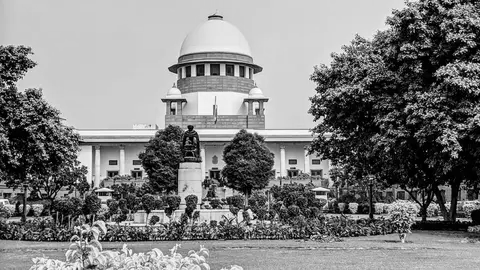
SC protects lawyers from harassment, upholds client confidentiality rights
In a landmark ruling aimed at safeguarding the independence of the legal profession, the Supreme Court on Friday ruled that investigating officers cannot summon lawyers representing accused persons in criminal cases unless they obtain prior written approval from a Superintendent of Police or a similarly ranked officer.
The judgment, hailed as a victory for lawyer-client confidentiality, also set aside the Enforcement Directorate’s (ED) summons to senior advocates Arvind Datar and Pratap Venugopal , declaring them a violation of fundamental rights.
The verdict was delivered by a bench comprising Chief Justice B.R. Gavai and Justices K. Vinod Chandran and N.V. Anjaria in a suo motu case triggered by the ED’s move to question the two lawyers in a money laundering probe, an action that had sparked widespread outrage within the legal community.
Justice Chandran, pronouncing the operative part of the verdict, said the bench sought to “harmonise the evidentiary and procedural rules” to prevent misuse of power by probe agencies while respecting the boundaries of lawful investigation.
Under the new directions, no investigating officer or station house officer can summon an advocate to disclose information about a client or case details unless it falls under specific exceptions listed in Section 132 of the Bharatiya Sakshya Adhiniyam (BSA) , the provision that codifies lawyer-client privilege. If such an exception applies, the summons must clearly state the reasons and be approved in writing by a superior officer not below the rank of SP, who must record satisfaction about the necessity of the summons.
The Court emphasised that these summonses will be subject to judicial review under the Bhartiya Nagrik Suraksha Sanhita (BNSS), 2023 , giving both the advocate and client the right to challenge them in court.
The bench further clarified that this protection extends to advocates engaged in litigation, non-litigation, and even pre-litigation matters, underscoring that the duty of confidentiality does not depend on the stage of representation . However, the privilege does not automatically apply to client documents in a lawyer’s possession, as courts will decide their admissibility based on the circumstances.
In a significant step toward digital-era privacy, the court ruled that if a probe agency seeks to examine a lawyer’s digital devices , they must be produced only before a jurisdictional court , not an investigating officer. The device can then be examined in the presence of both the lawyer and the client, with the option to engage a domain expert of their choice, and without compromising the confidentiality of other clients.
Importantly, the court excluded in-house counsels , lawyers employed by companies and not engaged in independent practice, from the purview of Section 132 protection.
The verdict came months after the Supreme Court Bar Association (SCBA) and the Supreme Court Advocates-on-Record Association (SCAORA) criticised the ED’s summons to Datar and Venugopal as a “disturbing trend” that threatened the autonomy of the legal profession. The controversy had prompted the ED itself to issue internal instructions in June barring its officers from summoning advocates without prior approval from the Director and adherence to the BSA provisions.
This ruling is widely seen as a progressive step towards protecting advocates from harassment through arbitrary summons and ensuring that lawyers are not forced to divulge confidential information shared by their clients . Legal experts say the judgment not only strengthens professional independence but also reinforces citizens’ right to secure and confidential legal counsel.
Calling itself the “custodian of citizens’ rights,” the Supreme Court’s decision marks a historic reaffirmation of the sanctity of professional privilege , ensuring that lawyers can advise their clients freely without fear of investigative overreach. The detailed judgment is awaited.