
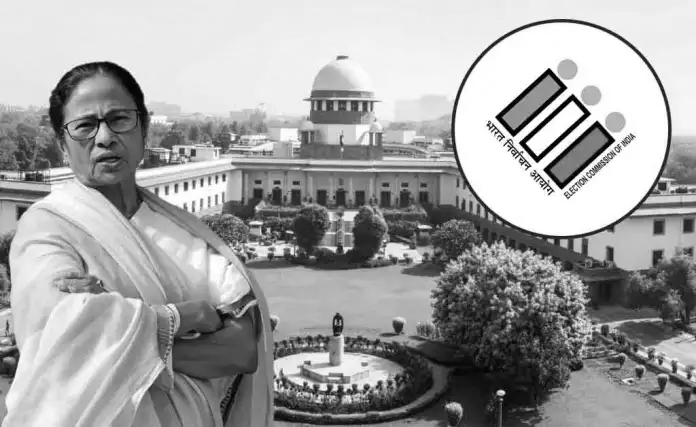
SC orders probe as West Bengal judicial officers held hostage over voter roll row
The Supreme Court of India on Thursday ordered an independent CBI or NIA probe into the shocking gherao of seven judicial officers in Malda district , West Bengal, during the Special Intensive Revision (SIR) of electoral rolls, a process central to the upcoming Assembly elections. The court also sharply criticised the West Bengal government for its “deplorable” inaction and described the state as the “most polarised” in the country.
The crisis began on Wednesday afternoon, April 1 , when a group of villagers in Kaliachak’s Block Development Office (BDO), angered over the deletion of names from the voter list in the SIR exercise, surrounded and “gheraoed” the judicial officers. The standoff started in the late afternoon (around 3:30-4 PM) and continued for over nine hours , trapping the officers, including three women and a five-year-old child, inside the office without adequate food or water.
Initial protests began after villagers were denied a meeting with the officers. Demonstrators then blocked National Highway 12 (Kolkata‑Siliguri), placed bamboo poles and other obstructions on the road, and at times attempted to attack the officers’ vehicles .
It was only around midnight to 1 AM that a large contingent of police and paramilitary forces were able to disperse the crowd and rescue the trapped officers, moving them to safety amid stone‑pelting and damage to vehicles.
A bench led by Chief Justice Surya Kant , along with Justices Joymalya Bagchi and Vipul M. Pancholi, said the incident appeared to be a “calculated, motivated attempt” to demoralise judicial officers and disrupt the electoral process. The court underscored that such acts were effectively an attack on the authority of the judiciary and ordered that the investigation be entrusted to a federal probe agency, with a compliance report to be filed directly to the Supreme Court .
The bench also issued showcause notices to the state chief secretary, director general of police, district magistrate and superintendent of police in Malda, directing them to justify why action should not be taken against them for failing to act despite repeated alerts from the Calcutta High Court and other authorities.
In its orders, the Supreme Court directed the Election Commission of India to requisition adequate Central Forces for all places where judicial officers are adjudicating objections, and to put in place security measures to ensure the safety of officers, their families and staff . The bench emphasised that gatherings of more than five people should not be permitted near adjudication sites.
The West Bengal assembly elections are scheduled in two phases on April 23 and 29 , with votes to be counted on May 4 . The SIR process, aimed at cleaning the electoral rolls ahead of polling, has seen over 63 lakh names deleted and about 60 lakh objections under adjudication , making it a highly contentious issue in the politically charged run‑up to the polls.
Reacting to the Supreme Court’s rebuke, West Bengal Chief Minister Mamata Banerjee condemned the attack on the officers but blamed the Election Commission for stripping her government of authority over the administration by transferring senior officials and placing EC‑nominated officers in key roles. She also suggested that vested political interests were trying to derail the election process and trigger unrest.
The BJP accused the TMC of orchestrating the protest to intimidate officials and influence the SIR process, further adding to political tensions ahead of the crucial polls.
The Supreme Court will next hear the matter on April 6 , when top state officials are expected to appear online before the bench.