
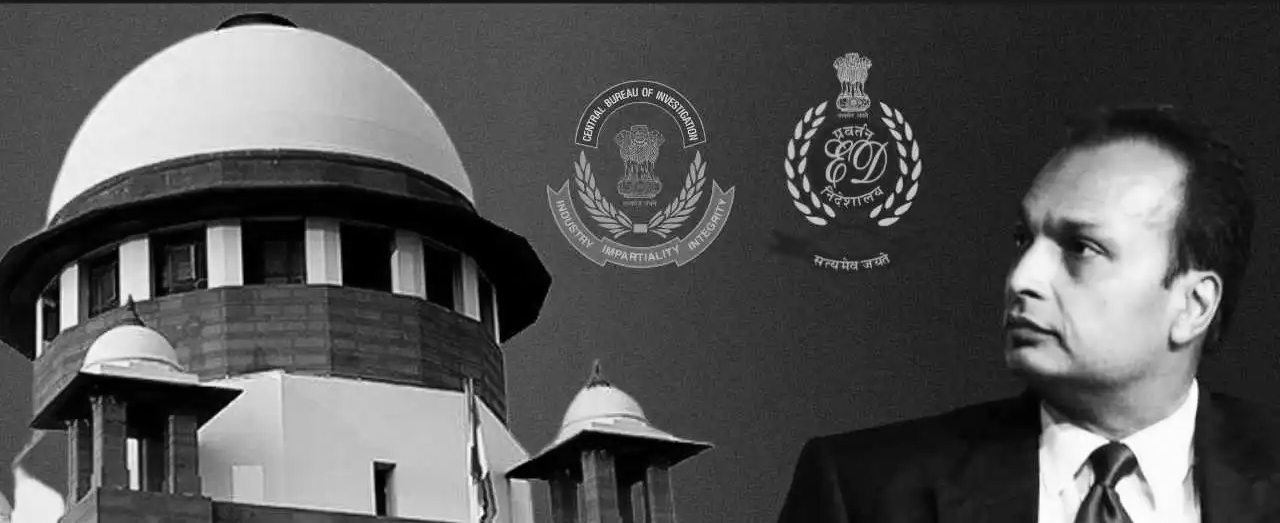
SC orders CBI, ED to probe Anil Ambani in banking fraud, four-week deadline
The Supreme Court on Wednesday issued stern directions to the Central Bureau of Investigation (CBI) and the Enforcement Directorate (ED) to conduct a “fair,” “prompt” and "dispassionate" probe into alleged massive banking and corporate fraud involving the Anil Dhirubhai Ambani Group (ADAG), its chairman Anil Ambani, and associated companies. The court’s intervention came amid growing judicial concern over the slow pace of investigations so far.
A bench comprising Chief Justice Surya Kant and Justices Joymalya Bagchi and Vipul M. Pancholi directed both agencies to submit fresh status reports within four weeks on the progress made in their ongoing probes. The court also asked the ED to constitute a special investigation team (SIT) of senior officers to expedite the examination of ADAG and related entities.
During the hearing, the bench noted that the probe agencies “have already taken time to start the probe,” signalling its dissatisfaction with the pace of action. In strong terms, the court criticised the unexplained delays by the ED and the CBI, particularly in relation to the alleged ₹40,000‑crore banking fraud , and emphasised that no further procrastination would be tolerated.
Anil Ambani and ADAG were represented before the court by senior advocates Mukul Rohatgi and Shyam Divan, who were granted four weeks to file their responses to the public interest litigation (PIL) . In court, Rohatgi opposed any direction to prevent Ambani from leaving the country, assuring the bench that Ambani would remain in India and would not depart without the court’s permission . Solicitor General Tushar Mehta, appearing for the probe agencies, stated that various look‑out circulars have been issued to ensure that the person concerned does not exit the country.
The Supreme Court’s latest orders follow earlier procedural steps, including a requirement for sealed status reports from the CBI and ED and notices issued on November 18 to the Centre, CBI, ED, Anil Ambani and ADAG regarding the PIL. The bench made clear that it was granting the parties “one last opportunity” to appear and respond.
The PIL, filed by former Cabinet Secretary EAS Sarma, alleges systematic diversion of public funds, fabrication of financial statements, and institutional complicity across multiple entities of the Anil Ambani‑led Reliance ADAG . These charges encompass complaints from public sector banks and assertions of irregular lending and loan defaults.
In public discourse around this case, critics have highlighted a perception that the CBI and ED are sometimes slow or selective in handling high‑profile investigations. Opposition leaders and commentators have long argued that these agencies can be used for political purposes, noting that many cases against political rivals receive intense media and political attention, yet rarely lead to convictions. Over the past decade, the ED has registered numerous cases against politicians, with very few resulting in legal outcomes, raising questions about its effectiveness and impartiality.
Observers also point to instances in recent Indian history where central investigative agencies allegedly delayed action or pursued cases inconsistently, contributing to public scepticism about their autonomy. Concerns often focus on inquiries that appear to align with political or strategic interests rather than strictly legal ones, though the agencies maintain their actions are guided by legal mandates and evidence. While the role of political influence in law enforcement remains a matter of debate, the Supreme Court’s insistence on prompt and impartial investigation in the ADAG matter underscores its position that powerful entities must be held to the same standards of accountability as any citizen.
The Supreme Court is expected to review the matter again after the fresh status reports and responses are filed, underscoring the judiciary’s continued monitoring of what has been described as one of India’s most significant alleged corporate and banking frauds.