
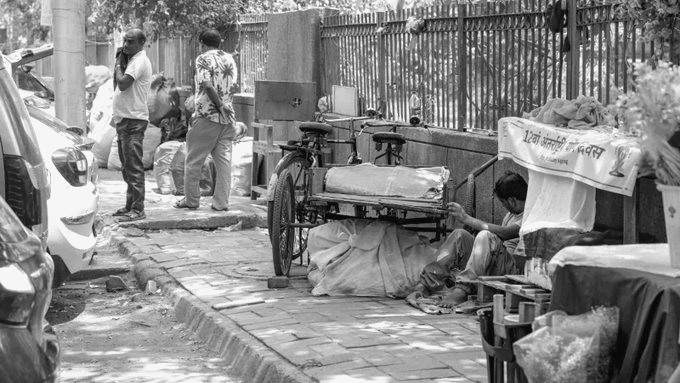
SC Directs States, UTs to Ensure Encroachment-Free, Demarcated Footpaths
The Supreme Court on Monday directed all states and Union Territories to respond to advisories aimed at ensuring properly demarcated and encroachment-free footpaths wherever roads exist, stressing that safe pedestrian spaces are an essential part of everyday life.
A bench of Justices PS Narasimha and Alok Aradhe impleaded all states and UTs as parties in the suo motu proceedings concerning pedestrian infrastructure. The bench told Additional Solicitor General KM Nataraj, representing the Centre, that the first step was to clearly demarcate space for pedestrians and ensure that people could walk without fear of moving vehicles.
Nataraj informed the court that roads fall under the jurisdiction of states and that the Ministry of Road Transport and Highways (MoRTH) and the Ministry of Housing and Urban Affairs (MoHUA) had issued advisories to states, UTs and the National Highways Authority of India for creating designated pedestrian spaces.
The court asked states and UTs to respond to the advisories, observing that “the existence of footpaths is an integral part of human life.”
The latest proceedings follow the court’s August 3 direction to the Centre to ensure that every road has a properly demarcated space for pedestrians, protected from encroachment and physically separated from motor-vehicle lanes.
In a significant ruling on June 19, the Supreme Court held that the right to walk on a demarcated footpath is a fundamental right, forming part of the right to movement under Article 19(1)(d) and the right to life and liberty under Article 21.
The court said pedestrians’ rights on designated footpaths take priority over motorised traffic. It also held that urban development authorities, municipal bodies and panchayats have a duty to construct, maintain and safeguard pedestrian infrastructure.
The ruling further stated that violations could entitle citizens to seek constitutional and legal remedies, including restitution and compensation, independently of remedies available under the Motor Vehicles Act.