
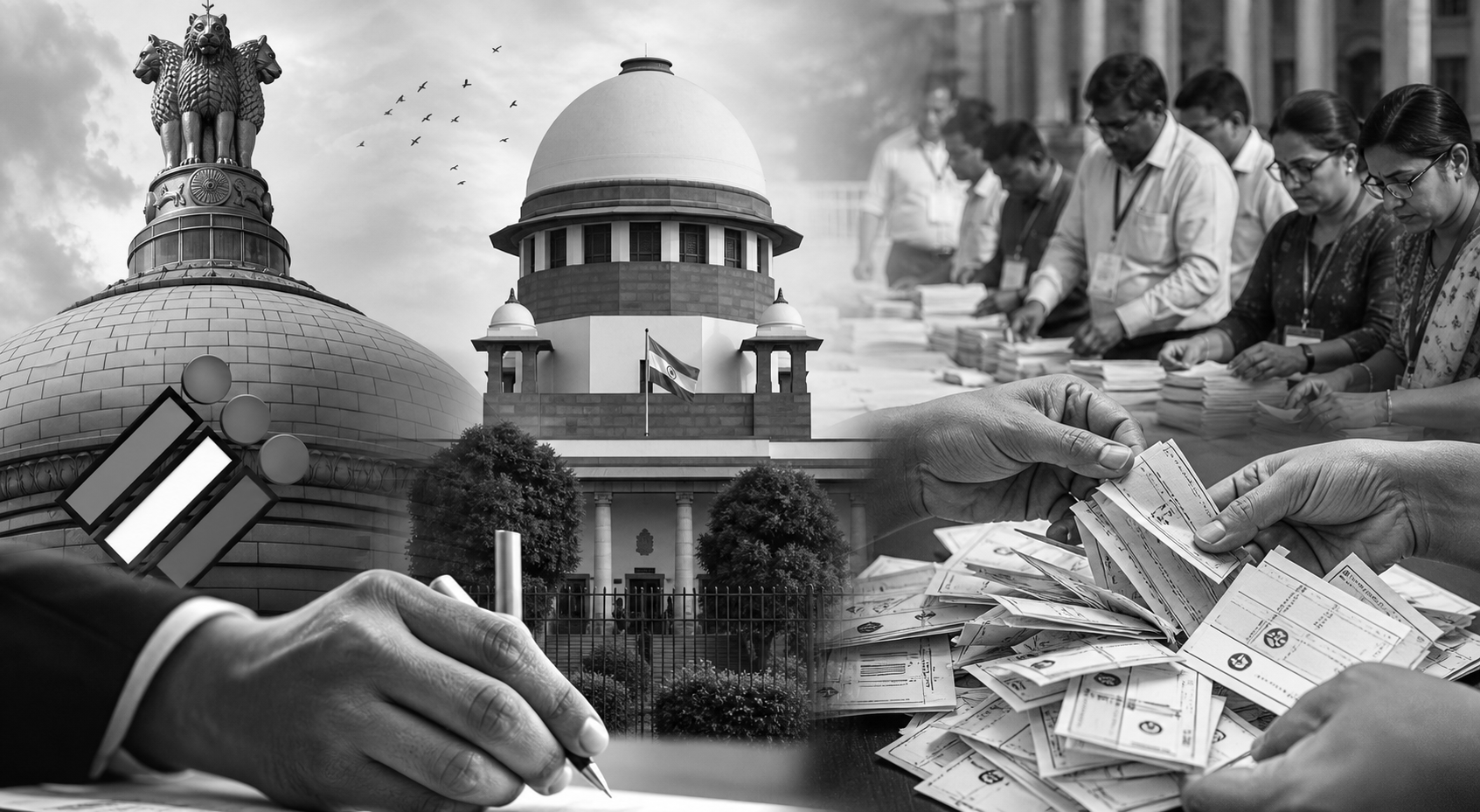
SC Declines to Intervene, Upholds EC’s Counting Personnel Directive in West Bengal
The Supreme Court of India on Saturday declined to intervene in a plea filed by the Trinamool Congress (TMC) , effectively backing the Election Commission of India (EC) on its directive to deploy central government and PSU personnel for vote counting in the West Bengal Assembly elections .
The case, listed urgently ahead of counting day , was heard by a special bench comprising Justices P S Narasimha and Joymalya Bagchi . The bench observed that the EC is empowered to determine counting staff and ruled that its April 13 circular could not be termed incorrect. Concluding that no further judicial intervention was warranted, the court disposed of the plea.
During the hearing, senior advocate Kapil Sibal , appearing for the TMC, argued that the party became aware of the directive only on April 29 and sought its proper implementation. The EC, represented by D S Naidu , maintained that the circular clearly provides for a mix of central and state personnel and assured the court it would be implemented in letter and spirit .
At the core of the dispute was the EC’s directive mandating that at least one counting supervisor or assistant per table be drawn from central government or PSU employees . The poll panel defended the move as necessary to ensure neutrality and credibility in the counting process, especially in a politically sensitive environment .
The TMC had earlier challenged the directive before the Calcutta High Court , arguing it was issued without jurisdiction and based on mere apprehensions . The party also raised concerns that such personnel could be influenced by the Union government, potentially benefiting its rival, the Bharatiya Janata Party (BJP) .
However, the high court dismissed the petition, holding there was no illegality in the EC’s decision. It relied on the Representation of the People Act, 1951 , which allows the Commission to delegate functions and manage election personnel. The court also rejected allegations of bias, noting no evidence supported claims of political control.
Importantly, the high court emphasised that the counting process includes multiple layers of oversight , such as micro-observers, counting agents, and returning officers , ensuring transparency. It also noted the petition was filed close to the counting date , despite the directive being issued earlier.
Endorsing this reasoning, the Supreme Court reiterated that the EC’s circular cannot be faulted and that apprehensions alone are insufficient for judicial interference. The bench also questioned the need for litigation when the petitioner itself sought implementation of the same directive .
The dispute unfolds amid heightened political rivalry in West Bengal between the TMC and BJP, with recurring concerns around electoral transparency and neutrality . The EC’s move is seen as part of efforts to strengthen trust in the counting process .
Polling for the 294-member Assembly was held in two phases on April 23 and April 29 , with vote counting scheduled for May 4 . The EC has assured that the process will be conducted in a free, fair, and transparent manner .