
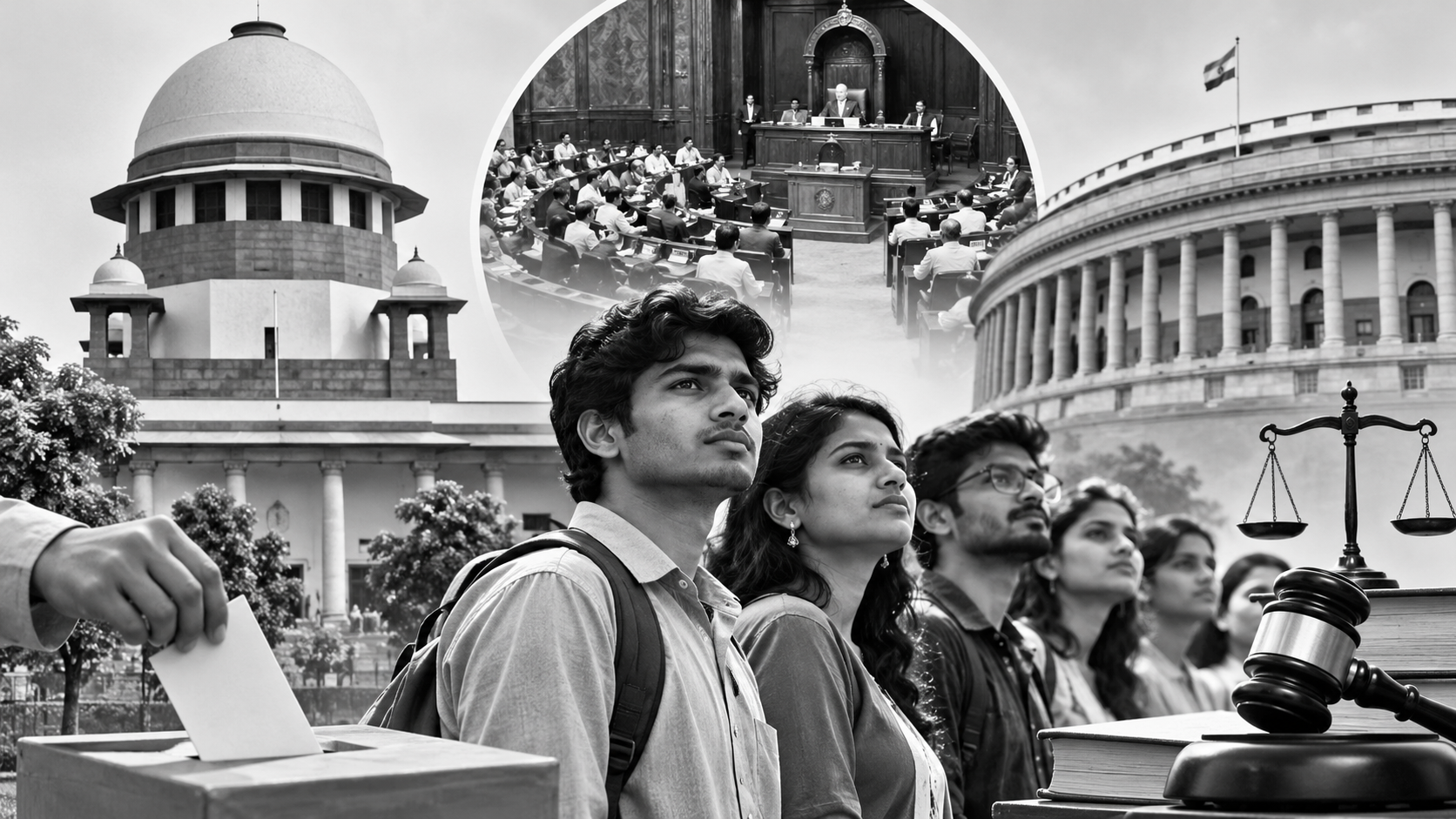
SC Declines Plea to Lower Minimum Age for Contesting Elections
The Supreme Court on Saturday declined to entertain a petition seeking to reduce the minimum age required to contest elections to Parliament and State Legislatures, bringing renewed attention to the constitutional distinction between the right to vote and eligibility to become an elected representative. A Bench comprising Justices Vikram Nath and Aparesh Kumar Singh advised the petitioner to approach the jurisdictional High Court under Article 226 for directions on deciding his representation. The petitioner subsequently withdrew the plea, which was dismissed as withdrawn.
The petition, Nalla Suresh Reddy v. Union of India, highlighted the difference between India's voting age of 18 and the higher eligibility requirements for elected representatives. The petitioner's counsel pointed out that while the 61st Constitutional Amendment Act, 1988 reduced the voting age from 21 to 18, candidates must be at least 25 to contest Lok Sabha and State Assembly elections and 30 to enter the Rajya Sabha and State Legislative Councils. The Union Government and Election Commission of India were named as respondents.
When the Bench observed that the petition was not an appropriate proceeding, the counsel requested directions to communicate the outcome of an earlier representation. The court suggested approaching the High Court under Article 226, which empowers High Courts to issue writs and directions to public authorities. The petitioner then sought permission to withdraw the case. Importantly, the Supreme Court did not examine the constitutional merits of lowering the minimum age or declare the existing requirements valid or invalid.
The eligibility thresholds are prescribed under Articles 84 and 173 of the Constitution, while Article 326 establishes adult suffrage for citizens aged 18 and above, subject to legal disqualifications. The 61st Amendment, which came into force on March 28, 1989, changed the voting age but left candidacy requirements untouched. Its stated objectives included expanding democratic participation and recognising growing political awareness among young Indians.
The Representation of the People Act, 1951, through Sections 4, 5 and 6, prescribes additional qualifications for candidates contesting parliamentary and state legislative elections. Any reduction in the constitutionally prescribed age limits would require an amendment under Article 368, securing a special majority in both Houses of Parliament and presidential assent.
The development has revived debate over youth representation, with supporters arguing that younger candidates could bring greater attention to employment, education, technology and climate change. Others emphasise the responsibilities associated with legislative membership. Countries such as the United Kingdom, Canada and Australia permit candidates aged 18 to contest lower-house elections, unlike India's 25-year threshold.
The Election Commission, empowered under Article 324 to administer elections, cannot independently alter these constitutional requirements. Any reform would require parliamentary intervention, leaving the broader question of aligning voting and candidacy ages open for constitutional consideration.