
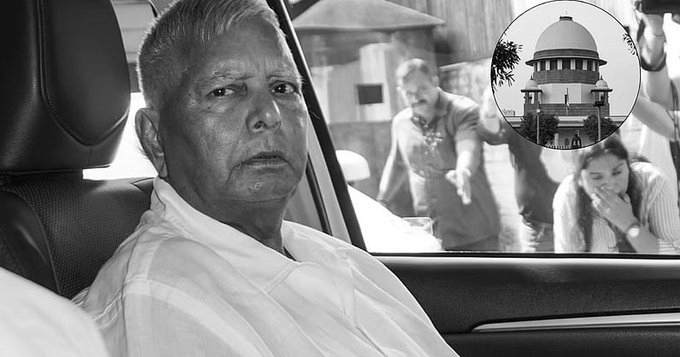
SC Allows Trial in Land-for-Jobs Case Against Lalu Prasad Yadav, Declines to Quash FIR
The Supreme Court of India has refused to quash the CBI FIR and chargesheet in the land-for-jobs case involving former Railway Minister and RJD chief Lalu Prasad Yadav and members of his family, allowing the criminal proceedings to continue.
A bench comprising Justices M M Sundresh and N Kotiswar Singh, while declining to interfere at this stage, allowed Yadav to raise legal objections regarding the applicability of Section 17A of the Prevention of Corruption Act , which deals with prior sanction required before initiating investigations against public servants for official decisions. The Court, however, granted him exemption from personal appearance before the trial court , providing procedural relief during the ongoing proceedings.
The case relates to alleged irregularities during Yadav’s tenure as Railway Minister between 2004 and 2009 , when Group D appointments were made in the West Central Zone of Indian Railways, headquartered in Jabalpur, Madhya Pradesh. According to the CBI, these appointments were allegedly made in exchange for land parcels transferred or gifted to Yadav’s family members or associates, forming a suspected quid pro quo arrangement. The agency has already filed chargesheets in the matter after completing the investigation.
Earlier, the Delhi High Court had also refused to quash the FIR, observing that the case required a full trial rather than premature termination, thereby reinforcing the CBI’s position.
The Supreme Court’s latest order ensures that the trial process will continue , while leaving open key legal questions on sanction and procedural compliance to be examined during the course of proceedings.
Politically, the case continues to remain highly sensitive in Bihar and national politics. Yadav remains a key figure of the Rashtriya Janata Dal (RJD) , and the case has repeatedly been invoked in political debates around corruption, governance, and transparency in public appointments. Opposition parties have often cited the allegations as an example of misuse of official position and alleged nepotism , while the RJD has consistently maintained that the case is politically driven and legally flawed , particularly questioning the absence of prior sanction under anti-corruption law.
With the Supreme Court allowing the matter to proceed, the case is expected to remain a significant legal and political flashpoint in the months ahead.