
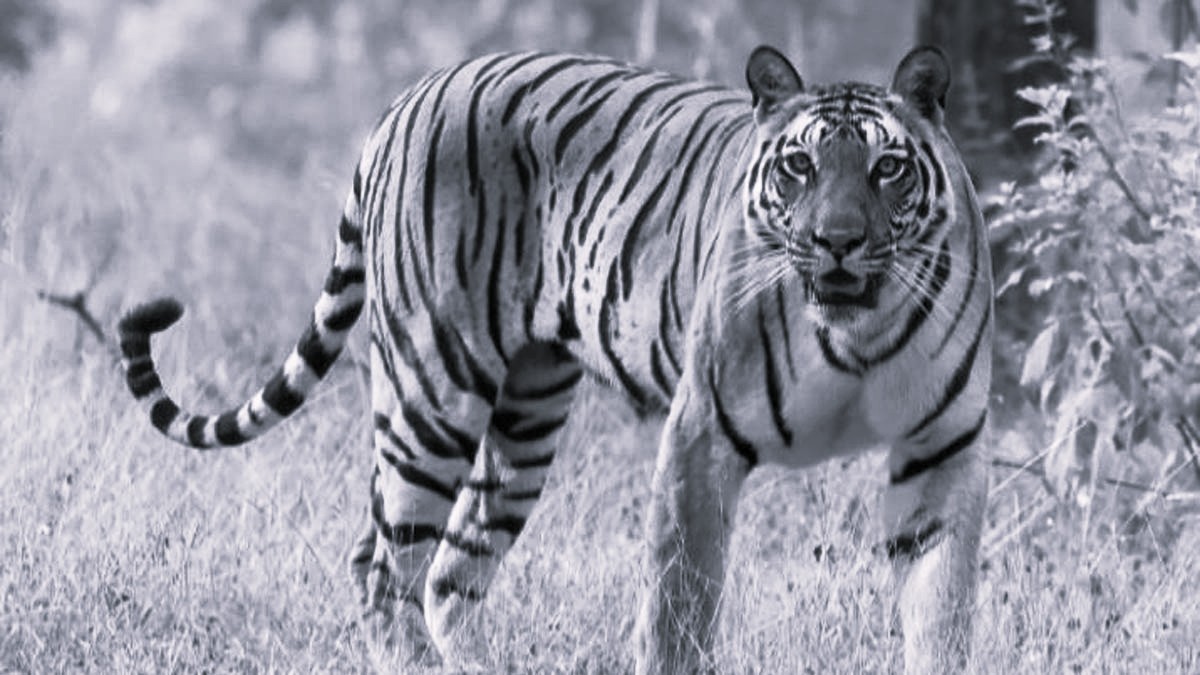
Satellite-Collared Tiger from Kurmapuram Tracked in Rajavommangi Forests
A satellite-collared male tiger that previously triggered concern in parts of East Godavari district has now been tracked entering the Rajavommangi forest range under the Rampachodavaram division, prompting forest authorities to intensify monitoring of its movement.
Forest officials said the big cat appears to have travelled from the dense forests of Papikonda National Park , passing through forest corridors around the Yeleru Reservoir before reaching Rajavommangi. Signals received from the tiger’s tracking collar indicate that the animal is currently moving within forested terrain while exploring the region for a suitable territory. Officials are monitoring its movement continuously using GPS collar data, Very High Frequency (VHF) signals, and ground verification through pugmarks .
The tiger had earlier drawn attention after it strayed close to human habitations in Kurmapuram village of East Godavari district earlier this year. The three-year-old animal reportedly attacked cattle after entering the village outskirts on February 6 , leading forest authorities to capture it as a precautionary measure to prevent human-wildlife conflict.
Following its capture, the tiger was transported to the Indira Gandhi Zoological Park in Visakhapatnam , where veterinarians conducted detailed health examinations and kept it under observation for several days. Once medical teams confirmed that the animal was healthy and capable of hunting in the wild, forest officials decided to release it back into its natural habitat.
Before the release, authorities fitted the tiger with a satellite-based radio collar to enable continuous monitoring of its movements. The animal was subsequently released in the forest landscape of Papikonda National Park , one of the key wildlife habitats in the Eastern Ghats region.
Recent tracking data indicated that the tiger had moved further south and entered the Rajavommangi forest range , where officials later found evidence suggesting it had preyed on a few cattle near Marivedu village , located along the forest boundary. Field teams confirmed the presence of the tiger based on collar signals and footprints found during patrols.
Wildlife experts note that such movement is typical of young male tigers , which often disperse over long distances after reaching maturity in search of new territories. During this phase, the animals may travel across multiple forest divisions before settling in an area with sufficient prey and minimal competition from other dominant males.
In view of the tiger’s movement, forest authorities have advised residents of nearby villages to remain cautious. People living in forest-fringe settlements have been urged to avoid venturing alone into forest areas or agricultural fields, particularly during early morning and evening hours. Livestock owners have also been asked to take additional precautions while grazing cattle.
Divisional forest officials said special monitoring teams have been deployed to track the animal’s movements and ensure that it does not stray into densely populated areas. They assured that both wildlife protection and public safety remain priorities, and rapid-response teams are prepared to act if the tiger approaches human settlements again.
Residents have also been requested to immediately inform forest personnel if they notice pugmarks or any signs of tiger movement , allowing authorities to respond quickly and prevent potential conflict.