
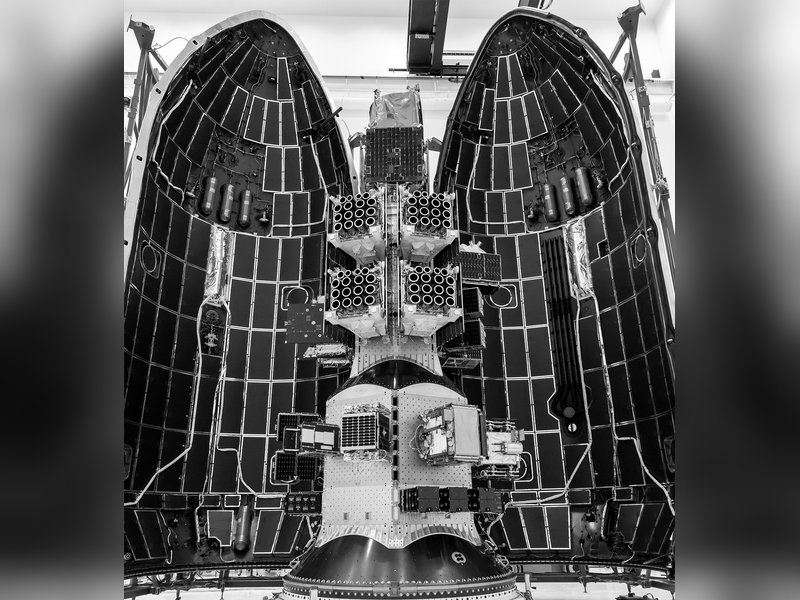
Satellite Development in India Moves Beyond ISRO: GalaxEye Launches India’s Largest Privately Built Satellite Drishti
For nearly five decades, India’s presence in space was defined almost entirely by ISRO . From Aryabhata in 1975 to Chandrayaan , Mangalyaan , and Aditya L1 , India’s satellites were overwhelmingly conceived, built, and operated by the state. Private industry largely played the role of supplier, manufacturing components for national missions while the idea of independently built Indian satellites remained distant.
That era is now changing dramatically.
With the successful launch of Mission Drishti by Bengaluru based GalaxEye , India’s space story has moved decisively beyond a government only model. Launched aboard a SpaceX Falcon 9 rocket from California, Drishti is being hailed as India’s largest privately built satellite and the world’s first operational OptoSAR platform, combining optical imaging and synthetic aperture radar into a single spacecraft capable of seeing clearly through clouds, darkness, and adverse weather.
The milestone reflects a larger transformation set in motion after India’s 2020 space sector reforms , which opened the gates for private participation. From virtually zero serious private space companies before liberalisation, India today has 400+ space startups , according to government estimates. What India’s 1991 economic reforms did by opening sectors once dominated by the state to private ambition, space reforms are now beginning to do for the skies. Just as India once moved beyond a Doordarshan only era , it is now moving beyond an ISRO only age .
GalaxEye’s own journey captures this shift. Incubated through the IIT Madras ecosystem , its founders emerged from Team Avishkar Hyperloop , the student engineering group that reached the finals of the SpaceX Hyperloop competition . What began as India’s startup incubation experiment has now produced a company delivering globally relevant space hardware. The symbolic arc is striking: from competing in a SpaceX challenge to launching on a SpaceX rocket.
GalaxEye is not alone. Pixxel builds hyperspectral Earth observation satellites. Dhruva Space develops satellite platforms and infrastructure. Digantara focuses on space situational awareness. PierSight targets maritime intelligence. These firms differ from launch vehicle builders like Skyroot Aerospace and Agnikul Cosmos , which focus on rockets rather than satellites themselves. In simple terms, some companies build the spacecraft, others build the vehicles that carry them.
Mission Drishti is not a Government of India satellite. It is privately owned by GalaxEye, which plans to commercially sell its imaging and intelligence data to governments, defence agencies, agriculture firms, infrastructure players, and global enterprise clients. This means India’s defence and strategic agencies can access advanced domestic satellite intelligence without necessarily owning the satellite itself.
That distinction matters. It creates a commercial ecosystem where private capital funds innovation, founders build globally competitive technology, and government becomes a major customer rather than sole creator.
For India, this shift could be transformational. Investor capital flowing into frontier sectors like space may help retain some of the country’s brightest engineering talent, giving them stronger reasons to build in Bengaluru, Hyderabad, or Chennai instead of leaving for Silicon Valley.
ISRO built India’s space age. Private enterprise may now define its scale.
India’s golden age of private space exploration may just be beginning.